


The Discovery of the Lac La Belle: A 60-Year Quest Comes to an End
After nearly six decades of searching, shipwreck hunters have finally located the remains of a luxurious 19th-century steamship that met its tragic fate in the turbulent waters of Lake Michigan. The discovery represents not just a remarkable achievement in maritime archaeology, but also a testament to human perseverance and the enduring allure of solving historical mysteries that lie beneath the waves.
A Lifetime of Searching Pays Off
Paul Ehorn, an 80-year-old shipwreck enthusiast from Illinois, has dedicated much of his life to uncovering the secrets hidden in the depths of the Great Lakes. Since he was just 15 years old, Ehorn has been captivated by the stories of vessels lost to storms and accidents, spending countless hours researching, planning, and exploring the underwater landscape. His latest discovery, the Lac La Belle, represents his 15th successful shipwreck location and perhaps one of his most satisfying finds. The announcement came from Shipwreck World, an international organization dedicated to locating and documenting shipwrecks around the globe, which revealed on a Friday that Ehorn’s team had actually made the discovery back in October 2022. The wreck was found approximately 20 miles offshore, positioned between the Wisconsin cities of Racine and Kenosha, resting in the cold, dark waters that have preserved it for over 150 years.
The delay in announcing this significant find wasn’t due to any desire for secrecy or dramatic effect, but rather a practical consideration. Ehorn and his team wanted to create a comprehensive three-dimensional video model of the shipwreck before making their discovery public. This would allow historians, archaeologists, and the interested public to virtually explore the wreck in detail. However, Lake Michigan had other plans. The notoriously unpredictable weather conditions of the Great Lakes, combined with various scheduling conflicts among the dive team members, prevented them from returning to the site until the following summer. This delay, while frustrating, demonstrates the challenges that modern shipwreck hunters face—the same unpredictable weather that claimed so many vessels in the past continues to complicate efforts to study them today.
The Hunt: Puzzle Pieces and Perseverance
Ehorn’s search for the Lac La Belle began in 1965, making this a 57-year quest that spanned most of his adult life. The breakthrough came from an unexpected source—fellow wreck hunter and author Ross Richardson provided a crucial clue in 2022 that helped Ehorn narrow down his search area. The world of shipwreck hunting is surprisingly competitive, and both men remain tight-lipped about the specific nature of this clue. Ehorn simply won’t discuss it, while Richardson would only reveal that a commercial fisherman operating at “a certain location” had snagged an item in his nets that was specific to steam-powered ships from the 1800s. This tantalizing hint, whatever its exact nature, proved to be the missing piece Ehorn needed.
Armed with this new information, Ehorn was able to refine his search grid—the specific area of lake bottom he would scan. Using side-scan sonar technology, which creates detailed images of the lake floor by bouncing sound waves off objects, Ehorn’s team located the wreck after just two hours on the water. For someone who had been searching for nearly six decades, the relative ease of the final discovery must have been both surprising and deeply satisfying. Ehorn described the experience with the enthusiasm of someone who truly loves what they do: “It’s kind of a game, like solve the puzzle. Sometimes you don’t have many pieces to put the puzzle together but this one worked out and we found it right away.” He characterized his feelings upon confirmation of the find as “super elated”—an understatement, perhaps, for the culmination of a lifetime’s work. The competitive nature of shipwreck hunting means that searchers guard their methods and sources carefully, as Richardson explained. Revealing too much about how they obtained their information could give other hunters insights into research techniques, potentially leading competitors to other undiscovered wrecks.
The Lac La Belle: A Ship with History
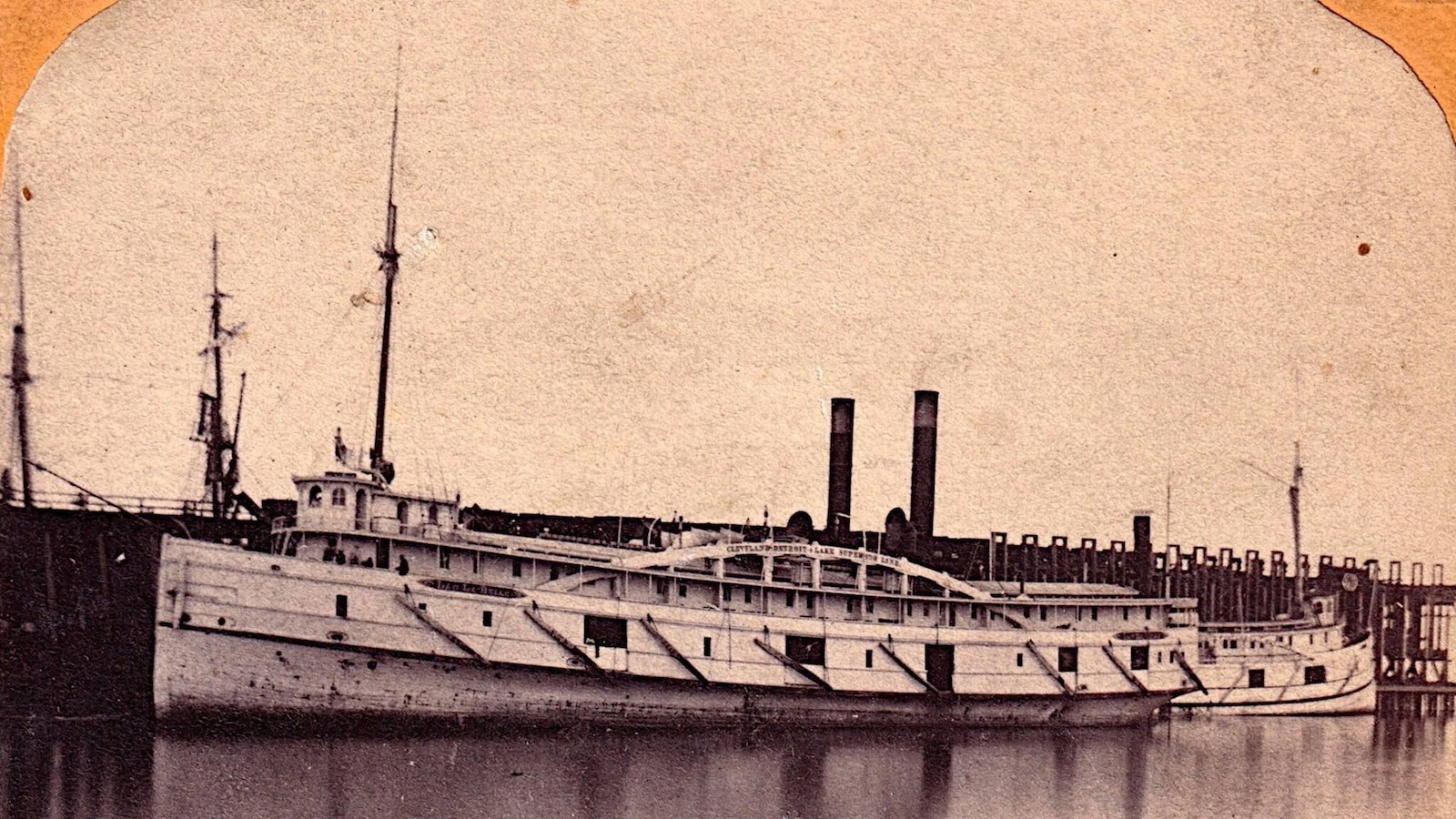
The vessel that now rests on the bottom of Lake Michigan had quite a story even before its final, fatal voyage. The Lac La Belle was constructed in 1864 in Cleveland, Ohio, during the height of Great Lakes commercial shipping. At 217 feet long, it was a substantial vessel, representing the luxury and ambition of 19th-century maritime engineering. The steamship served an important route, running between Cleveland and Lake Superior, carrying both passengers and cargo across the vast inland seas. However, the Lac La Belle’s service was interrupted early when, in 1866, the ship collided with another vessel and sank in the St. Clair River, which connects Lake Huron to Lake Erie. Many ships of that era would have been abandoned after such an incident, but the Lac La Belle was considered valuable enough to raise from the river bottom. In 1869, salvage operations successfully brought the ship back to the surface, and it underwent extensive reconditioning to make it seaworthy once again. This second life would prove tragically short.
On the night of October 13, 1872, the Lac La Belle departed from Milwaukee bound for Grand Haven, Michigan. The captain made what would prove to be a fatal decision: proceeding despite an ongoing gale. Aboard were 53 passengers and crew members, along with a cargo hold filled with barley, pork, flour, and whiskey—typical commodities of the Great Lakes trade. Just two hours into the voyage, the ship began taking on water at an uncontrollable rate. The captain, recognizing the danger, attempted to turn the vessel back toward Milwaukee, but Lake Michigan was unforgiving that night. Massive waves crashed over the deck with such force that they extinguished the ship’s boilers—the very heart of its propulsion system. Without power, the Lac La Belle was at the mercy of the storm, which drove the helpless vessel southward. As dawn approached around 5 a.m., with the ship clearly doomed, the captain gave the order to lower the lifeboats. Shortly after, the Lac La Belle went down stern-first, slipping beneath the waves to begin its long rest on the lake bottom. The evacuation was partially successful but ultimately tragic. One of the lifeboats capsized during the desperate journey to shore, claiming eight lives. The occupants of the other lifeboats managed to reach the Wisconsin coastline between Racine and Kenosha, cold and traumatized but alive.
What Remains Below
When Ehorn and his team finally located the wreck after all these years, they found a vessel transformed by time and nature. The exterior of the Lac La Belle is now completely covered with quagga mussels, an invasive species that has colonized much of the Great Lakes in recent decades. These small mollusks attach themselves to any hard surface, creating a living blanket that obscures the original features of shipwrecks. The upper cabins of the ship, likely the first to deteriorate or possibly torn away by the sinking itself or subsequent storms, are gone. However, the hull appears to remain intact—a testament to the solid construction of 19th-century shipbuilding. Most remarkably, the oak interiors are still in relatively good condition. The cold, fresh water of the Great Lakes acts as a preservative, slowing decay significantly compared to saltwater environments. This means that the Lac La Belle’s interior spaces, where passengers once socialized and crew members worked, may still contain artifacts and features that provide a window into life aboard a luxury steamer more than 150 years ago.
The Broader Context of Great Lakes Shipwrecks
The discovery of the Lac La Belle is significant not just as an individual achievement but as part of a much larger story. According to the University of Wisconsin-Madison’s Wisconsin Water Library, the Great Lakes are home to an estimated 6,000 to 10,000 shipwrecks. These vessels represent every era of Great Lakes navigation, from early wooden sailing ships to modern steel freighters. The vast majority of these wrecks remain undiscovered, lying in waters that can reach depths of over 1,300 feet in Lake Superior. In recent years, shipwreck hunters have been working with increased urgency, driven by concerns about the very quagga mussels that now cover the Lac La Belle. These invasive mollusks, while creating visually interesting coverage, are actually slowly destroying the wrecks. Their acidic secretions can eat away at wood and metal, and their sheer weight can cause structural components to collapse. Ships that have survived intact for a century or more are now facing an accelerated deterioration that could erase these underwater museums within decades.
Looking to the Future
For Paul Ehorn, the discovery of the Lac La Belle represents a significant milestone, but certainly not a retirement. With characteristic enthusiasm, he noted, “It was one more to put a check mark by. Now it’s on to the next one. It’s getting harder and harder. The easier ones have been found.” This statement captures both the satisfaction of achievement and the challenge that lies ahead for shipwreck hunters. The most accessible wrecks, those in shallower water or closer to shore, have mostly been located. What remains are the truly difficult finds—ships in deep water, far from shore, or in areas where historical records provide few clues. Each new discovery requires more sophisticated technology, more extensive research, and often, more luck. The competitive but collegial world of Great Lakes shipwreck hunting continues to attract enthusiasts who are driven by the thrill of solving historical puzzles and connecting with maritime history. The Lac La Belle, now documented and known, adds another chapter to our understanding of the risks and realities of 19th-century Great Lakes commerce, and serves as a memorial to those who lost their lives in the gale of 1872.