

Bitcoin’s Path Forward: Navigating Resistance Zones and Market Dynamics
A Hard-Fought Recovery From Recent Lows
Bitcoin has clawed its way back to around $77,600 after experiencing a brutal downturn that saw prices plummet to approximately $60,000 just two months ago. This wasn’t just a minor correction—it represented one of those gut-wrenching moments that test even seasoned crypto investors’ resolve. The recovery has been significant enough to push Bitcoin back into what traders call a “resistance zone” between $75,000 and $80,000, a price range that has historically acted as both a ceiling during rallies and a floor during corrections. For context, when Bitcoin was scraping those $60,000 levels back then, the market looked genuinely beaten down. Technical indicators like the Relative Strength Index (RSI) were flashing deeply oversold readings, and on-chain metrics—the behind-the-scenes data that shows actual blockchain activity—suggested we were seeing capitulation selling, where even long-term holders were throwing in the towel. During that dark period, very few people in the crypto space were talking about recovery. Confidence had evaporated, social media sentiment turned overwhelmingly negative, and the prevailing question wasn’t “when will we recover?” but rather “how much lower can we go?” Now that Bitcoin has bounced back substantially, the conversation has completely shifted. Instead of wondering about further downside, analysts and traders are looking upward again, debating whether this recovery has legs or if we’re simply setting up for another disappointing rejection at these familiar resistance levels.
The Great Debate: Breakout or Rejection?
Market analysts are split on what comes next for Bitcoin, presenting two distinct scenarios that will likely play out over the coming weeks and months. Michael van de Poppe, a well-known crypto analyst, remains optimistic about Bitcoin’s prospects. In his assessment shared on social media platform X, he pointed out that markets are still looking for additional upside momentum in the weeks ahead. Interestingly, he noted that the Nasdaq—the tech-heavy stock index that often correlates with Bitcoin’s movements—has been showing even stronger momentum than Bitcoin itself, suggesting that the leading cryptocurrency may simply be lagging behind broader market strength rather than showing inherent weakness. Van de Poppe argues that there’s little compelling reason to dismiss the possibility of further gains from current price levels. He’s set $86,000 as a critical threshold, suggesting that a clean break above that level in the coming months would essentially confirm that the market has already found its bottom. This is a crucial point for investors because if the bottom is indeed in, it would mean that buying at current levels is still getting in relatively early in the next bull phase. Van de Poppe has stated that he personally assigns a high probability to the scenario where the recent lows represent the cycle bottom, signaling his confidence in the recovery’s sustainability.
However, not everyone shares this bullish outlook. Analyst Rekt Capital has raised important concerns about a specific technical resistance level that Bitcoin continues to struggle with—the 21-week Exponential Moving Average (EMA). For those unfamiliar with this indicator, it’s essentially a trend line that gives more weight to recent price action and is widely watched by traders as a dividing line between bullish and bearish market structures. Rekt Capital’s warning is straightforward: Bitcoin needs to not just touch or briefly break above this level, but actually reclaim it and hold it as support. The difference matters enormously. A brief poke above followed by a rejection creates what’s called a “weaker retest structure,” which often leads to further downside. If Bitcoin fails to hold above this moving average convincingly, Rekt Capital suggests the price could fall back down to retest the top of a double-bottom pattern that was broken just last week—essentially giving back some of the recent gains and creating uncertainty about whether the recovery is real or just a temporary bounce in an ongoing downtrend.
Understanding the Liquidity Squeeze Dynamic
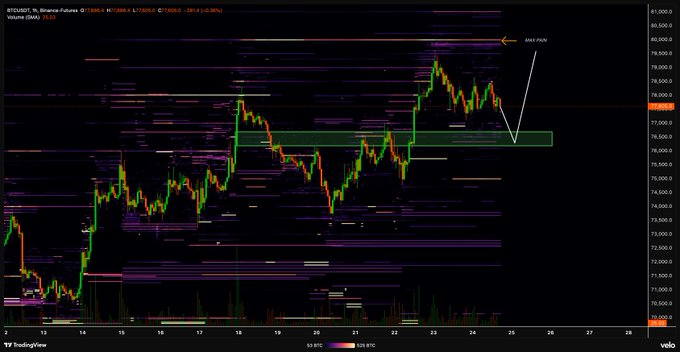
One of the more sophisticated aspects of cryptocurrency trading involves understanding liquidation clusters and how they influence price movement. Analyst Ted has been tracking these patterns and points to significant liquidation clusters building below Bitcoin’s current price levels. One particularly notable area sits near $80,000, which coincidentally (or perhaps not) is where Bitcoin found support back in November 2025. These liquidation clusters form when large numbers of leveraged positions—trades made with borrowed money—are positioned at similar price points. When the market moves to these levels, these positions get automatically closed out, creating sudden bursts of buying or selling pressure that can dramatically accelerate price movements. Based on this setup, Ted suggests that the “maximum pain scenario”—the outcome that would hurt the most traders—over the coming months might actually be a sharp dump rather than a continued pump. This contrasts with the more optimistic view from other analysts and highlights how different market participants are looking at different data sets to form their conclusions.
Meanwhile, analyst Ardi has focused attention on the opposite side of the equation: short positions stacked above the recent local high. Short sellers are traders betting on price declines, and when they’re wrong and prices rise, they’re forced to buy back their positions at a loss, creating additional upward pressure. Ardi’s analysis revealed that several hundred million dollars worth of short exposure is concentrated just above $79,500, particularly dense around the $79,900 area. This represents months of positioning—traders who have been betting on further downside, slowly building up their short positions as Bitcoin rallied. All of this exposure is compressed into one relatively narrow price band, creating what amounts to a massive amount of potential fuel for an upward move. Ardi’s thesis is straightforward: if the support zone below current levels holds during any retest or pullback, market makers—the large players who provide liquidity and often move prices—would have a strong incentive to push prices up through that liquidation zone. This would trigger a cascade of short covering (forced buying), which could add significant strength to any advance and help push Bitcoin convincingly through the $80,000 level. As Ardi noted, liquidity sitting only 2% above the current price rarely goes untouched for long—it’s simply too tempting a target for those with the capital to move markets.
Shifting Market Structure and Participation
Beyond the price action and technical levels, there are important changes happening in the underlying market structure that deserve attention. According to data from CoinGlass, an analytical platform that tracks cryptocurrency derivatives, there’s been a noticeable pullback in Bitcoin futures and options activity recently. Trading volume in these derivatives declined by 20.20% to $61.97 billion, while open interest—the total value of outstanding derivative contracts—dropped 3.03% to $57.45 billion. These numbers tell a story of softer participation and lighter positioning in the futures markets. In practical terms, this means fewer traders are actively betting on Bitcoin’s near-term direction with leverage, and those who are in positions aren’t committing as much capital as they were previously. This could be interpreted multiple ways: perhaps traders are waiting for clearer directional signals before committing capital, or maybe the recent volatility has scared away some of the more speculative participants, leaving a healthier market structure with less leverage that could get liquidated and cause cascading price movements.
Interestingly, while the derivatives market has cooled, the spot market—particularly through U.S. exchange-traded funds—has shown considerably stronger demand. BlackRock’s Bitcoin ETF, trading under the ticker IBIT, has actually climbed into the top 10 U.S. ETFs ranked by capital inflows. This is a significant development because it represents a very different type of investor than those trading futures with leverage. ETF investors are typically more conservative, often retirement-focused individuals and institutions who are buying and holding rather than trading actively. The fact that substantial capital is flowing into spot Bitcoin exposure through regulated ETF vehicles while derivatives activity is declining suggests a shift toward more stable, long-term oriented investment rather than speculative trading. Some market observers attribute this shift to ongoing geopolitical tensions around the world, as certain investors increasingly view Bitcoin as a potential hedge against traditional market uncertainty and currency debasement—essentially digital gold for the modern age.
Technical Levels and Key Price Zones to Watch
For anyone trying to make sense of where Bitcoin might head next, understanding the key technical levels is essential. The current price around $77,600 sits within that critical $75,000 to $80,000 zone that has proven to be significant throughout Bitcoin’s trading history. This range has acted as both strong support during bull markets and formidable resistance during recovery attempts, making it a natural battleground where bulls and bears clash. Just above current levels, around $79,500-$79,900, sits that concentration of short positions that Ardi highlighted—a potential catalyst for upward acceleration if triggered. Moving higher, the $80,000 psychological level represents not just a round number that humans naturally pay attention to, but also the area where Ted identified liquidation clusters and where Bitcoin found support back in November, giving it multiple layers of technical significance.
Looking further out, Michael van de Poppe’s $86,000 level becomes the major test for whether this recovery has truly changed the market structure or is simply a bear market rally. A convincing break and hold above that level would likely attract a new wave of buyers who have been sitting on the sidelines waiting for confirmation that the worst is over. On the downside, the most immediate support comes from that green zone that Ardi mentioned, which if broken would likely trigger a retest of lower levels. The 21-week EMA that Rekt Capital emphasized remains another crucial marker—falling back below it and failing to reclaim it would signal that the recovery momentum has stalled. Further down, there’s the top of that double-bottom pattern, and below that, the $60,000 area that represented the recent low. Each of these levels represents not just lines on a chart but actual areas where large amounts of buying or selling interest exists, where traders have placed their stop losses, and where algorithmic trading systems are programmed to take action.
What This Means for Bitcoin’s Near-Term Outlook
Pulling all of these threads together paints a picture of a market at a genuine crossroads. Bitcoin has mounted an impressive recovery from what looked like a potentially catastrophic breakdown, showing resilience that has surprised many skeptics. The fact that it’s now testing meaningful resistance levels rather than collapsing to new lows is itself a victory of sorts for the bulls. However, the path forward is anything but certain, with legitimate arguments on both sides of the directional debate. The optimistic case rests on improving technical structure, strong spot demand through ETFs, declining leverage in the derivatives market (which reduces the risk of liquidation cascades), and the fact that major resistance levels are within striking distance. If Bitcoin can push through and hold above $80,000, and especially if it can reach van de Poppe’s $86,000 target, it would represent a significant regime change that would likely attract substantial new capital.
The cautionary case emphasizes that Bitcoin hasn’t yet proven it can hold the technical levels needed to confirm a true trend reversal, that resistance zones often require multiple attempts before breaking, and that the liquidation dynamics could just as easily trigger downside moves as upside breakouts. The reduction in derivatives activity might also indicate a lack of conviction among traders, suggesting the market needs more time and probably more fundamental catalysts before making a decisive move. For investors and traders, this environment requires both patience and attention to how Bitcoin behaves at these key levels. Does it grind higher and gradually reclaim the 21-week EMA, building a sustainable base? Or does it fail at resistance and roll over, forcing another test of lower support levels? The answer will likely emerge over the coming weeks as these various technical and fundamental factors play out in real-time. What seems clear is that the period of maximum pessimism has passed, but the path to sustained recovery still requires navigating significant obstacles and proving that demand is strong enough to absorb selling pressure at higher levels.