

Chaos at the White House Correspondents’ Dinner: A Night of Terror in Washington
The Terrifying Sprint Through the Hilton
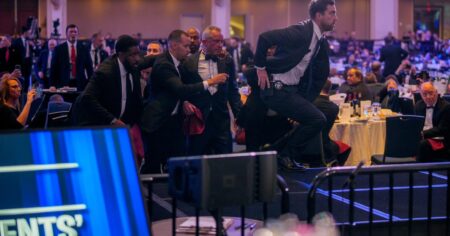
Saturday night at Washington D.C.’s Hilton hotel was supposed to be an evening of celebration, speeches, and solidarity among journalists and government officials. Instead, it became the scene of a harrowing assassination attempt that sent shockwaves through the nation’s capital. Security footage and witness accounts paint a chilling picture: 31-year-old Cole Tomas Allen sprinting at approximately 9 miles per hour through the hotel’s second-floor corridor, bypassing magnetometers with a shotgun in hand. As he raced past security checkpoints, he discharged his weapon in what investigators believe may have struck a Secret Service officer’s bulletproof vest—specifically hitting a cellphone tucked inside the vest’s pocket. The officer, demonstrating remarkable composure under fire, managed to return fire with five shots aimed at the charging gunman. The sound of gunfire echoed through the historic hotel’s corridors, marking one of the most serious security breaches at a high-profile Washington event in recent memory. Officials continue to conduct ballistics testing to definitively confirm whether Allen’s shotgun blast was indeed what struck the officer’s protective gear, but early evidence strongly suggests this was the case.
The Takedown and Immediate Response
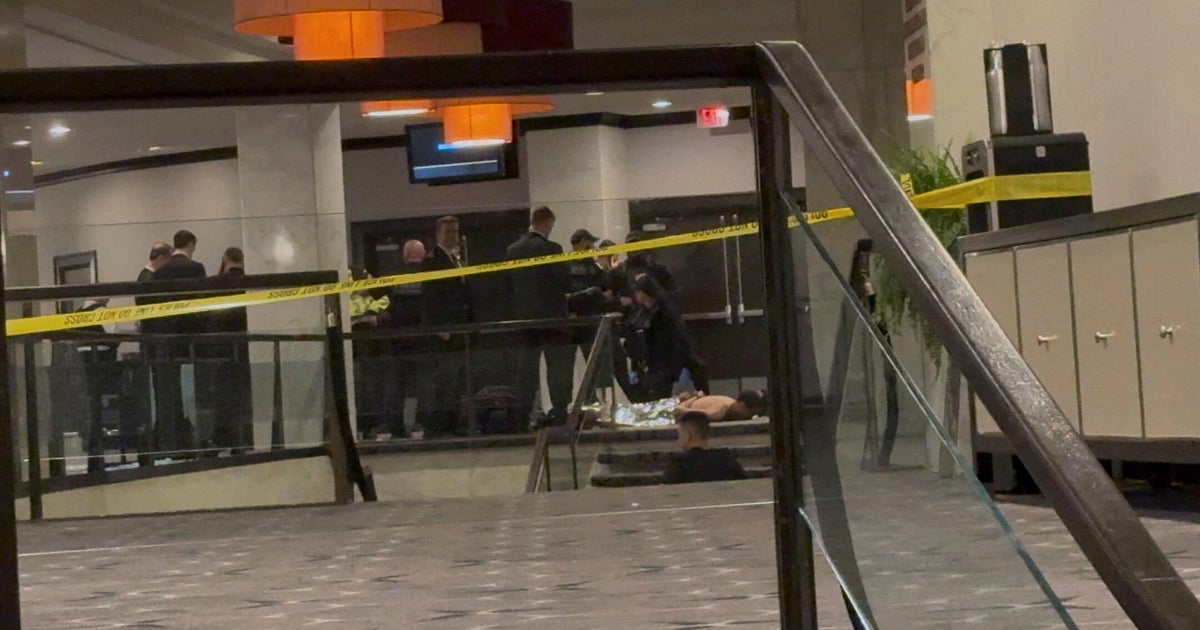
The confrontation reached its dramatic conclusion when Allen suddenly tripped and fell to the ground. Investigators are still determining whether he discharged his shotgun just before, during, or immediately after his fall, and whether the powerful recoil from the weapon itself may have contributed to him losing his balance. The moment he hit the floor, law enforcement officers swarmed him without hesitation. In a matter of seconds, they had pinned him down and began the critical process of securing the threat. Officers quickly stripped Allen of his weapons and removed his shirt—a standard protocol in such situations to ensure the suspect isn’t wearing explosives or carrying additional concealed weapons. One eyewitness described the surreal moment when Allen fell right in front of her as she was taking a phone call at the top of the staircase, just a short flight above where more than 2,000 people were gathered in the ballroom below. The swift action by law enforcement prevented what could have been an unimaginable tragedy. The officer who was shot in the chest, protected by his bulletproof vest, was not seriously injured—a small miracle considering the close-quarters nature of the confrontation. Remarkably, despite multiple officers being in the vicinity, only the one officer who was struck returned fire, suggesting a high level of discipline and training in an extraordinarily stressful situation.
Panic in the Ballroom Below
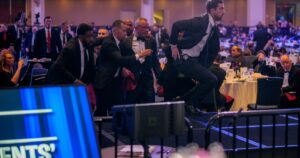
While the violent confrontation unfolded on the second floor, one level below in the grand ballroom, an entirely different scene was taking place. President Trump, First Lady Melania Trump, numerous Cabinet members and their spouses, and more than 2,000 journalists and guests were suddenly thrust from an evening of dinner and entertainment into a life-threatening emergency. Those seated toward the rear of the massive ballroom reported hearing the unmistakable sound of gunshots, and some even detected the acrid smell of gunpowder wafting down from above—likely from Allen’s shotgun discharge. Attendees closer to the front, where the president was seated, may not have initially heard the shots, but the sudden commotion and the swift, urgent movements of Secret Service agents made it immediately clear that something was terribly wrong. Within moments, Secret Service agents surrounded the president and first lady, whisking them away from the ballroom to a secure location. Meanwhile, the remaining guests—powerful politicians, prominent journalists, and influential figures from across the media landscape—found themselves scrambling beneath their dinner tables for cover, their elegant evening attire pressed against the ballroom floor as they waited anxiously for the all-clear signal. The contrast couldn’t have been starker: moments before, they had been enjoying speeches and camaraderie; now they huddled in fear, uncertain whether additional threats lurked nearby.
The Suspect’s Disturbing Journey and Intentions
The investigation into Cole Tomas Allen has revealed deeply troubling details about his preparation and intentions. Allen had traveled all the way from California to Washington D.C. by train—a journey of several days that gave him ample time to reconsider his plans, yet he pressed forward. He came armed not just with the shotgun he discharged at the Hilton, but with a second firearm and multiple knives, suggesting he was prepared for a prolonged confrontation. Federal prosecutors have charged him with attempting to assassinate the president of the United States, discharging a firearm during a crime of violence, and transportation of a firearm and ammunition with the intent to commit a felony—charges that carry severe penalties including potential life imprisonment. Perhaps most chilling is an email Allen reportedly sent to family members on Saturday night, just before or during his attack, in which he outlined his intention to target administration officials “prioritized from highest ranking to lowest.” This statement reveals not just a desire to harm the president, but a broader plan to inflict damage on the government’s leadership structure. Allen appeared in federal court on Monday for a brief initial hearing, wearing a blue jumpsuit and flanked by U.S. Marshals. His attorneys have not responded to media requests for comment, and he has not yet entered a plea. The question that haunts investigators and the public alike is how someone with such clear and stated violent intentions was able to get so close to carrying out his plan.
Critical Security Questions and Hotel Vulnerabilities
The most pressing question emerging from this terrifying incident is how Allen managed to penetrate so deeply into a hotel hosting one of Washington’s highest-profile events. The answer reveals significant vulnerabilities in security protocols. Allen had booked a room at the Hilton—a seemingly ordinary action that provided him with legitimate access to the hotel. From his room ten floors above the event, he accessed an unguarded back stairwell, a route that allowed him to descend toward the ballroom level while avoiding the more heavily monitored main corridors and elevators. This discovery has raised serious concerns about the security planning for such high-profile events. Secret Service Director Sean Curran addressed these concerns in a statement, explaining that the hotel itself, being open to the public, and the ballroom where the dinner took place were considered two separate security zones, with the ballroom being fully secured. However, critics have questioned whether this separation was sufficient given the level of threat facing the president and other high-ranking officials. The incident has prompted a comprehensive review of security procedures for future events, particularly those held in public venues where maintaining complete control over access points proves challenging. The fact that Allen was able to bypass magnetometers while carrying a shotgun suggests either a failure in equipment, procedure, or both—issues that security experts say must be addressed immediately.
Aftermath and Moving Forward
In the wake of this shocking incident, the reverberations continue to be felt throughout Washington’s political and security establishments. White House Chief of Staff Susie Wiles personally met with Secret Service Director Sean Curran to offer the administration’s support to the agency—a gesture that acknowledges both the severity of the security breach and the bravery of the agents who responded. Director Curran, in his public statement released late Saturday night, praised his personnel, saying, “Tonight we saw exactly what our brave men and women do each and every day.” Indeed, the swift response by law enforcement—from the officer who returned fire despite being shot, to those who immediately subdued the suspect—prevented what could have been a national catastrophe. Yet questions linger about how such a breach could occur in the first place. The incident serves as a stark reminder of the constant threats facing political leaders and the tremendous responsibility borne by those charged with protecting them. For the journalists, officials, and guests who attended what should have been a celebratory evening, the trauma of those moments—the gunshots, the smell of gunpowder, the frantic dive beneath tables—will not soon fade. The investigation continues, with officials working to piece together every detail of Allen’s planning, travel, and execution of his attack. As the legal process moves forward, Cole Tomas Allen faces the prospect of spending the rest of his life in prison. But beyond his individual prosecution, this incident demands a broader reckoning with security protocols, threat assessment procedures, and the ongoing challenge of protecting public figures in an era where determined individuals can exploit vulnerabilities in even well-planned security operations.