


Terrifying Close Call: United Airlines Jet Strikes Light Pole and Truck During Newark Landing
A Startling Incident Over the New Jersey Turnpike
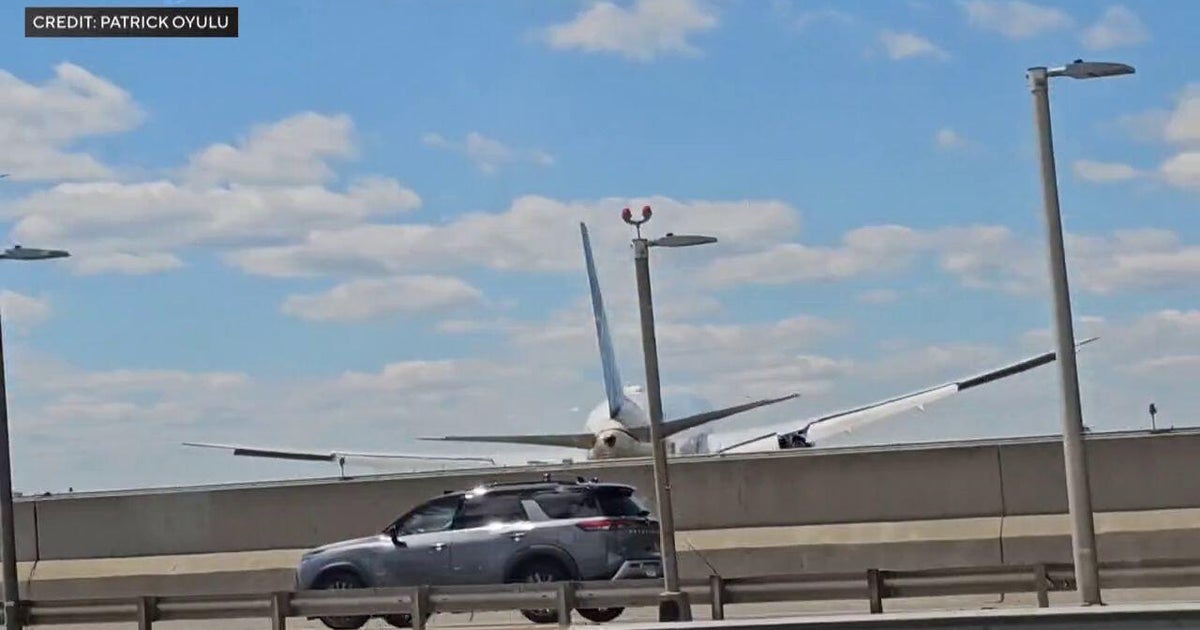
What should have been a routine landing turned into a heart-stopping moment for travelers and motorists alike this past Sunday afternoon. A United Airlines flight from Venice, Italy, made an alarmingly low approach over the busy New Jersey Turnpike before striking a light pole and colliding with vehicles below as it descended toward Newark Liberty International Airport. The Boeing 767, carrying 221 passengers and 10 crew members, was captured on cellphone video flying so low over the highway that witnesses couldn’t believe their eyes. Despite the shocking nature of the incident, the aircraft managed to land safely just after 2 p.m., and remarkably, all passengers and crew members walked away without injuries. The event has sparked a full-scale investigation by multiple agencies, including the Federal Aviation Administration and the National Transportation Safety Board, as authorities work to understand how such a dangerous situation could have occurred at one of the nation’s busiest airports.
What Happened During the Final Approach
United Flight UA169 was making its final descent toward Runway 29 at Newark Liberty International Airport when the frightening sequence of events unfolded. According to eyewitness accounts and video footage that quickly circulated on social media, the massive Boeing 767 was flying at an unusually low altitude as it passed over the New Jersey Turnpike. The plane’s landing gear appeared dangerously close to the ground—closer than anyone traveling below could have anticipated on what seemed like an ordinary Sunday afternoon. United Airlines acknowledged the incident in an official statement, explaining that their aircraft “came into contact with a light pole” during its final approach. However, the airline emphasized that despite this contact, the plane landed safely and was able to taxi to the gate normally, following standard procedures. The maintenance team was immediately dispatched to evaluate the extent of the damage to the aircraft, and the company pledged to conduct a thorough investigation into how this alarming incident could have happened. The fact that all 231 people aboard the flight remained unharmed stands as a testament to the skill of the flight crew and the structural integrity of the aircraft, even under such unexpected and dangerous circumstances.
Impact on the Ground: Vehicles and Drivers Affected
While everyone aboard the aircraft escaped without injury, the same cannot be said for those traveling on the New Jersey Turnpike at the time of the incident. The Port Authority of New York and New Jersey confirmed that when the plane struck the light pole, it caused a chain reaction of damage on the busy highway below. The impact didn’t just damage the pole itself—it also affected a tractor-trailer that was traveling southbound on the turnpike at the time. The truck driver bore the brunt of the ground-level chaos, sustaining injuries that required immediate medical attention. Fortunately, these injuries were classified as minor, and the driver was treated at a local hospital before being released later that day. According to the preliminary investigation conducted by New Jersey State Police, a tire from the plane’s landing gear and parts of the aircraft’s underside made contact with both the light pole and the tractor-trailer. The situation became even more complicated when the damaged pole, after being struck by the aircraft, fell or swung into the path of a Jeep that was also traveling on the turnpike. The occupants of the Jeep also experienced a terrifying moment as they found themselves unexpectedly involved in an aviation incident while simply driving down the highway. This multi-vehicle involvement highlights just how dangerous the situation was and how much worse it could have been had the timing or positioning been slightly different.
Swift Response and Investigation Launch
In the immediate aftermath of the incident, emergency response protocols were activated across multiple agencies. Airport staff quickly moved to inspect Runway 29 and the surrounding area for any debris that might have fallen from the aircraft or been scattered from the damaged light pole. This careful inspection is standard procedure following any incident of this nature, as even small pieces of debris can pose serious hazards to other aircraft during takeoff and landing operations. Remarkably, the inspection was completed efficiently, and normal airport operations resumed quickly, minimizing disruption to the thousands of travelers passing through Newark Liberty International Airport that day. The Federal Aviation Administration wasted no time in announcing that it would be conducting a full investigation into the circumstances surrounding the incident. The National Transportation Safety Board, the federal agency responsible for investigating civil aviation accidents and incidents in the United States, also launched its own comprehensive investigation. These investigations will examine multiple factors, including the flight path, weather conditions, pilot communications with air traffic control, mechanical systems on the aircraft, and adherence to standard approach procedures. Investigators will review the flight data recorder and cockpit voice recorder, interview the flight crew and air traffic controllers, and analyze radar data to piece together exactly what happened and why the aircraft was flying so low over the turnpike during its approach.
Official Responses and Public Concern
The incident quickly caught the attention of government officials, including New Jersey Governor Mikie Sherrill, who took to social media to address the situation. “I’m grateful the aircraft landed safely, and all passengers and crew are unharmed,” the governor wrote, expressing relief at the outcome while acknowledging the seriousness of what had occurred. Her response reflected the sentiment of many who learned about the incident—grateful for the positive outcome while deeply concerned about how such a situation could happen in the first place. The fact that a commercial airliner came into contact with ground infrastructure during a landing approach raises significant questions about safety protocols, approach procedures, and the various systems designed to prevent exactly this type of incident. For the passengers aboard Flight UA169, what should have been the final relaxing moments of a transatlantic journey from Venice turned into a frightening experience they’re unlikely to forget. Many may not have even realized how close they came to potential disaster until they saw news reports or spoke with concerned family members after landing. For the motorists on the New Jersey Turnpike, the experience was even more surreal—going about their daily travels when suddenly confronted with an aircraft flying at an impossibly low altitude overhead, followed by the crash of a light pole and the realization that they’d just been involved in an aviation incident while driving on the highway.
Looking Ahead: Safety Questions and Lessons Learned
As investigations continue into this alarming incident, the aviation community and the traveling public will be watching closely for answers. How did an experienced flight crew, following established approach procedures at a major international airport with sophisticated air traffic control systems, end up flying low enough to strike a light pole and damage vehicles on a highway? Was there a mechanical issue with the aircraft’s altimeter or other navigation equipment? Did weather conditions play a role? Was there a miscommunication with air traffic control? Or was there perhaps an error in judgment during the approach? These are the questions investigators will work to answer in the coming weeks and months. The incident serves as a stark reminder that despite the remarkable safety record of commercial aviation—with millions of flights operating safely each year—the potential for dangerous situations still exists, and constant vigilance is required from everyone involved in the industry. For United Airlines, the incident represents not only a maintenance and investigation challenge but also a public relations concern as travelers may question the safety of their operations. The airline’s quick acknowledgment of the incident and commitment to investigation demonstrates appropriate corporate responsibility, but the company will need to provide clear answers and implement any necessary corrective actions to maintain public confidence. For aviation regulators, this incident may prompt a review of approach procedures at Newark and potentially other airports where flight paths pass over busy roadways or populated areas. Ultimately, the fact that this incident ended without fatalities or serious injuries is something for which everyone can be grateful, but it should not overshadow the serious safety implications and the need for thorough investigation and appropriate action to prevent similar incidents in the future. As more information becomes available through the ongoing investigations, CBS News New York and other outlets will continue to provide updates on this developing story that has captured national attention and raised important questions about aviation safety in our busy skies.