
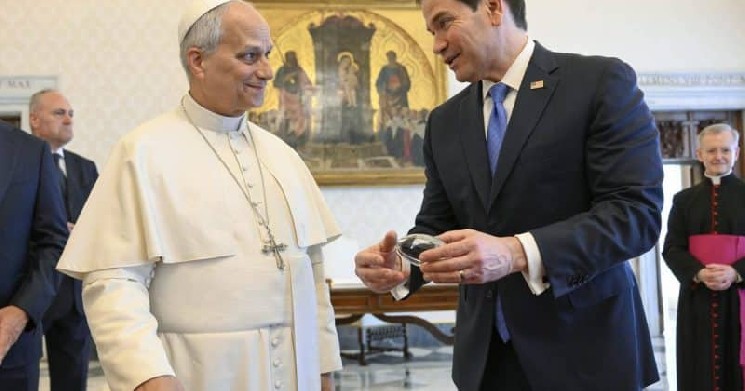

A Delicate Dance: Secretary Rubio’s High-Stakes Meeting with Pope Leo XIV
The ornate halls of the Vatican bore witness to a diplomatic encounter that captured the attention of millions around the world when US Secretary of State Marco Rubio sat down with Pope Leo XIV on May 7th for an extended conversation lasting approximately two and a half hours. What unfolded behind those ancient walls was more than just a routine diplomatic courtesy call—it was a carefully choreographed attempt to bridge a widening chasm between the Trump administration and the leader of the world’s 1.3 billion Catholics. Multiple news organizations characterized the atmosphere as simultaneously warm and strained, a reflection of the complicated relationship between American political power and the moral authority of the Catholic Church. The meeting addressed pressing humanitarian concerns in regions devastated by warfare, but it also served as an unmistakable signal that the relationship between Washington and the Vatican had entered troubled waters. With an estimated 53 million Catholics living in the United States representing a significant voting bloc, the political implications of this ecclesiastical friction extended far beyond matters of faith and into the realm of electoral mathematics that no administration can afford to ignore.
The Gathering Storm: Understanding the Context Behind Closed Doors
The Rubio-Pope Leo meeting didn’t happen in a vacuum but rather against a backdrop of escalating tension that had been building between President Trump and the relatively new pontiff. Pope Leo XIV, whose papacy represents a continuation of the Catholic Church’s increasingly vocal stance on issues of peace, justice, and humanitarian concern, had found himself at odds with the Trump administration’s approach to foreign policy, particularly regarding military intervention and the use of American power abroad. The friction had reached a boiling point in the weeks leading up to Secretary Rubio’s visit, with President Trump making the extraordinary decision to publicly criticize the Pope—a move that shocked both diplomatic circles and everyday Catholics who had supported Trump in previous elections. The President’s accusation that Pope Leo was somehow endangering Catholics by opposing US actions in Iran represented an unusually direct confrontation between the American presidency and the papacy, two institutions that typically maintain at least a veneer of mutual respect despite policy disagreements. This public spat created an uncomfortable situation for millions of American Catholics who found themselves caught between their political allegiances and their spiritual leadership, forcing many to grapple with questions about where their ultimate loyalties should lie when secular and religious authority figures find themselves in conflict.
Iran and the Middle East: The Flashpoint of Disagreement
At the heart of the disagreement between the Vatican and the White House lay fundamentally different perspectives on how to address Iran and the broader Middle East security situation. The Trump administration had taken an increasingly aggressive stance toward Iran, viewing the nation as a primary threat to regional stability and American interests, particularly concerning Iran’s nuclear program development and its support for various militant groups throughout the region. Secretary Rubio, during his meeting with Pope Leo and in subsequent statements to the press, vigorously defended the administration’s position, arguing that Iran’s pursuit of nuclear weapons capabilities posed an existential threat not just to Israel and American allies in the region, but potentially to global security as a whole. From the administration’s perspective, a strong, uncompromising approach—including military options that remained “on the table”—represented the most responsible path to preventing a nuclear-armed Iran that could destabilize the entire Middle East. Pope Leo XIV, however, had taken a markedly different view, one rooted in the Catholic Church’s long-standing emphasis on peaceful conflict resolution, dialogue, and the protection of civilian populations from the devastating consequences of military action. The Pope had expressed concern that aggressive American policies toward Iran could precipitate a wider regional conflict with catastrophic humanitarian consequences, potentially displacing millions of people, destroying essential infrastructure, and creating conditions for famine and disease. The pontiff’s position emphasized diplomatic engagement, economic development, and multilateral cooperation as alternatives to military confrontation—a perspective that Trump characterized as naïve and dangerous, hence his accusation that the Pope’s stance endangered Catholics living in regions that could be affected by an emboldened, nuclear-capable Iran.
Humanitarian Concerns Take Center Stage
While the Iran disagreement provided the most visible source of tension, the actual substance of the Rubio-Pope Leo meeting focused extensively on broader humanitarian concerns affecting populations in war-torn regions around the globe. The conversation reportedly addressed the situations in Syria, Yemen, Ukraine, and parts of sub-Saharan Africa where ongoing conflicts have created massive humanitarian crises characterized by food insecurity, forced displacement, inadequate medical care, and the systematic targeting of civilian populations. Pope Leo has been particularly vocal about what he views as the international community’s inadequate response to these crises, calling for greater humanitarian aid, protection for refugees, and more serious diplomatic efforts to end conflicts that have dragged on for years with no resolution in sight. Secretary Rubio, for his part, emphasized the substantial financial contributions the United States makes to humanitarian relief efforts worldwide, along with the complexity of situations where providing aid can inadvertently strengthen authoritarian regimes or militant groups that control territory. The discussions also touched on the role of American military presence in various regions, with the Vatican perspective generally favoring withdrawal and diplomatic solutions, while the State Department position emphasized the stabilizing role of American military power in preventing even worse humanitarian catastrophes. This portion of the meeting, by most accounts, proceeded in a more collaborative spirit than the Iran discussions, with both sides acknowledging shared concerns about civilian suffering even while disagreeing on the best approaches to alleviate it. The Catholic Church’s extensive network of charitable organizations working in conflict zones gave the Vatican unique on-the-ground intelligence about humanitarian conditions, information that American policymakers genuinely valued even when they disagreed with the Pope’s policy prescriptions.
The Political Calculation: Catholics and the American Electoral Map
Beneath the theological and diplomatic dimensions of the Rubio-Vatican visit lay a hard political reality that couldn’t be ignored: American Catholics represent a crucial swing constituency that no presidential administration can afford to alienate. With approximately 53 million Catholics in the United States, representing roughly 20-22% of the total population, this demographic has historically played a decisive role in presidential elections, particularly in key swing states like Pennsylvania, Wisconsin, Michigan, Ohio, and Florida where Catholic populations are substantial. Unlike some religious constituencies that vote as relatively predictable blocs, American Catholics have shown themselves willing to shift allegiances based on issues and candidates, making them genuine swing voters in the truest sense. Reports suggesting that Trump’s support among Catholics had been declining in the wake of his public confrontation with Pope Leo XIV set off alarm bells within the administration’s political operation. While evangelical Protestant support for Trump has remained relatively stable, Catholics—who often prioritize different issues and maintain a somewhat different theological perspective on matters like immigration, economic justice, and peace—appeared to be responding negatively to the President’s attacks on the Pope. The Rubio visit, therefore, served dual purposes: genuinely attempting to find common ground on policy matters while simultaneously functioning as a highly visible olive branch designed to reassure Catholic voters that the administration respected their spiritual leader and sought constructive dialogue rather than continued confrontation. Media coverage of the meeting, which largely emphasized the cordial aspects and downplayed the tensions, suggested that from a public relations standpoint, the visit achieved at least some of its intended effect, even if the underlying policy disagreements remained unresolved.
Looking Forward: Can the Breach Be Bridged?
As Secretary Rubio departed Vatican City and returned to Washington, the fundamental question remained whether this single meeting could repair the damage done by weeks of public acrimony between President Trump and Pope Leo XIV, or whether it merely represented a temporary pause in an ongoing conflict between two very different worldviews. The tension between the Vatican and the White House reflects deeper divisions within American society and the global community about the appropriate use of military power, the balance between security concerns and humanitarian values, and the role of moral authority in shaping political decisions. Pope Leo XIV, like his recent predecessors, has sought to position the Catholic Church as a voice for peace, dialogue, and concern for the poor and vulnerable—a posture that sometimes puts the Vatican at odds with powerful nations pursuing what they view as necessary security measures. The Trump administration, meanwhile, operates from a perspective that emphasizes American interests, strength as a deterrent to adversaries, and skepticism toward international institutions and multilateral approaches. These are not differences that can be easily reconciled through a single afternoon of conversation, no matter how cordial or extensive. Nevertheless, the fact that the meeting occurred at all, lasted as long as it did, and concluded without any public expressions of continued animosity suggests that both sides recognize the value of maintaining at least a working relationship. For American Catholics watching these events unfold, the encounter offered some reassurance that their political and spiritual leaders could sit in the same room and discuss their differences with respect, even if perfect agreement remained elusive. Whether this represents a genuine turning point or merely a tactical pause in a longer conflict will likely depend on the Trump administration’s future actions in the Middle East and other hotspots around the world, and how Pope Leo XIV chooses to respond to those actions in his increasingly influential voice on the global stage.