


From Reality TV Villain to Political Hopeful: Spencer Pratt’s Unconventional Run for Los Angeles Mayor
A Surprising Political Emergence
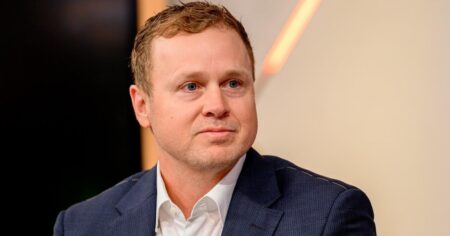
Spencer Pratt, the 42-year-old former reality television personality who became a household name as the controversial figure on MTV’s “The Hills” in the mid-2000s, has taken an unexpected turn in his career path. The registered Republican is now making waves in Los Angeles politics by running for mayor of America’s second-largest city, despite having absolutely no previous political experience. In an exclusive interview with CBS News, Pratt acknowledged his unconventional background but argued that what he lacks in political credentials, he makes up for in practical wisdom and fresh perspective. “I may not have the experience, but I have the common sense to say this is not working,” he stated confidently. What’s perhaps most surprising about his campaign isn’t just his lack of traditional qualifications, but that he’s actually gaining traction with voters—current polling shows him running in second place in the mayoral race. For a city that hasn’t elected a Republican mayor since Richard Riordan left office in 2001 after serving two terms beginning in 1993, Pratt’s campaign represents a significant political shift that few would have predicted.
The Challenge of Turning a Blue City Red
The road ahead for Pratt is admittedly steep, and political analysts aren’t shy about pointing out the obstacles he faces. Melanie Mason, California bureau chief for Politico, summed up the challenge succinctly: “It’s going to be a hard road to convince a very blue city like L.A. to take a chance on not only a novice politician, but somebody who has pretty much aligned himself with Donald Trump and with Republicans.” Los Angeles has long been considered a Democratic stronghold, and the idea of a Republican—particularly one with connections to Trump—winning the mayor’s office seems almost unthinkable to many political observers. However, Pratt appears undaunted by these concerns and believes he has a strategy to overcome the partisan divide. Interestingly, he claims that his support base is broader than one might expect. “Thankfully all my supporters in Los Angeles are Democrats,” the Southern California native explained, suggesting that his message is resonating across party lines. Rather than focusing on divisive partisan rhetoric, Pratt has centered his campaign on basic quality-of-life issues that affect all Angelenos regardless of their political affiliation. “I just want to fix our streets, get the lights on. I want people to feel safe,” he stated, emphasizing practical concerns over ideological battles. This approach of focusing on fundamental city services and public safety may be his best hope for building a coalition that transcends traditional political boundaries.
A Personal Tragedy That Changed Everything
Pratt’s decision to enter the political arena wasn’t part of some long-term career plan or lifelong political ambition. Instead, it was born out of personal tragedy and frustration with government response. By his own admission, running for mayor wasn’t something he had ever envisioned for himself. “I didn’t want to run for mayor,” he revealed, but that perspective changed dramatically last year when his family became victims of the devastating Palisades Fire that swept through Southern California. The fire destroyed his home and fundamentally altered his view of local government effectiveness. Standing in the ruins of his community, Pratt experienced firsthand what he perceived as inadequate leadership and failed crisis management. This personal loss transformed him from a concerned citizen into an active candidate determined to prevent such failures from happening again. “I had to step up so that my sons one day can come back here and live in the L.A. that I lived in—beautiful, safe,” he explained, his motivation now deeply personal and tied to his children’s future. The fire didn’t just destroy physical structures; it shattered his confidence in the city’s leadership. “I’m standing in what happened because of failed politicians,” Pratt declared, making clear that he views current leadership as inadequate and in need of replacement. His campaign message is rooted in this authentic experience of loss and his determination to ensure better preparation and response to future disasters.
Criticisms of Current Leadership
A significant part of Pratt’s campaign narrative involves criticism of incumbent Mayor Karen Bass, particularly regarding her handling of the Los Angeles fires. Bass, a Democrat, faced substantial public backlash for what many residents and observers considered an inadequate response to the fire crisis that devastated communities like Pacific Palisades. The criticism of Bass’s leadership became a major political issue, with many questioning whether the city was properly prepared for such disasters and whether the response was swift and effective enough. In January, one year after the fire, Mayor Bass attempted to highlight progress in the recovery efforts, stating, “I feel good that there’s over 400 homes that are under construction now, that there’s over 800 homes approved to be built.” However, for those like Pratt who lost everything, these numbers likely felt insufficient given the scale of destruction and the time that had passed. The fire response has become a central issue in the mayoral race, with Pratt positioning himself as someone who understands the failures firsthand and has the determination to prevent such inadequate responses in the future. The controversy surrounding Bass’s handling of the disaster has created an opening for challengers like Pratt, who can point to concrete examples of what they perceive as governmental failure while offering themselves as alternatives who will prioritize emergency preparedness and effective crisis management.
The Campaign Trail and Public Debates
The race has intensified as candidates have begun directly confronting each other in public forums. Bass recently faced off in what was described as a heated debate against both Pratt and Los Angeles City Councilmember Nithya Raman, another mayoral candidate. These debates have given voters the opportunity to see the candidates side by side, comparing their visions for the city’s future and their approaches to solving Los Angeles’s most pressing problems. The mayoral election is officially nonpartisan, meaning candidates don’t run under party labels on the ballot, though their political affiliations and philosophies certainly influence their campaigns and policy proposals. The election is scheduled for June 2, but there’s a significant possibility that no candidate will secure a majority of votes in that initial election. If that happens, the two candidates who receive the most votes will advance to a runoff election scheduled for November 3, giving voters a clear choice between the top two contenders. This runoff possibility actually works in Pratt’s favor, as his current second-place polling position would likely secure him a spot in that final showdown, giving him additional months to make his case to voters and potentially build his coalition.
Authenticity Versus Performance: Addressing His Reality TV Past
Perhaps the most interesting aspect of Pratt’s campaign is how he’s addressing his past as a reality television personality, specifically his role as what he himself acknowledges was the “reality villain” on “The Hills.” During his time on the show, Pratt was frequently accused of being intentionally dramatic, stirring up conflict, and manipulating situations for entertainment value—behaviors that made for compelling television but don’t necessarily inspire confidence in a political candidate. However, Pratt has developed a remarkably candid approach to discussing this aspect of his background, essentially arguing that voters should distinguish between his manufactured television persona and his authentic self. “People know when I was a reality villain, I was doing it to get paid. It was strategic. I was working with producers,” he explained, openly acknowledging that his on-screen behavior was performance rather than genuine personality. This transparency about the constructed nature of reality television might actually help him with voters who appreciate his honesty about the entertainment industry’s manipulative aspects. Pratt draws a clear distinction between his past work in entertainment and his current political mission: “I’m being very strategic to win and save L.A., but there’s no strategy when you’re standing in an Airstream on your burned out town. You can’t fake that.” This message emphasizes that while he was once paid to create drama, his current motivation comes from genuine loss and authentic concern for his community’s future. Whether voters will accept this distinction and look past his reality TV persona remains one of the central questions of his campaign, but his willingness to address it directly rather than avoid his past shows a level of self-awareness that might resonate with an electorate tired of polished politicians who seem disconnected from real-world problems. Pratt’s campaign represents a fascinating test of whether authenticity and common-sense appeals can overcome lack of experience and partisan disadvantages in one of America’s most important cities.