

Terrifying Incident at Denver Airport: Frontier Airlines Flight Strikes Pedestrian During Takeoff
The Shocking Moments Captured on Audio
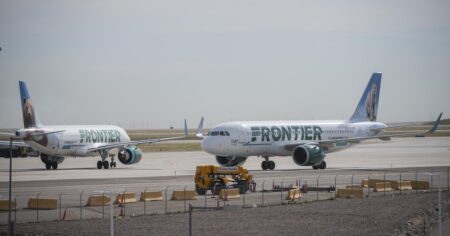
What should have been a routine Friday evening departure from Denver International Airport turned into a nightmare scenario that nobody could have anticipated. Audio recordings from air traffic control have revealed the chilling moments immediately following an unthinkable incident: a Frontier Airlines flight struck a pedestrian who had somehow made their way onto an active runway. The recording begins innocuously enough, with the control tower providing standard clearance for takeoff and offering the flight crew a pleasant “good night” as they prepared to depart for Los Angeles. Within just 30 seconds of receiving that clearance, however, everything changed. The pilot’s voice comes through urgently, announcing they are “stopping on the runway.” What follows is a statement that air traffic controllers rarely, if ever, hear: “We just hit somebody. We have an engine fire.” The calm professionalism in the pilot’s voice, despite the extraordinary circumstances, is evident as he begins to assess the situation and communicate with ground control.
Emergency Response and Evacuation
The situation rapidly escalated as the flight crew realized the full extent of the emergency they were facing. Air traffic control immediately began providing instructions to help the aircraft safely exit the runway, but approximately 40 seconds after the initial report, the pilot made another concerning announcement: there was smoke inside the aircraft cabin. With passenger safety as the paramount concern, the pilot made the critical decision to evacuate all 224 passengers and seven crew members directly on the runway rather than attempting to taxi the aircraft to a gate or other location. Video footage captured by passengers aboard the plane and subsequently shared with CBS News shows smoke visibly filling the cabin, creating an understandably frightening scene for everyone on board. The evacuation was conducted using the aircraft’s inflatable emergency slides, with passengers sliding down to safety on the runway surface. The disturbing images from the scene also appeared to show blood on the plane’s engine, a grim reminder of the collision that had just occurred. Despite the traumatic nature of the incident and the emergency evacuation, Frontier Airlines reported that remarkably, none of the passengers or crew members sustained any injuries during either the collision itself or the subsequent evacuation procedures.
The Mystery of How Someone Entered an Active Runway
Perhaps the most perplexing aspect of this entire incident is the fundamental question that investigators will need to answer: how did an individual manage to access an active runway at one of the busiest airports in the United States? According to the pilot’s communication with air traffic control, there “was an individual walking across the runway” at the moment the aircraft was accelerating for takeoff. Denver International Airport is known for its extensive security measures, multiple layers of fencing, restricted access areas, and sophisticated surveillance systems designed specifically to prevent unauthorized access to operational areas like runways and taxiways. The fact that someone was able to breach these security measures and find themselves in the path of a departing aircraft raises serious questions about potential gaps in security protocols or monitoring systems. As of the immediate aftermath of the incident, authorities had not released any information regarding the condition of the person who was struck by the aircraft, their identity, or how they managed to gain access to such a highly restricted and dangerous area. This information gap has left many questions unanswered and will undoubtedly be a major focus of the ongoing investigation.
Investigation and Airport Operations Impact
In the wake of this unprecedented incident, multiple agencies have launched investigations to determine exactly what happened and why. Frontier Airlines immediately began its own internal investigation into the circumstances surrounding the collision and the flight crew’s response to the emergency. Additionally, the National Transportation Safety Board (NTSB), the federal agency responsible for investigating civil transportation accidents in the United States, was officially notified and is expected to conduct a thorough examination of all aspects of the incident. The NTSB’s investigation will likely encompass everything from the airport’s security measures and how they may have been bypassed, to the actions of the flight crew, to the aircraft’s condition and whether all safety systems functioned as designed. Denver International Airport officials announced that the runway where the collision occurred would remain closed for the duration of the investigation, allowing investigators to thoroughly document the scene, collect evidence, and reconstruct the sequence of events. This closure undoubtedly affected airport operations and other flights, though Denver International’s multiple runways likely helped minimize broader disruptions to air travel.
Passenger Experience and Airline Response
For the 224 passengers who boarded that Frontier Airlines flight expecting a routine journey to Los Angeles, the experience was undoubtedly traumatic and unforgettable. After evacuating the aircraft via emergency slides onto the runway, the passengers were met by emergency response crews who transported them back to the airport terminal via buses. While physically unharmed, many passengers were likely shaken by the experience of feeling the aircraft strike something during takeoff acceleration, seeing smoke fill the cabin, and having to evacuate via emergency slides—something most air travelers hope never to experience. Frontier Airlines worked to accommodate the displaced passengers by rescheduling their flight to Los Angeles, though the emotional impact of such an incident cannot be easily resolved with a rescheduled departure. The airline’s handling of the situation, from the flight crew’s professional response to the emergency through the ground staff’s arrangements for the affected passengers, will be scrutinized as part of the broader examination of the incident. The crew’s quick decision-making and execution of emergency procedures undoubtedly prevented what could have been a far worse outcome had the situation not been handled with such professionalism.
Broader Implications for Aviation Security
This incident at Denver International Airport serves as a stark reminder of the complex security challenges facing modern airports and the aviation industry as a whole. While airport security measures have focused heavily on preventing prohibited items and dangerous individuals from boarding aircraft, this event highlights the equally critical importance of securing the operational areas of airports—runways, taxiways, and aprons—from unauthorized access. The question of how someone could access an active runway will likely prompt airports nationwide to review their perimeter security measures, surveillance systems, and protocols for monitoring restricted areas. This incident also raises questions about whether additional safeguards, such as enhanced motion detection systems, infrared monitoring, or more frequent security patrols, might be necessary to prevent similar occurrences in the future. As investigations continue and more information becomes available about both the condition of the person who was struck and the circumstances that led to their presence on the runway, the aviation industry will undoubtedly examine lessons learned and consider whether changes to security protocols are necessary. For now, the most important outcome is that all passengers and crew members emerged from this frightening incident without physical injury, thanks in large part to the professional response of the flight crew and emergency personnel who responded to the scene.