
Understanding the Dramatic Price Movement in $ELF Cryptocurrency
A Shocking Hourly Decline Raises Questions
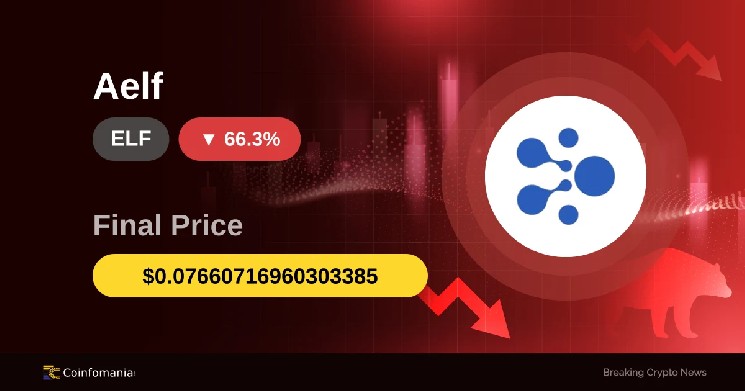
The cryptocurrency market has once again demonstrated its notorious volatility, with $ELF experiencing a shocking plunge that has left investors and market observers scrambling for answers. In just a single hour, this digital asset suffered a catastrophic decline of 66.29%, tumbling from its previous trading price of $0.2272 down to a mere $0.07659. This kind of dramatic price movement is exactly what makes cryptocurrency trading both thrilling and terrifying for participants at all levels of experience. The severity of this drop has naturally sparked intense discussions across trading communities and social media platforms, with everyone trying to understand what triggered such a massive selloff and whether this represents a temporary blip or the beginning of a more sustained downward trend.
What makes this situation particularly noteworthy is the accompanying surge in trading volume, which suggests that this wasn’t simply a case of low liquidity creating exaggerated price movements. Instead, the market saw significant activity as traders rushed to respond to the rapidly changing situation. Some were likely cutting their losses, while others may have been attempting to catch what they hoped would be a temporary dip. This combination of steep price decline and high volume creates a perfect storm of uncertainty that demands careful analysis from anyone holding or considering positions in $ELF. For those who held positions during this decline, the losses have been substantial and painful, serving as yet another reminder of the risks inherent in cryptocurrency investments.
Current Market Position and Recent Performance
Taking a step back to look at the broader picture, $ELF currently sits at a price of $0.07659, which actually represents a modest gain of 1.18% over the past 24 hours. This positive daily movement might seem contradictory given the severe hourly decline mentioned earlier, but it illustrates just how volatile and unpredictable cryptocurrency markets can be within different timeframes. The 24-hour trading volume has reached approximately $9.75 million, a figure that indicates substantial market participation and interest in the token despite—or perhaps because of—the recent turbulence.
Looking at the price range over the past day provides additional context for understanding the market’s behavior. $ELF touched a high of $0.2272 before plummeting to a low of $0.076575, representing an enormous intraday range that would be almost unthinkable in traditional financial markets. This kind of price action creates both opportunities and dangers for traders, depending on their timing, strategy, and risk tolerance. The token’s market capitalization currently stands at around $76 million, placing it firmly in the mid-to-lower tier of cryptocurrency assets by valuation. This relatively modest market cap can contribute to heightened volatility, as it takes less capital to move the price significantly compared to larger, more established cryptocurrencies. For traders and investors, understanding where $ELF sits in the broader ecosystem is crucial for making informed decisions about position sizing and risk management.
Potential Catalysts Behind the Price Collapse
Understanding what drove such a dramatic price movement is critical for anyone trying to navigate these turbulent waters. While pinpointing exact causes in cryptocurrency markets can be challenging due to their decentralized and often opaque nature, analysts have identified several likely contributing factors. The broader cryptocurrency market has been sending mixed signals recently, creating an environment of uncertainty that can quickly translate into panic when prices begin moving sharply in one direction. This general market anxiety appears to have played a significant role in $ELF’s decline.
Additionally, the pattern of trading volume suggests that the drop may have been accelerated by two common trader behaviors: profit-taking and panic selling. Those who had purchased $ELF at lower prices may have decided to lock in their gains as the price approached the $0.2272 level, creating initial selling pressure. As the price began to fall, this could have triggered stop-loss orders and panic selling from less experienced traders or those with lower risk tolerance, creating a cascading effect that drove the price even lower. This snowball effect is a well-documented phenomenon in financial markets, particularly in highly speculative assets like cryptocurrencies. Furthermore, the possibility of coordinated selling by larger holders, sometimes called “whales” in crypto parlance, cannot be ruled out, though without additional data, this remains speculative.
The Influence of Broader Market Dynamics
The cryptocurrency market rarely operates in isolation, and movements in major assets like Bitcoin and Ethereum often have ripple effects throughout the entire ecosystem. Currently, market sentiment across these flagship cryptocurrencies has been notably volatile, with significant price swings occurring across the board. This broader instability creates a challenging environment for smaller altcoins like $ELF, which tend to experience even more dramatic price movements than their larger counterparts.
When Bitcoin or Ethereum experiences uncertainty or downward pressure, traders often become more risk-averse, leading them to reduce positions in smaller, more speculative assets first. This flight to relative safety—or sometimes to fiat currency entirely—can create disproportionate selling pressure on mid-tier tokens. The psychological aspect of trading also plays a crucial role during these periods. When investors see red across their portfolios, the tendency to sell indiscriminately increases, regardless of the fundamental merits of individual projects. This herd mentality can override rational analysis and create price movements that seem disconnected from any specific news or developments related to a particular cryptocurrency. For $ELF holders, understanding these broader market forces is essential, as the token’s price may be influenced as much by Bitcoin’s performance as by anything happening within the $ELF ecosystem itself.
Increased Trading Activity and On-Chain Signals
Digging deeper into the data, on-chain analytics reveal a surge in trading activity surrounding $ELF that provides additional insights into market behavior. The increase in transactions and wallet activity suggests that investors are actively reassessing their positions rather than simply holding through the volatility. This heightened activity is a double-edged sword: it indicates strong engagement and liquidity, which are generally positive for any cryptocurrency, but it also suggests uncertainty and disagreement among market participants about the token’s proper valuation.
When wallet activity increases dramatically during price drops, it often indicates distribution—the transfer of coins from holders who have lost confidence to those who see the lower price as an opportunity. Whether these new buyers are making a wise decision or catching a falling knife remains to be seen and will depend on how the market develops in the coming hours and days. The pattern of this activity can also provide clues about potential future movements. If large wallets are accumulating during this dip, it might signal confidence from more sophisticated investors. Conversely, if the distribution is primarily from large holders to smaller retail investors, it could indicate that those with more information or experience are exiting their positions. For active traders, monitoring these on-chain metrics alongside price action can provide valuable context for making more informed decisions about entry and exit points.
Critical Levels and What Lies Ahead
As the dust begins to settle from this dramatic price movement, traders and investors are now focused on identifying key technical levels that will determine $ELF’s near-term trajectory. The current support level around $0.076575 has taken on critical importance—this represents the recent low and serves as a psychological and technical floor. If the price breaks decisively below this level, it could trigger another wave of selling and push the token into uncharted territory with uncertain consequences. Conversely, maintaining this support level could provide a foundation for recovery and renewed confidence among holders.
On the upside, traders are eyeing the $0.10 level as the next significant resistance point. A move back toward this price would represent a substantial recovery from current levels and might attract fresh buying interest from those who missed the initial dip. However, reaching this level will require a shift in market sentiment and likely needs support from broader cryptocurrency market strength. Beyond these technical considerations, investors should remain alert to any developments within the $ELF project itself—such as partnerships, technological updates, or changes in the development team—as these could influence the token’s fundamental value proposition. Additionally, macroeconomic factors affecting the entire cryptocurrency space, including regulatory developments, institutional adoption trends, and traditional market conditions, will continue to play important roles in shaping $ELF’s price trajectory. The coming days will be crucial for determining whether this dramatic drop represents a temporary shakeout or the beginning of a more prolonged downturn.