



A Historic Tie at the 2026 Oscars: When Two Winners Share One Award
A Surprising Announcement That Made Oscar History
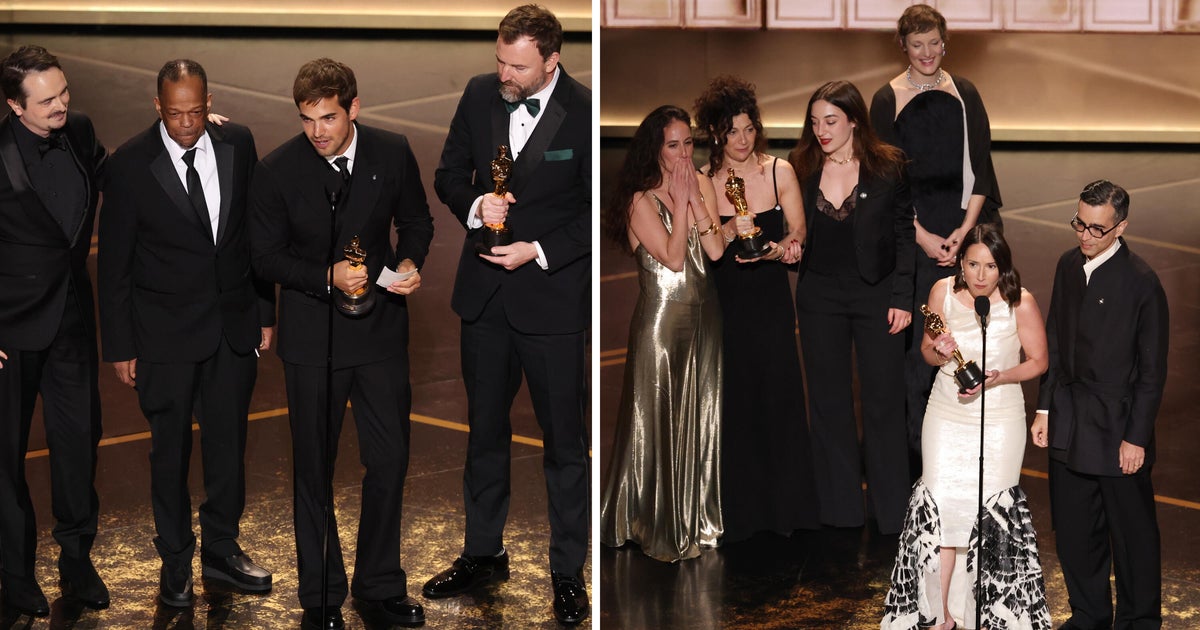
The 2026 Academy Awards ceremony delivered an unexpected moment that sent ripples through the Dolby Theatre when presenter Kumail Nanjiani took the stage to announce the winner of Best Live-Action Short. Instead of the usual single name being called, the actor and comedian created a moment of genuine surprise as he exclaimed to the audience: “And the Oscar goes to … it’s a tie. I’m not joking. It’s actually a tie.” This announcement marked only the seventh time in the Academy’s nearly century-long history that two films would share an Oscar in the same category. The winners were “The Singers,” a musical comedy that captivated audiences with its charm and wit, and “Two People Exchanging Saliva,” a French-language short drama that pushed boundaries with its bold storytelling. The rarity of this occurrence made it a standout moment in what was already a memorable evening celebrating the best in cinema. For those watching both in the theater and at home, it served as a reminder that even in an institution as established as the Academy Awards, surprises can still happen, and sometimes excellence cannot be easily ranked or separated.
The Winners Take the Stage in Disbelief
When director Sam Davis and his team from “The Singers” approached the stage to accept their golden statuette, the disbelief was evident in his voice and expression. “A tie, wow. I didn’t know that was a thing, a tie, but we’re happy to be up here,” Davis said, perfectly capturing the surreal nature of the moment. His genuine surprise reflected what many in the audience and watching at home were feeling – that ties at the Oscars are so uncommon that even nominees might not realize they’re possible. After “The Singers” team had their moment in the spotlight, Nanjiani returned to the microphone to call up the second set of winners. Director Natalie Musteata and her team from “Two People Exchanging Saliva” then had their turn to address the crowd and millions of viewers worldwide. Musteata’s acceptance speech carried a different tone, one of gratitude mixed with acknowledgment of her film’s unique position in cinema. “We love all of our fellow nominees, and we’re so, so grateful to everyone who has supported our film,” she said, before adding a particularly meaningful note: “Thank you to the academy … for supporting a film that is weird and that is queer and that is made by a majority of women.” Her words highlighted not just the victory itself, but what it represented for underrepresented voices and unconventional storytelling in the film industry.
Understanding the Rarity: Only Seven Ties in Oscar History
To truly appreciate the significance of this 2026 tie, it’s important to understand just how infrequent such outcomes have been throughout the Academy’s history. Over nearly a century of honoring cinematic achievement, there have been only seven ties across all categories. This statistic underscores that while ties are possible, they require an extraordinarily rare alignment of voting patterns among Academy members. The mathematical probability of hundreds or thousands of voters arriving at exactly the same number of votes for two different films speaks to how closely matched “The Singers” and “Two People Exchanging Saliva” must have been in quality, impact, and appeal to Academy members. These rare occurrences become part of Oscar lore, discussed and remembered long after more routine wins are forgotten. They represent moments when the subjective nature of art meets the objective reality of vote counting, and the Academy must acknowledge that sometimes there simply isn’t a way to declare one work superior to another. Each tie in Oscar history tells a story not just about the films involved, but about the specific moment in cinema history when they competed, the tastes and values of Academy members at that time, and the evolution of filmmaking itself.
The Evolution of Tie Rules: From Three Votes to Exact Matches
The history of how the Academy handles ties has itself evolved over the decades, making the 2026 outcome even more significant under current rules. At the 5th annual Academy Awards, actors Fredric March for “Dr. Jekyll and Mr. Hyde” and Wallace Beery for “The Champ” shared the Best Actor award in what appeared to be a tie. However, historical records reveal this wasn’t a true tie in the strictest sense – March actually received one more vote than Beery. Under the rules that existed at that time, if the runner-up in any category came within three votes of the winner, both would receive an Oscar. This generous margin meant that very close races could result in shared honors even without identical vote counts. However, recognizing that this rule might dilute the significance of winning, the Academy eventually changed its policies. Under current regulations, only an exact tie in the number of votes qualifies for two awards to be given in a single category. This makes modern ties, like the one witnessed in 2026, genuinely remarkable achievements where Academy members were split with mathematical precision. The rule change ensures that ties reflect true equality in voting rather than just a close race, adding weight and meaning to those rare occasions when two winners share the spotlight.
A Look Back at Previous Oscar Ties
Each of the previous six ties in Oscar history has its own fascinating context and significance. In 1949, the Academy recognized two documentaries – “A Chance to Live” and “So Much for So Little” – with shared honors in the short subject category, demonstrating early on that ties could occur beyond the major acting categories. Perhaps the most famous tie in Oscar history came in 1968 when two legendary performers, Katharine Hepburn for “The Lion in Winter” and Barbra Streisand for “Funny Girl,” both received Oscars for Best Actress. This remains one of the most discussed outcomes in Academy Awards history, as it involved one of the most prestigious categories and two performers at pivotal moments in their careers – Hepburn as an established icon and Streisand as a rising star making her film debut. Nearly two decades later in 1986, the Feature Documentary category saw another tie between “Artie Shaw: Time Is All You’ve Got” and “Down and Out in America,” two films with vastly different subjects that nonetheless equally impressed Academy voters. The Best Live-Action Short category, which saw the tie in 2026, had actually experienced this phenomenon before in 1994 when “Franz Kafka’s It’s a Wonderful Life” and “Trevor” received identical vote counts. The most recent tie before 2026 occurred in 2012 in the technical category of Sound Editing, with both “Skyfall” and “Zero Dark Thirty” recognized for their exceptional audio work. These previous ties span different eras, different categories, and different types of films, but they all share the common thread of representing moments when Academy members simply could not choose between two excellent works.
What This Tie Means for Cinema and Recognition
The 2026 tie between “The Singers” and “Two People Exchanging Saliva” carries significance beyond the simple mathematics of vote counting. The contrasting nature of the two films – one a musical comedy and the other a boundary-pushing queer drama made predominantly by women – suggests that excellence in short filmmaking can take radically different forms and still achieve equal recognition. This is particularly meaningful in an era when conversations about diversity, representation, and what kinds of stories deserve spotlight have become central to discussions about the film industry. The fact that a film described by its own director as “weird” and “queer” could tie with a more traditional musical comedy format suggests an Academy membership with increasingly broad tastes and appreciation for different voices. For emerging filmmakers, this tie sends an encouraging message that there isn’t just one path to Oscar recognition, and that taking creative risks can pay off at the highest levels of industry acknowledgment. The tie also highlights the continued importance of short films as a category, often seen as a breeding ground for new talent and experimental storytelling that might not find space in feature-length formats. As the film industry continues to evolve with streaming platforms, changing audience habits, and ongoing conversations about inclusion and representation, ties like this one serve as interesting data points about where Academy values stand at a particular moment in time. Whether we’ll see another tie soon or wait years for the eighth occurrence remains unknown, but the 2026 Best Live-Action Short tie will undoubtedly be remembered as a special moment in Oscar history.