

Hope on the Prairie: How America Rallied to Save Nebraska Ranchers
Life on the Edge of Nowhere
In the vast, rolling sandhills of western Nebraska, where the horizon seems to stretch endlessly in every direction, Mike and Kayla Wintz have built their life as cattle ranchers in one of America’s most remote landscapes. Their home sits so far from civilization that the simple act of buying milk requires a round trip of over two hours. It’s the kind of isolation that many couldn’t imagine—a place where neighbors are measured in miles rather than footsteps, and the nearest town feels like a distant memory. Yet despite living in what Mike calls “the middle of nowhere,” this young ranching couple has discovered something profound about the American spirit. Their story isn’t one of loneliness or hardship in isolation, but rather a testament to how deeply connected we all are, even across vast distances. When disaster struck their ranch this past spring, they learned that geographical remoteness means nothing when it comes to the bonds that tie communities together across this nation. The sandhills may be isolated, but the people who call this rugged landscape home have never felt more embraced by their fellow Americans.
When the Fire Came
March 2024 will forever be etched in the memory of Nebraska ranchers as the month everything changed. The Morrill Fire, which would become the largest wildfire in Nebraska’s recorded history, tore across the landscape with devastating fury, consuming approximately 1,000 square miles of precious ranchland in its path. For Mike and Kayla Wintz, the disaster was both swift and total. In just two hours, flames devoured all 11,000 acres of the land they lease for their cattle operation—every blade of grass, every fence post, every bit of vegetation their livelihood depended upon simply vanished into smoke and ash. “Within two hours it’s all gone, it’s tough,” Mike recalled, his words barely capturing the magnitude of watching years of careful stewardship disappear in moments. The loss wasn’t just about property or grass—it threatened the very foundation of their ranching operation. Without grazing land, their cattle had nothing to eat. The situation was dire and immediate, with no obvious solution in sight. Making matters worse, the ranchers who might normally help each other in times of trouble were facing identical devastation. The fire had been indiscriminate, wiping out resources across the region and leaving neighboring ranchers just as desperate and unable to share what they didn’t have.
The Unexpected Lifeline
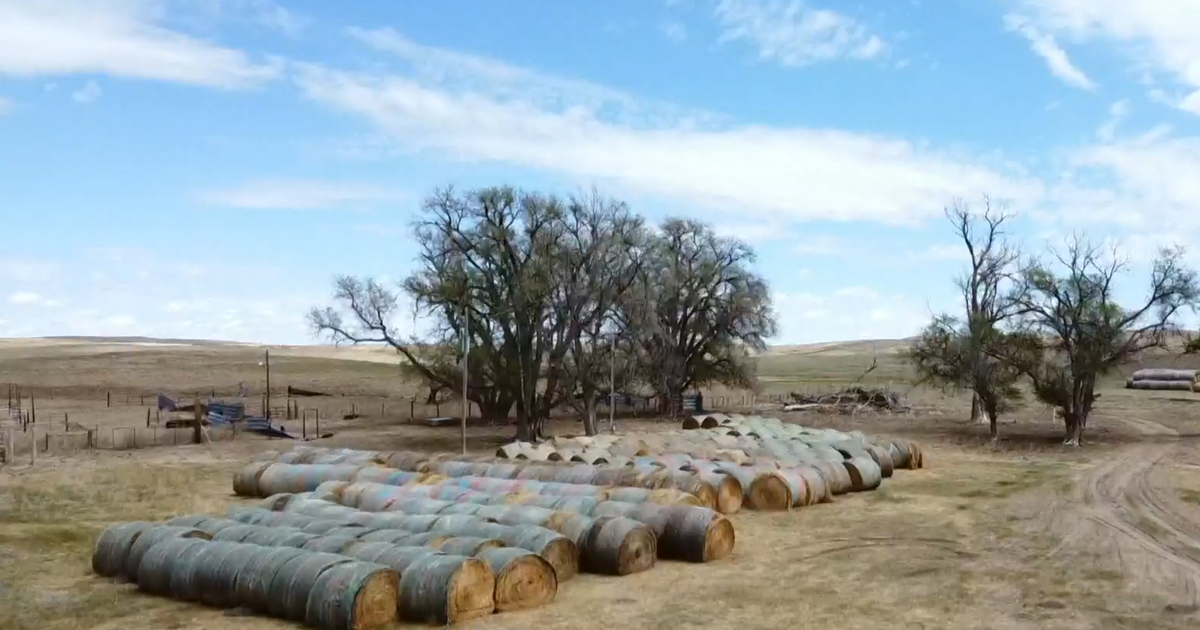
Just when the situation seemed hopeless, something remarkable began to happen. Mike’s phone started ringing—not with condolences or sympathetic words, but with concrete offers of help. Strangers from across the country were calling to donate hay, the essential feed that would keep his cattle alive and his ranch operational. The calls didn’t stop. Day after day, the messages poured in from people Mike and Kayla had never met, offering truckloads of hay with no expectation of payment or recognition. To date, the couple has received approximately $80,000 worth of donated hay, an astounding figure made even more meaningful by the fact that most donors chose to remain anonymous. “They don’t want the glory,” Mike explained about these mysterious benefactors. “They know they did it and that’s all they need,” Kayla added, her voice reflecting both gratitude and amazement at this outpouring of generosity. These weren’t wealthy philanthropists looking for tax write-offs or publicity—they were fellow farmers and ranchers, truckers and everyday Americans who understood what it meant to lose everything and wanted to help someone get back on their feet. The donations came without strings attached, without fanfare, and without any expectation of recognition. It was pure, unfiltered compassion in action.
A Movement of Compassion
Sara Cover, a volunteer who stepped up to coordinate the relief efforts, found herself at the center of an unprecedented wave of generosity that even she couldn’t have anticipated. Her phone became a lifeline between desperate ranchers and generous donors, ringing constantly with offers of help. “Up to 200 phone calls a day of people wanting to donate hay,” Cover told reporters, still seeming somewhat amazed by the scale of the response. The coordination effort revealed something beautiful about American character—when people see a genuine need, they respond not with excuses but with action. Cover described scenes that could have come from a Frank Capra film: convoys of more than twenty trucks loaded with hay rolling through small Nebraska towns, while schoolchildren lined the streets cheering them on like heroes returning from battle. These weren’t military parades or political demonstrations, but celebrations of ordinary people doing extraordinary things for strangers. The hay came from everywhere—from neighboring states, certainly, but also from as far away as South Carolina, where farmers who had never seen the Nebraska sandhills loaded up their trucks for a multi-day journey to help people they’d never met. Nobody organized a formal campaign. There were no celebrity spokespeople or social media influencers rallying their followers. The help simply materialized organically, spreading through word of mouth and the invisible networks that connect rural America.
The Humble Heart of Rural America
Perhaps the most moving aspect of this entire story is what happened when volunteers like Sara Cover contacted affected ranchers to arrange hay deliveries. Rather than rushing to accept help for themselves, these struggling ranchers—people who had lost everything and faced uncertain futures—consistently made the same request: send the hay to their neighbor first. Think about that for a moment. These are people whose livelihoods hang in the balance, whose cattle face starvation, whose financial security has literally gone up in smoke. Yet when offered a lifeline, their first instinct was to make sure their neighbor was taken care of before accepting help themselves. This wasn’t one or two exceptional individuals—it was a pattern Sara Cover encountered repeatedly in her coordination efforts. “Every rancher that we have called to send them hay has asked us to send it to their neighbor first,” she reported. This response reveals something fundamental about the culture of rural America and ranching communities in particular. There’s an understanding that we’re all in this together, that individual survival depends on community survival, and that helping your neighbor isn’t just good ethics—it’s practical wisdom. These ranchers know that their community’s strength lies not in any single operation succeeding, but in all of them making it through together. It’s a value system that seems almost quaint in our competitive, individualistic modern culture, yet it persists in these remote communities where people still depend on each other in fundamental ways.
Connected in the Middle of Nowhere
The story of Mike and Kayla Wintz and their fellow ranchers offers us something precious in these divided times—a reminder of what connects us rather than what separates us. In an era when we’re constantly told that America is irreparably fractured, here’s evidence of thousands of people acting in concert without any organization, ideology, or agenda beyond simple human compassion. The Wintz family began this ordeal feeling isolated in the geographical sense, living hours from the nearest grocery store in one of America’s most remote regions. But through tragedy, they discovered they were anything but alone. They found themselves embraced by a nation of strangers who became friends through acts of generosity. They experienced firsthand what Sara Cover articulated so beautifully: qualities like empathy, charity, and grace guarantee that no matter how isolated you are physically, you are never truly alone. The response to the Morrill Fire wasn’t about politics, religion, or culture wars. It was about Americans helping Americans, farmers helping farmers, neighbors helping neighbors across distances that made the word “neighbor” a spiritual rather than geographical term. This story suggests that beneath all our surface differences and disagreements, there remains a bedrock of shared values and mutual concern that emerges when people face genuine hardship. The convoys of hay rolling across state lines, the anonymous donors wanting no recognition, the ranchers insisting their neighbors be helped first—these aren’t the actions of a broken nation, but of a people who still understand that we rise or fall together. In the sandhills of Nebraska, in the middle of nowhere, Mike and Kayla Wintz found the heart of America—and it was good.