



Bitcoin’s Turbulent Journey: Are We Headed for Further Decline?
The Rollercoaster Week That Shook Crypto Markets
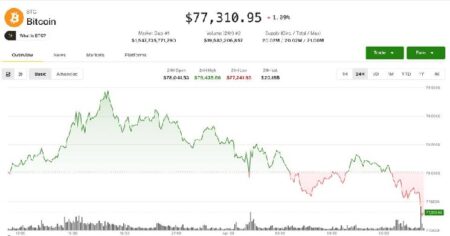
Last week proved to be an emotional whirlwind for Bitcoin investors as the world’s leading cryptocurrency experienced a dramatic downturn that sent shockwaves throughout the digital asset community. Bitcoin plummeted to the concerning level of $60,000, a price point that hadn’t been seen in quite some time and one that triggered anxiety among both seasoned traders and newcomers alike. Just when many investors were bracing for even worse news, the resilient cryptocurrency managed to stage an impressive comeback, climbing back up to the $70,000 mark. This $10,000 swing in such a short timeframe perfectly encapsulates the volatile nature of cryptocurrency markets and serves as a reminder of why Bitcoin continues to be one of the most unpredictable yet fascinating investment assets in today’s financial landscape. While this recovery initially brought relief to many holders who watched their portfolios shrink during the dip, the celebration may have been premature, as several prominent market analysts are sounding alarm bells that this rebound might simply be the calm before an even more significant storm.
Skeptics Question the Sustainability of Bitcoin’s Recovery
Despite Bitcoin’s impressive bounce back from its recent lows, not everyone in the cryptocurrency analysis community is convinced that we’re out of the woods just yet. In fact, a growing chorus of respected market watchers and technical analysts are raising red flags, suggesting that the recent recovery might be nothing more than a temporary reprieve before Bitcoin faces another, potentially more severe, downturn. The skepticism runs deep among these professionals who have spent years studying market patterns, chart formations, and investor behavior. They’re not simply being pessimistic for the sake of it; rather, their concerns are grounded in technical analysis, historical comparisons, and on-chain data that paints a picture quite different from the optimistic narrative that short-term price recovery might suggest. These analysts argue that the fundamental conditions that typically signal a true market bottom simply aren’t present yet, and that the current price level represents what they call a “bull trap” – a temporary rise that lures investors into a false sense of security before the market continues its downward trajectory. This divergence of opinion between the immediate price action and expert analysis creates a challenging environment for investors trying to navigate these turbulent waters and make informed decisions about their Bitcoin holdings.
The $50,000 Prediction and Its Implications for ETF Investors
Among the most attention-grabbing predictions comes from an analyst operating under the pseudonym BitBull, who has staked out a particularly bearish position on Bitcoin’s near-term prospects. BitBull’s analysis suggests that Bitcoin’s “ultimate capitulation” – a term traders use to describe the final, panic-driven selloff that typically marks a market bottom – hasn’t occurred yet. According to this perspective, the true bottom for Bitcoin lies somewhere below the psychologically significant $50,000 threshold, representing a potential decline of more than 28% from the recent recovery price of $70,000. What makes this prediction particularly concerning is its potential impact on a specific group of investors: those who have entered the Bitcoin market through the newly approved spot Bitcoin Exchange-Traded Funds (ETFs) in the United States. According to on-chain data that tracks these investment vehicles, the average purchase price for US spot Bitcoin ETF buyers currently sits at approximately $82,000. This figure is especially noteworthy because it means that even at Bitcoin’s current recovery level around $70,000, many of these ETF investors are already sitting on paper losses. Should BitBull’s prediction come to fruition and Bitcoin decline to $50,000 or below, virtually all ETF participants would find themselves in negative territory, having lost a substantial portion of their investment. This scenario would represent a significant test of investor resolve and could potentially trigger a wave of selling pressure as institutional and retail investors alike rush to limit their losses, potentially creating a self-fulfilling prophecy that drives prices even lower.
Historical Comparisons to the 2022 Bear Market Paint a Concerning Picture
Several analysts have drawn parallels between Bitcoin’s current price behavior and the devastating bear market of 2022, a period that many cryptocurrency investors would prefer to forget but which offers valuable lessons for understanding potential future movements. Filbfilb, another respected analyst in the cryptocurrency space, has been particularly vocal about these similarities, even sharing detailed charts that overlay current price action with patterns observed during that difficult period. The comparisons focus on how Bitcoin is interacting with key technical levels, particularly long-term moving averages that traders use to gauge market health and direction. Filbfilb specifically points to the 50-week exponential moving average (EMA), which currently sits at approximately $95,300, as a critical level that Bitcoin has failed to reclaim and hold. In the analyst’s view, this failure to maintain position above such an important technical threshold makes it extremely difficult to characterize the current recovery as a genuine structural reversal – the kind of sustainable turnaround that would signal the start of a new bull market. Instead, the pattern suggests we might be experiencing a temporary relief rally within an ongoing downtrend, similar to what occurred in 2022 when Bitcoin briefly recovered after testing its 200-week moving average, only to subsequently lose that level and experience an even sharper decline. This historical perspective adds weight to the argument that investors should remain cautious and avoid interpreting the recent price recovery as confirmation that the worst is behind us.
Technical Indicators Point Toward New Lows on the Horizon
The bearish sentiment isn’t limited to just a handful of analysts; rather, it appears to be gaining traction among various technical analysis experts who approach the market from different methodological perspectives. Tony Severino, another well-regarded technical analyst, has stated with notable confidence that new lows are “almost certain” based on the various indicators he monitors. While the specific indicators weren’t detailed in his public commentary, technical analysts typically examine a combination of factors including momentum oscillators, volume patterns, support and resistance levels, and various moving averages to form their conclusions. The convergence of multiple technical indicators pointing in the same bearish direction typically carries more weight than any single metric, which is why Severino’s assessment deserves attention from serious investors. Adding another voice to this analytical consensus, Caleb Franzen, the founder of Cubic Analytics, shared his perspective with the cryptocurrency news outlet Cointelegraph, further reinforcing the comparison to 2022’s market dynamics. Franzen’s analysis specifically warns that the recent recovery could be what traders call a “bull trap” – a temporary rise in price that gives the appearance of a trend reversal but ultimately fails, leaving latecomers to the rally holding positions at disadvantageous prices. His reference to 2022 is particularly instructive: during that bear market, Bitcoin did manage to stage a recovery after retesting its 200-week moving average, temporarily convincing some investors that the bottom was in, only to subsequently fail to maintain that critical level and experience a sharp, painful decline that caught many off guard. The current situation appears to be following a similar script, which raises legitimate concerns about what might happen next.
Navigating Uncertainty in an Unpredictable Market
Despite the abundance of bearish analysis and the concerning technical and historical comparisons, it’s crucial for investors to remember that financial markets – and cryptocurrency markets in particular – rarely follow a perfectly predictable script. Caleb Franzen himself acknowledged this fundamental truth when he noted that while the current situation shows similarities to 2022, “the market cannot perfectly repeat its past,” making it inherently difficult to predict with certainty what will unfold in the coming weeks and months. This caveat is important because it highlights the limitations of technical analysis and historical comparison as predictive tools. Markets are influenced by an incredibly complex web of factors including macroeconomic conditions, regulatory developments, institutional adoption trends, technological innovations, geopolitical events, and the collective psychology of millions of participants worldwide. While patterns do tend to repeat because human behavior tends to be relatively consistent, the specific circumstances surrounding each market cycle are unique, which means outcomes can diverge from historical precedents in unexpected ways. For individual investors trying to make sense of these conflicting signals – the recent price recovery on one hand and the bearish expert analysis on the other – the situation underscores the importance of several key principles of sound investing: maintaining a long-term perspective rather than reacting to short-term volatility, only investing money you can afford to lose in highly speculative assets like cryptocurrency, diversifying across different asset classes to manage risk, and being extremely cautious about making decisions based solely on predictions, no matter how credible the source might seem. It’s also worth remembering the standard disclaimer that applies to all market commentary: none of this constitutes professional investment advice, and anyone considering buying, selling, or holding Bitcoin should conduct their own thorough research and, if appropriate, consult with a qualified financial advisor who understands their specific financial situation, risk tolerance, and investment goals. The cryptocurrency market has surprised observers countless times in both directions, and while the current analytical consensus leans bearish, the only certainty is continued uncertainty.