

Daily Crypto Market Analysis: Understanding Today’s Market Movements
Market Overview: A Bearish Day Across the Board
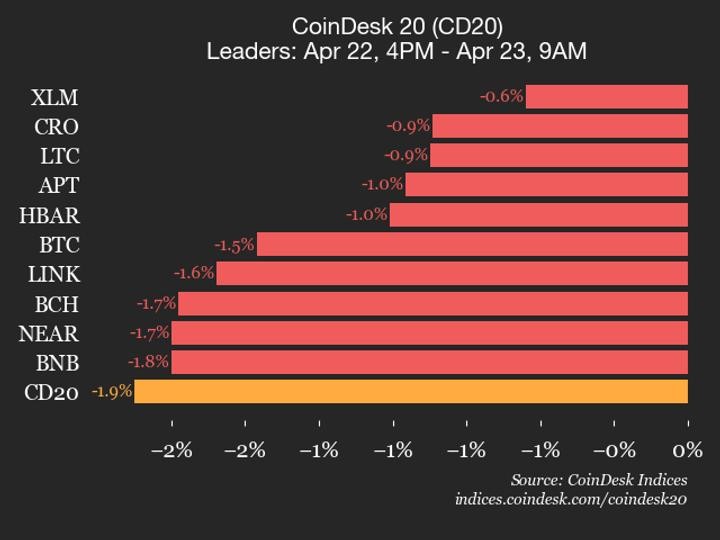
The cryptocurrency market experienced a notably challenging trading session, as reflected in the CoinDesk 20 Index performance. Currently sitting at 2117.36 points, the index has declined by 1.9%, representing a loss of 40.48 points since 4 p.m. Eastern Time on Wednesday. What makes today’s market movement particularly significant is the uniformity of the downturn – all twenty assets included in this prestigious index are trading in negative territory. This kind of across-the-board decline often signals broader market sentiment shifts or reactions to significant news affecting the entire cryptocurrency sector. The CoinDesk 20 Index serves as an important barometer for the overall health of the digital asset market, tracking the performance of the most significant cryptocurrencies by market capitalization and trading volume. When we see such widespread red across the board, it typically indicates that investors are taking a risk-off approach, potentially responding to macroeconomic concerns, regulatory developments, or profit-taking after previous gains.
Understanding the CoinDesk 20 Index and Its Importance
Before diving deeper into today’s specific market movements, it’s essential to understand what the CoinDesk 20 Index represents and why it matters to both institutional and retail investors. The CoinDesk 20 is a carefully curated, broad-based index that captures the performance of twenty of the most established and liquid digital assets in the cryptocurrency market. Unlike narrower indices that might focus on just Bitcoin and Ethereum, this index provides a more comprehensive view of the digital asset landscape, including major players across different blockchain ecosystems and use cases. The index is designed to be traded on multiple platforms across several regions globally, making it an accessible benchmark for investors worldwide who want exposure to a diversified basket of cryptocurrencies without having to manage individual positions in each asset. This global accessibility and comprehensive coverage make it an invaluable tool for understanding market trends, assessing portfolio performance, and making informed investment decisions. The methodology behind the index ensures that it represents assets with sufficient liquidity, market capitalization, and trading history, providing a reliable snapshot of the established cryptocurrency market rather than speculative or highly volatile smaller tokens.
Today’s Relative Winners: XLM and CRO Show Resilience
Even in a down market, some assets demonstrate relative strength, and today’s session was no exception. Stellar (XLM) and Cronos (CRO) emerged as the day’s leaders, though it’s important to note that in this context, “leaders” means they declined less than their peers rather than posting actual gains. Stellar’s XLM token dropped only 0.6%, making it the most resilient asset in the index today. This relative outperformance suggests that XLM holders maintained confidence despite broader market weakness, possibly due to ongoing developments in Stellar’s payment network or partnerships that continue to generate optimism about its long-term prospects. Stellar has long positioned itself as a bridge between traditional finance and blockchain technology, focusing on cross-border payments and remittances, and this fundamental value proposition may be providing some support during market turbulence.
Cronos (CRO), the native token of the Crypto.com ecosystem, came in as the second-best performer with a decline of just 0.9%. CRO’s relative strength might be attributed to the continued expansion of the Crypto.com platform, its sports marketing initiatives, and its growing DeFi ecosystem. The token benefits from multiple use cases within the Crypto.com exchange, including reduced trading fees, staking rewards, and access to various platform features. When a platform token like CRO shows resilience during market downturns, it often reflects sustained user activity and confidence in the underlying exchange or ecosystem. Both XLM and CRO’s performance today demonstrates an important principle in cryptocurrency investing: relative strength matters just as much as absolute performance, and assets that decline less during bearish sessions often rebound more strongly when market sentiment improves.
The Day’s Biggest Decliners: UNI and ETH Under Pressure
On the opposite end of the spectrum, Uniswap (UNI) and Ethereum (ETH) experienced the most significant selling pressure among CoinDesk 20 constituents. Uniswap’s governance token, UNI, dropped 3.9%, making it the day’s worst performer. This decline in UNI is particularly noteworthy given Uniswap’s position as the leading decentralized exchange in the cryptocurrency ecosystem. Several factors could be contributing to UNI’s underperformance, including concerns about decreasing trading volumes on decentralized exchanges during bearish market conditions, competitive pressure from other DEX platforms, or profit-taking from traders who had accumulated UNI during previous rallies. Governance tokens like UNI can be especially sensitive to market sentiment because their value derives largely from the success and usage of the underlying protocol, and during risk-off periods, investors often rotate out of these more specialized tokens into more established assets like Bitcoin.
Ethereum (ETH), the second-largest cryptocurrency by market capitalization and arguably the most important smart contract platform in the blockchain space, fell 2.9%, making it the second-worst performer in today’s session. Ethereum’s decline is particularly significant because ETH often serves as a bellwether for the broader altcoin market and the health of the decentralized application ecosystem. When Ethereum experiences notable selling pressure, it can signal concerns about network usage, gas fees, competition from alternative Layer 1 blockchains, or broader risk aversion among cryptocurrency investors. The fact that both UNI and ETH—two closely related assets within the Ethereum ecosystem—were among the day’s biggest losers might suggest specific concerns about Ethereum-based projects or DeFi protocols. Alternatively, it could simply reflect profit-taking in assets that had previously outperformed, as traders rebalance their portfolios in response to changing market conditions. The underperformance of these two prominent assets serves as a reminder that even the most established projects in the cryptocurrency space are not immune to market volatility and shifting investor sentiment.
Broader Market Context: What’s Driving Today’s Weakness
To fully understand today’s market decline, it’s helpful to consider the broader context in which these price movements are occurring. Cryptocurrency markets don’t exist in isolation; they’re influenced by a complex interplay of factors including macroeconomic conditions, regulatory developments, institutional investor behavior, and technical market dynamics. The uniform decline across all twenty assets in the CoinDesk 20 suggests that today’s selling pressure stems from factors affecting the entire cryptocurrency sector rather than news specific to individual projects. This could include developments in traditional financial markets, such as movements in U.S. Treasury yields, shifts in Federal Reserve policy expectations, or changes in risk appetite among institutional investors. When traditional markets experience turbulence, cryptocurrencies—still considered relatively risky assets despite their growing maturity—often experience sympathetic selling as investors move toward safer havens like government bonds or cash.
Regulatory concerns could also be playing a role in today’s market weakness. Any hints of stricter cryptocurrency regulation from major economies, enforcement actions against prominent exchanges or projects, or uncertainty about the legal status of specific tokens can trigger selling pressure across the board. Additionally, technical factors shouldn’t be overlooked. After strong rallies, cryptocurrency markets often experience consolidation periods or corrections as early buyers take profits and the market searches for new equilibrium levels. Today’s 1.9% decline, while noticeable, falls within the normal range of cryptocurrency market volatility and doesn’t necessarily indicate a shift in longer-term trends. Experienced cryptocurrency investors and traders understand that days like today are part of the natural rhythm of these markets, and that patience and perspective are essential qualities for navigating the inevitable ups and downs of digital asset investing.
Looking Ahead: What Today’s Market Tells Us About Tomorrow
While no one can predict short-term market movements with certainty, today’s market behavior does offer some insights that might inform expectations for the days ahead. The fact that all twenty assets declined suggests a coordinated response to some broader concern, which means that if that concern dissipates or positive news emerges, we could see a similarly coordinated recovery. The relative performance of different assets also provides clues about where investor confidence remains strongest. XLM and CRO’s resilience suggests that projects with clear use cases, established ecosystems, and ongoing development maintain support even during difficult market conditions. Conversely, the weakness in UNI and ETH might indicate that investors are temporarily rotating out of DeFi-related assets or taking profits in tokens that had previously outperformed.
For investors trying to navigate these market conditions, today’s session reinforces several timeless principles. First, diversification matters—even within the cryptocurrency space, different assets respond differently to market pressures, and a well-balanced portfolio can help smooth out volatility. Second, relative performance is meaningful; assets that hold up better during declines often have characteristics worth studying and may represent more resilient long-term holdings. Third, market declines create opportunities for patient investors with longer time horizons. While it’s never pleasant to see portfolio values decline, periods of weakness often represent attractive entry points for quality assets. Finally, maintaining perspective is crucial. A 1.9% decline in a single session, while notable, represents normal volatility in cryptocurrency markets, which have historically experienced much more dramatic swings in both directions. As the cryptocurrency market continues to mature and institutional participation increases, we may see volatility moderate over time, but for now, days like today remain part of the landscape that digital asset investors must navigate with discipline, patience, and a clear understanding of their investment objectives and risk tolerance.