
Crypto Market Faces Thursday Slump as Bitcoin Retreats from $80K Resistance
Bitcoin’s Brief Rally Meets Selling Pressure
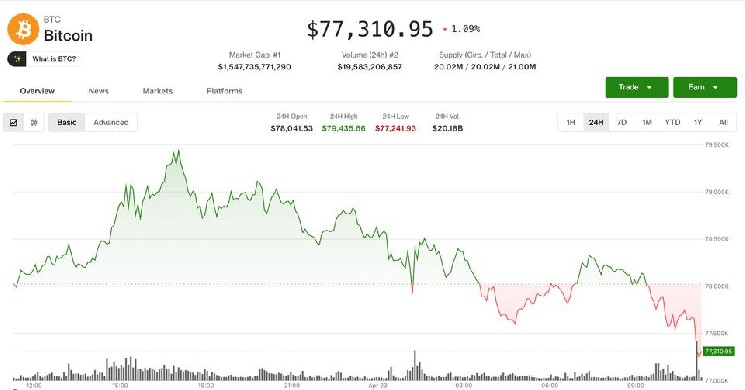
The cryptocurrency market experienced a downturn on Thursday as investors took profits following bitcoin’s recent surge toward a critical price level. Bitcoin, the world’s largest cryptocurrency by market capitalization, slipped 0.7% from its midnight UTC value to settle around $77,600. This decline came on the heels of Wednesday’s momentum, when the digital asset reached its highest point since January before encountering strong resistance just below the psychologically significant $80,000 mark. The pullback wasn’t entirely unexpected, as seasoned traders had been watching this price level closely, knowing it could trigger profit-taking among investors who had ridden the recent wave upward. Despite the overnight losses, the broader sentiment around bitcoin remains constructive, with many analysts viewing this as a healthy consolidation after the asset successfully broke out of a two-month trading range that had kept prices confined between $63,000 and $75,000 since early February. This breakout represents a significant technical achievement for the cryptocurrency, suggesting that the market may have established a new higher trading range going forward.
Geopolitical Tensions Impact Risk Assets Across the Board
The cryptocurrency market’s Thursday decline didn’t occur in isolation—it was part of a broader risk-off movement across global markets triggered by escalating geopolitical tensions. Oil prices surged by 1.5% overnight, reaching $103 per barrel following reports that the United States had seized three Iranian tankers in Asian waters. This development raised immediate concerns about potential supply disruptions and retaliatory actions that could further destabilize energy markets. The oil price spike had a ripple effect across financial markets, prompting investors to reduce their exposure to riskier assets, including cryptocurrencies and stocks. U.S. stock futures reflected this cautious sentiment, with both S&P 500 and Nasdaq 500 futures declining 0.5% overnight. The situation highlighted how interconnected global markets have become, with developments in one sector or region quickly influencing asset prices worldwide. For cryptocurrency investors, this served as a reminder that digital assets haven’t yet achieved true independence from traditional market forces and continue to be affected by macroeconomic and geopolitical events, despite the industry’s aspirations toward creating an alternative financial system.
Ethereum and Altcoins Face Steeper Losses
While bitcoin’s decline was relatively modest, other cryptocurrencies experienced more significant pressure. Ethereum, the second-largest cryptocurrency and the backbone of the decentralized finance ecosystem, fell 2.5% to trade at $2,320 after having tested the $2,500 level over the weekend. This sharper decline in ethereum compared to bitcoin reflected a pattern that often emerges during market uncertainty: investors tend to flee toward the relative safety of bitcoin, viewing it as the most established and liquid cryptocurrency. The broader altcoin market echoed ethereum’s weakness, with CoinDesk’s DeFi Select Index (DFX) emerging as the worst-performing benchmark on Thursday, having shed 2.7% since midnight UTC. The bitcoin-dominant CoinDesk 20 (CD20) index performed somewhat better but still declined by 1.1%. CoinMarketCap’s “Altcoin Season” index—which measures whether altcoins are outperforming bitcoin—dropped to 32 out of 100 on Thursday, marking its lowest level in 10 days. This reading suggested that investors were showing a clear preference for bitcoin following Wednesday’s attempt to break through $80,000, with capital flowing out of alternative cryptocurrencies and back into the market leader.
Derivatives Market Reveals Complex Trading Dynamics
The derivatives market painted a fascinating and somewhat contradictory picture of trader sentiment. Bitcoin’s futures open interest (OI)—which measures the total number of outstanding futures contracts—slipped to 775,000 BTC from a record near 800,000 BTC on Wednesday, though it remained at historically elevated levels. What made the situation particularly interesting was the combination of high open interest with negative perpetual funding rates, which indicated that leveraged traders were actually betting against bitcoin even as the price climbed. This unusual combination led some analysts to characterize bitcoin’s current advance as a “most hated” rally, suggesting that many traders remained skeptical about the sustainability of the upward movement. This dynamic could potentially fuel further price increases if bearish traders are forced to close their short positions—a phenomenon known as a short squeeze. Meanwhile, the cumulative volume delta (CVD) signaled caution across the market, showing that more trades had been initiated by sellers than buyers over the past 24 hours for most major altcoins, including XRP, SOL, and ETH. Bitcoin, along with a handful of other assets, were the exceptions with positive CVD readings, reinforcing the observation that the broader market wasn’t yet fully participating in bitcoin’s rally. Perhaps most surprisingly, bitcoin and ethereum’s 30-day implied volatility indices remained flat around recently hit 2.5-month lows, suggesting calm prevailed in options markets despite ongoing geopolitical uncertainties.
Standout Performers and Sector-Specific Movements
Despite the generally downbeat market conditions, certain tokens managed to buck the trend and deliver impressive gains. The most notable outlier was Spark (SPK), which skyrocketed more than 70% after being listed on Upbit, South Korea’s largest cryptocurrency exchange. This dramatic price action illustrated the significant impact that major exchange listings can have on smaller tokens, as they gain access to a much larger pool of potential buyers and increased liquidity. Privacy-focused cryptocurrency Monero (XMR) also distinguished itself by rising 3.3% since midnight, significantly outperforming its privacy coin peers DASH and ZEC, both of which finished in negative territory. This outperformance may have reflected renewed interest in privacy-preserving technologies amid increasing regulatory scrutiny of the cryptocurrency sector. On the other end of the spectrum, DeFi tokens experienced particularly harsh selling pressure, with Morpho and Aave leading the sector’s decline with losses of 4.6% and 2.8%, respectively. This weakness appeared to be a continuation of negative sentiment that had plagued the DeFi industry following the weekend’s devastating $290 million KelpDAO exploit—a reminder of the security vulnerabilities that continue to challenge decentralized finance platforms and erode investor confidence in the sector.
Market Outlook and What Comes Next
Looking ahead, the cryptocurrency market finds itself at an interesting crossroads. Bitcoin’s successful breakout from its two-month trading range represents a significant technical achievement that could set the stage for further gains if the momentum can be sustained. However, several factors create uncertainty about the near-term direction. The elevated futures open interest combined with negative funding rates creates a powder keg scenario where rapid price movements in either direction could trigger cascading liquidations. The ongoing geopolitical tensions, particularly involving U.S.-Iran relations and their impact on oil markets, add another layer of complexity, as further escalation could drive investors away from risk assets including cryptocurrencies. The fact that ethereum and altcoins are lagging bitcoin’s performance suggests the market recovery remains tentative and hasn’t yet developed the broad-based participation that typically characterizes sustained bull markets. For individual investors, this environment calls for careful risk management and recognition that while bitcoin has demonstrated relative strength, the broader crypto ecosystem remains vulnerable to both external shocks and internal challenges, as evidenced by the ongoing fallout from the KelpDAO exploit. Whether bitcoin can successfully test and eventually breach the $80,000 resistance level will likely depend on a combination of technical factors, broader market sentiment, and the evolution of macroeconomic conditions in the weeks ahead.