



Bitcoin’s Precarious Position: Understanding the Hidden Risks Behind the Calm
Geopolitical Tensions Continue to Shake Cryptocurrency Markets
The cryptocurrency market finds itself navigating through turbulent waters as geopolitical tensions between the United States and Iran continue to cast a long shadow over investor sentiment. The uncertainty surrounding potential military conflict or diplomatic resolution has created an environment where markets swing dramatically on every piece of news coming from Washington or Tehran. Yesterday provided a perfect example of this volatility when Bitcoin experienced a remarkable surge, briefly climbing above the psychologically significant $70,000 threshold. This impressive rally was triggered by comments from US President Donald Trump suggesting that a ceasefire might be on the horizon, offering hope that the escalating tensions could be resolved through diplomatic channels rather than military action.
However, the euphoria proved to be remarkably short-lived, as is often the case in markets driven by geopolitical speculation rather than fundamental strength. The cryptocurrency quickly retreated from its highs, reminding traders and investors that in times of international crisis, even positive-sounding news may not provide a solid foundation for sustained price appreciation. The rapid reversal highlighted how fragile market confidence remains when the specter of potential conflict looms large. Investors are essentially trading on headlines and rumors, creating an environment where fortunes can be made or lost within hours based on little more than a carefully worded statement or an ambiguous tweet from political leaders.
The Surface Calm Hiding Deeper Market Concerns
While casual observers might look at Bitcoin’s recent price action and see relative stability, analysts at Bitfinex have issued a stark warning that this apparent calm may be deceiving. According to their latest research, the spot market for Bitcoin—where the actual cryptocurrency changes hands—has indeed shown relatively subdued movement, trading within a range that might suggest the market has found some equilibrium. However, this surface-level tranquility masks what these experts describe as mounting pressure in the derivatives markets, where traders use complex financial instruments to bet on or hedge against future price movements.
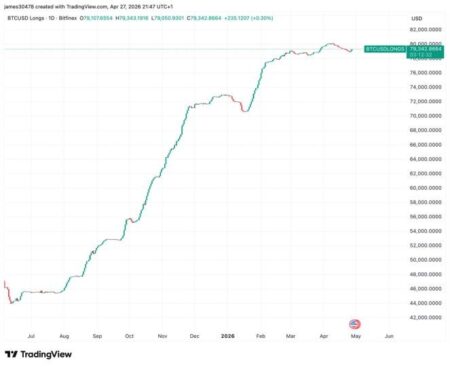
The derivatives market analysis reveals that Bitcoin has been confined to a trading range between approximately $64,000 and $74,000, which on the surface appears to be a reasonable consolidation after previous volatile movements. But beneath this seemingly stable pattern, the Bitfinex team has identified accumulating downside risks that could materialize suddenly and dramatically. The current market structure suggests that while things appear calm, the conditions are actually primed for potentially sharp downward movements should key support levels fail to hold. This disconnect between what appears to be happening on the surface and what the underlying market mechanics suggest is a recipe for surprise moves that catch unprepared traders off guard.
Understanding the Negative Gamma Environment and Its Implications
The technical concept that has Bitfinex analysts particularly concerned is what they describe as a “negative gamma environment” that has developed below the $68,000 price level. For those unfamiliar with options trading terminology, this requires some explanation. Gamma measures how quickly the delta of an option changes—essentially, it’s the rate of change of an option’s sensitivity to price movements in the underlying asset. When the market enters a negative gamma environment, it means that market makers—the institutions that provide liquidity by taking the other side of trades—find themselves in a position where they need to sell more of the underlying asset as prices fall, creating a self-reinforcing downward spiral.
This situation develops because market makers who have sold put options (contracts that give buyers the right to sell Bitcoin at a specified price) need to hedge their exposure as prices decline. As Bitcoin’s price drops toward the strike prices of these put options, the market makers’ risk increases, forcing them to sell Bitcoin to offset their potential losses. This hedging activity itself pushes prices down further, which then requires additional hedging sales, creating what traders call a “chain reaction” or “cascade effect.” It’s similar to a snowball rolling downhill, gathering mass and momentum as it descends. In the current market structure, analysts warn that even a relatively modest decline below critical support levels could trigger this mechanism, potentially accelerating Bitcoin’s fall toward the $60,000 level or even lower.
The Mechanics of a Potential Downward Cascade
To fully appreciate the risk that Bitfinex analysts are highlighting, it helps to understand the step-by-step process of how this downward cascade might unfold. The scenario begins with Bitcoin trading near or just below the $68,000 level, where the negative gamma environment becomes particularly pronounced. At this point, many put options that market makers have sold begin to move closer to being “in the money,” meaning they become more likely to be exercised by their holders. As this probability increases, the market makers’ risk exposure grows proportionally, requiring them to increase their hedging positions.
The hedging process involves selling Bitcoin—either the actual cryptocurrency or futures contracts—to offset the growing risk. This selling pressure adds to whatever organic selling might already be occurring due to bearish sentiment, geopolitical concerns, or simple profit-taking. As more selling enters the market, prices decline further, pushing additional put options closer to their strike prices. This creates a feedback loop where hedging sales beget price declines, which beget more hedging sales, and so on. What makes this particularly dangerous is that the process can accelerate quickly once it begins. A market that appears stable one moment can transform into a rapidly declining one within hours or even minutes. The analysts’ warning specifically mentions that “even a slight drop could turn into a steeper downward movement,” emphasizing how the current market structure amplifies downward pressure rather than absorbing it.
Temporary Equilibrium Rather Than Genuine Stability
Perhaps the most important takeaway from the Bitfinex analysis is the distinction they draw between temporary equilibrium and genuine market stability. On the surface, Bitcoin’s recent price action might suggest that the market has found a comfortable range where buyers and sellers are relatively balanced, creating what appears to be a stable environment for accumulation or consolidation before the next significant move. However, the analysts argue that this interpretation misses the crucial point about the underlying market structure and the forces that are currently in balance.
What we’re seeing, according to their assessment, is not the kind of robust equilibrium that could support a sustained upward movement. Instead, it’s a precarious balance where the apparent calm is maintained only because opposing forces haven’t yet been disturbed. The situation is somewhat analogous to a boulder balanced on the edge of a cliff—it may appear stable and stationary, but the introduction of even a small force could send it tumbling down. In Bitcoin’s case, that small force could come from various sources: a deterioration in US-Iran relations that causes risk assets to sell off broadly, unexpectedly hawkish comments from Federal Reserve officials about monetary policy, negative regulatory news affecting the cryptocurrency industry, or simply enough profit-taking from recent buyers to push the price below critical technical support levels.
The key insight here is that the current price stability doesn’t reflect underlying strength or conviction from buyers, but rather a temporary standoff where neither bulls nor bears have gained the upper hand. This type of equilibrium is inherently unstable and prone to breaking in whichever direction receives the next significant catalyst. Given the structure of the derivatives market that the analysts have identified, the path of least resistance appears to be downward, with the potential for accelerated declines if and when that direction is chosen.
Preparing for Increased Volatility Ahead
Looking forward, the Bitfinex team concludes that downward volatility is more likely to increase than decrease given the current market structure. This assessment should serve as a cautionary note for investors and traders who might be lulled into complacency by the recent relative stability in spot prices. The derivatives market structure suggests that the risk-reward profile is currently skewed toward the downside, meaning that potential losses from a breakdown are larger and more probable than equivalent gains from a breakout to the upside.
For market participants, this analysis suggests several possible approaches to risk management. Conservative investors might consider reducing exposure or taking some profits off the table while prices remain relatively elevated. More active traders might look to implement hedging strategies using put options or other protective instruments, though they should be aware that the negative gamma environment means such protection may become more expensive if the decline begins. Those with longer time horizons and strong conviction in Bitcoin’s fundamental value proposition might view a potential dip toward $60,000 as a buying opportunity, though they should be prepared for the psychological challenge of buying into a falling market.
It bears emphasizing, as noted in the original analysis, that these observations do not constitute investment advice. Every investor’s situation, risk tolerance, and time horizon are different, and what makes sense for one person may be entirely inappropriate for another. However, understanding the market structure and the potential risks that lie beneath calm surface conditions is valuable information for anyone involved in cryptocurrency markets. As the situation between the US and Iran continues to develop and Trump’s negotiation deadline approaches, remaining vigilant and prepared for increased volatility seems prudent regardless of one’s specific market position.