


The Future of Warfare: Inside the U.S. Military’s Drone-on-Drone Combat Training
A New Era of Combat at Fort Bragg
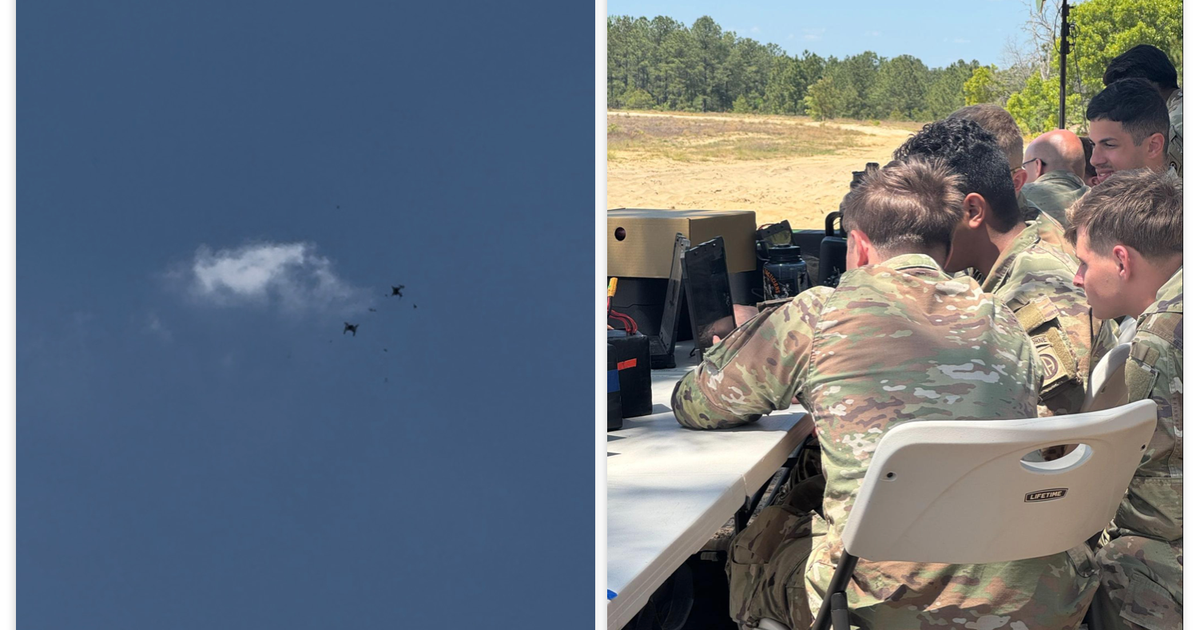
At Fort Bragg in Fayetteville, North Carolina, a revolutionary form of warfare training is taking place that would have seemed like science fiction just a few years ago. Soldiers from the elite 82nd Airborne Division are learning to fight drones with drones, guiding small flying machines called Bumblebees through their laptops in a carefully choreographed aerial ballet of destruction. The scene is both futuristic and slightly surreal: three small drones buzzing overhead while young soldiers, seated at computer screens, deliberately pilot two of them to crash into the third. This isn’t a video game or a Hollywood production—it’s the cutting edge of modern military training, born directly from lessons learned on the battlefields of Ukraine, where drone warfare has transformed how conflicts are fought. The Pentagon has recognized that the nature of warfare is changing rapidly, and American forces need to adapt just as quickly to counter the growing threat of hostile drones that can range from intelligence-gathering platforms to flying bombs.
Learning from Ukraine’s Battlefield Innovations
The training program represents a direct response to what military observers have witnessed in Ukraine, where drone-on-drone combat has become a daily reality for months. The soldiers are being trained on two versions of the Bumblebee system: the V1 model, which has already logged thousands of combat flights in Ukraine and is currently deployed with units from both the 82nd Airborne and 10th Mountain Divisions, and the newer V2 model, which features advanced automatic target recognition capabilities specifically designed for countering other drones. According to Sergeant Major Kellen Rowley, the senior enlisted adviser for the Pentagon’s interagency counter-drone task force, most of the current training focuses on the V1 model since it’s already proven itself in real-world combat situations. The training isn’t limited to Fort Bragg either—similar programs are being rolled out at multiple domestic military bases and at a U.S. Central Command training center in the Middle East, ensuring that as more service members deploy to various hotspots around the world, they’ll have the skills needed to counter the drone threat. Rowley emphasizes that while soldiers won’t master these systems in five minutes, dedicated training time of around 40 hours can transform them into effective operators capable of engaging in drone-on-drone combat.
The Economics of Modern Warfare
One of the driving forces behind this training program is simple economics. The U.S. military has traditionally relied on expensive interceptor missiles and sophisticated anti-aircraft systems that were primarily designed to shoot down incoming missiles and aircraft—weapons systems that can cost hundreds of thousands or even millions of dollars per shot. When you’re using a million-dollar missile to shoot down a drone that might cost only a few thousand dollars, the math doesn’t work in your favor, especially when facing adversaries who can deploy swarms of cheap drones. Lieutenant Colonel Alex Morse, who manages acquisitions for the counter-drone task force, explained the problem clearly: there’s a significant cost curve challenge when comparing offensive drones to the defensive systems used to counter them. The Bumblebee drones represent a dramatic shift in this equation. Small enough for a single soldier to hold in their hands, these devices consist of four legs with propellers, a camera in the middle, and a battery—simple components that keep costs down. While Morse held a prototype of the Bumblebee V2, he noted that the system costs far less than traditional defensive capabilities, and the Pentagon is working to drive costs down even further into the single-digit thousands of dollars range.
Technology and Tactics Working Together
The two versions of the Bumblebee drone showcase how rapidly military technology is evolving. The V1 requires pilots to manually adjust speed and altitude to lock onto targets, demanding precise hand-eye coordination and spatial awareness. The V2, by contrast, incorporates autonomous targeting software that can close in on pilot-approved targets automatically, featuring additional camera sensors and a gimbaled camera that can move up and down rather than remaining fixed in one position. Both systems are designed to counter drones smaller than the Iranian-produced Shahed drones, which weigh approximately 400 pounds and have been used by both Iran and Russia in recent conflicts. The Bumblebees are produced by Perennial Autonomy, a U.S. defense firm backed by former Google CEO Eric Schmidt, which had experts on-site at Fort Bragg to collect feedback directly from the soldiers using the systems. This collaborative approach between military users and developers is intentional—Colonel Tom Monaghan, director of the Army’s Joint Innovation Outpost, explained to reporters that the military doesn’t want to produce 10,000 units of something that doesn’t actually work in the field, so this iterative feedback process is crucial to developing effective systems.
Real Training for Real Threats
The demonstrations witnessed by reporters at Fort Bragg provided a glimpse into how these systems work in practice. In each scenario, three Bumblebee V1 drones were deployed: two working as a coordinated team against a third drone designated as the enemy. The enemy drone would hover in place, simulating an intelligence-gathering mission, while the two friendly drones took turns accelerating and ramming into it to bring it down. While each drone can be flown by a single pilot, the training emphasized teamwork, with two or three soldiers grouped around each laptop and another soldier walking behind them to coordinate between the teams. The soldiers worked together to calculate direction, altitude, and speed before executing their attack runs. The results were mixed, as would be expected in initial training—some attempts saw drones racing past their targets entirely, while twice the drones collided with the enemy drone but failed to completely disable it. When successful hits occurred, soldiers would walk over to retrieve both the attacking and targeted drones, adding them to a growing pile of damaged Bumblebees from earlier training sessions. Ted Chavis, senior adviser to the task force director, emphasized that what reporters witnessed was just “Day One” for these soldiers, who were already performing remarkably well while learning crew drills, marksmanship, drone assembly, mission planning, and coordination all at once.
Investment in Tomorrow’s Battlefield
The Pentagon is backing this initiative with substantial financial resources, recognizing that drone and counter-drone technology will define future conflicts. The budget request for this year includes nearly $75 billion dedicated to drones, representing what Pentagon comptroller Jules Hurst described as “the largest investment in drone warfare and counter-drone technology in U.S. history.” This massive commitment reflects the military’s understanding that the threats posed by hostile drones—whether from state actors like Iran or non-state groups—aren’t going away and will likely only intensify. The soldiers receiving this training will continue developing their skills over the coming weeks and months, with progressively more challenging scenarios including environmental factors like electronic jamming that could interfere with drone operations. The training will evolve from basic marksmanship against stationary targets to more complex scenarios involving moving targets and contested electromagnetic environments. As these soldiers become proficient, they’ll form the core of a new generation of military personnel who understand intuitively what previous generations never had to consider: that the battlefield of the future includes not just ground forces and aircraft, but swarms of small, agile drones that can serve as eyes in the sky, weapons platforms, or both—and that countering these threats requires developing entirely new skills, tactics, and technologies that blend the precision of a video game player with the strategic thinking of a traditional soldier.