
Explosive Device Outside NYC Mayor’s Residence: A Dangerous Protest Turns Violent
A Deadly Device Discovered at Gracie Mansion
What started as a heated political protest outside New York City’s Gracie Mansion on Saturday afternoon could have turned into a devastating tragedy. Law enforcement sources have confirmed that the explosive device detonated near the mayor’s official residence contained genuine explosive materials, nuts, bolts, and other fragmentation designed to cause maximum harm. According to investigators, this wasn’t a harmless smoke bomb or theatrical prop—it was a legitimate improvised explosive device (IED) with the potential to kill or seriously injure multiple people. The incident has launched a federal terrorism investigation, with charges now pending against the individuals involved.
The chaotic scene unfolded when two young men from Pennsylvania, identified as 18-year-old Emir Balat and 19-year-old Ibrahim Kayumi, arrived at what was already a tense gathering outside the residence of Mayor Zohran Mamdani. The demonstration had been organized by associates of Jake Lang, a far-right influencer and pardoned January 6th rioter, as an anti-Islam protest. Counter-protesters, numbering more than 100, showed up to oppose Lang’s message. Angered by the anti-Muslim demonstration, Balat and Kayumi brought homemade bombs to the scene with the apparent intention of causing harm. NYPD Commissioner Jessica Tisch confirmed these details at a press conference, describing the gravity of what could have been a mass casualty event in one of America’s largest cities.
The Sophisticated Construction of a Homemade Weapon
The devices themselves were alarmingly sophisticated for homemade explosives. According to law enforcement sources who spoke with CBS News, the bombs consisted of sports drink bottles that were filled or partially filled with explosive material. These bottles were then placed inside glass jars and surrounded by nuts and bolts—fragmentation specifically chosen to act as shrapnel that would spread outward upon detonation, causing injuries across a wider area. The fuse was connected to what investigators described as an M80-type firework, a common but powerful explosive component. Commissioner Tisch emphasized in her statement on Sunday that after the NYPD’s Bomb Squad sent the devices to the FBI’s specialized laboratory in Quantico for detailed analysis, experts determined this was absolutely “an improvised explosive device that could have caused serious injury or death,” not a hoax or theatrical prop as some might initially assume.
Even more concerning, two sources confirmed to CBS News that the IEDs contained TATP, which stands for triacetone triperoxide. This volatile explosive material has earned a notorious reputation in terrorism circles because it can be synthesized from relatively common household chemicals—acetone and hydrogen peroxide. TATP appears as a white crystalline powder and is particularly unstable and dangerous. It has been used in numerous terrorist attacks worldwide, which is why its presence in these devices immediately elevated the investigation to the terrorism level. The discovery of TATP wasn’t the only alarming development—on Sunday, another suspicious device was found in a vehicle parked on East End Avenue, about three blocks south of Gracie Mansion. This discovery prompted limited evacuations of nearby buildings while the NYPD Bomb Squad carefully assessed and removed the device, further demonstrating the ongoing threat and the comprehensive nature of the investigation.
How Events Unfolded During the Protest
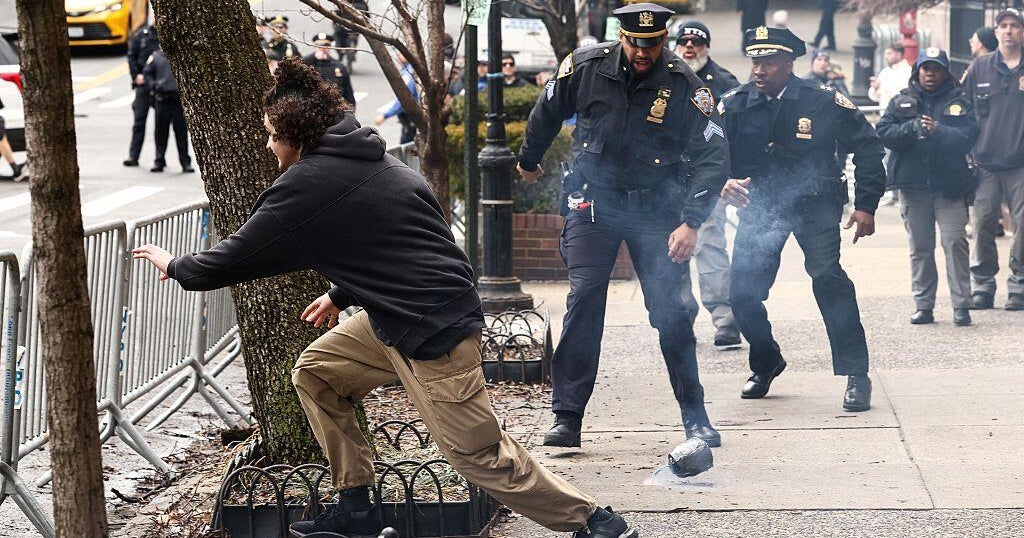
Videos from the scene, which were verified by the CBS News Confirmed team, captured the terrifying moments when the situation turned violent. The footage shows a man apparently shouting “Allahu Akbar”—an Arabic phrase meaning “God is Most Great”—just as Balat allegedly threw the first ignited device. According to Commissioner Tisch’s account of events, this first device struck a barrier in a crosswalk and fortunately extinguished itself. The device landed only a few feet from police officers who were on scene to monitor the dueling protests. Had it detonated as intended, those officers and nearby protesters would have been in immediate danger. After throwing the first device, Balat ran from the scene but didn’t flee entirely. Instead, he allegedly retrieved a second explosive device from his companion, Kayumi, lit its fuse, and began running with it before ultimately dropping it on the ground.
Both Balat and Kayumi were quickly taken into custody by police who were already present at the protest. The swift response by law enforcement likely prevented further attempts to detonate explosive devices in the crowded area. In addition to the two men charged with bringing the IEDs, police arrested three other individuals on various charges. Among them was 21-year-old Ian McGuiness, who allegedly used pepper spray on counter-protesters during the chaos. Three others were arrested on disorderly conduct and obstruction charges. The FBI’s Joint Terrorism Task Force has now taken the lead on the investigation, treating this as a terrorism case rather than simply a criminal assault or weapons violation. This distinction is significant because it brings federal resources and terrorism-specific investigative tools to bear on the case. Search warrants were expected to be executed in both Pennsylvania and New Jersey as investigators work to understand the full scope of the plot, whether others were involved, and where the materials for the bombs were obtained.
International Travel and Possible Extremist Connections
One of the most concerning aspects of the investigation involves the international travel patterns of both suspects. Investigators have discovered that Balat left the United States for several months in 2025, traveling to Istanbul, Turkey, where he stayed from May 6th through August 26th. Meanwhile, Kayumi also has a travel history to the region—he visited Istanbul for several weeks during July and August of 2024, and separately traveled to Saudi Arabia in late March of that same year. While travel to these countries is not inherently suspicious, law enforcement sources told CBS News that investigators are specifically looking into whether at least one of the suspects may have been influenced or inspired by ISIS extremist messaging. This is a crucial element of the investigation because it could indicate whether the attack was a spontaneous act by angry individuals or part of a more coordinated effort connected to international terrorist organizations.
The presence of TATP in the devices adds weight to concerns about possible ISIS connections, as this particular explosive has been favored by ISIS-affiliated attackers in Europe and elsewhere. The sophistication of the devices—with their carefully constructed fragmentation components and proper fusing—suggests that someone involved had either researched bomb-making extensively or received some form of instruction. Investigators will be examining the suspects’ electronic devices, online activities, and any contacts they may have made during their overseas travel. They’ll also be looking at whether the suspects were in communication with any known extremist individuals or organizations, and whether their radicalization happened gradually over time or was more recent. The FBI’s resources in tracking international terrorism connections will be essential in answering these questions and determining whether this was an isolated incident or part of a broader threat.
Political Context and Community Response
The protest that served as the backdrop for this attack was itself controversial and rooted in divisive politics. Jake Lang, the far-right influencer who organized the anti-Islam demonstration, is a pardoned January 6th Capitol rioter who has continued his provocative activism. His protest outside Gracie Mansion was specifically designed to be inflammatory, and it succeeded in drawing a large counter-protest of more than 100 people who opposed his anti-Muslim message. This clash of opposing groups created exactly the kind of tense, emotionally charged environment where violence becomes more likely. In a statement released on Sunday, Mayor Zohran Mamdani directly called out Lang by name and condemned the original protest as “rooted in bigotry and racism,” stating firmly that such demonstrations have no place in New York City. “It is an affront to our city’s values and the unity that defines who we are,” the mayor said, emphasizing the multicultural character that New York prides itself on.
However, Mayor Mamdani was careful to distinguish between the offensive but legally protected speech of the anti-Islam protesters and the criminal violence allegedly perpetrated by Balat and Kayumi. While he didn’t name the two arrested suspects in his statement, he made clear that their actions crossed a line that goes far beyond protected protest. “The attempt to use an explosive device and hurt others is not only criminal, it is reprehensible and the antithesis of who we are,” Mamdani stated. This incident highlights the increasingly dangerous intersection of online extremism, political polarization, and real-world violence that law enforcement agencies across the country are grappling with. Whether motivated by opposition to right-wing anti-Muslim rhetoric or by genuine extremist ideology connected to ISIS, the decision to bring deadly explosive devices to a public protest represents an escalation that authorities are taking extremely seriously. As the investigation continues and terrorism charges move forward, this case will likely serve as an important example of how quickly heated political disagreements can turn deadly when individuals decide that violence is an acceptable response to speech they find offensive.