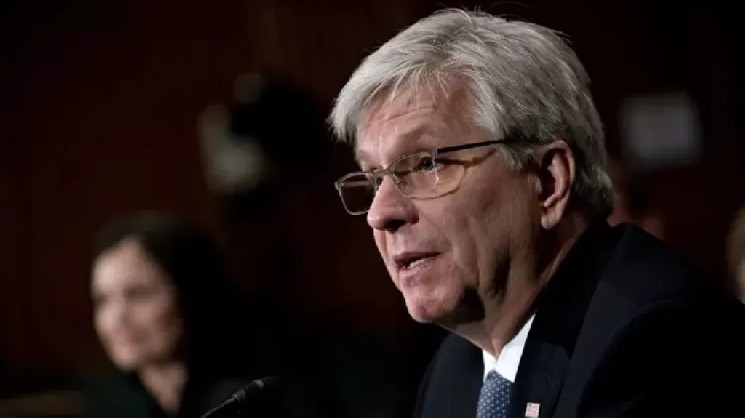

Federal Reserve’s Christopher Waller Shifts Stance on Interest Rates Amid Global Uncertainty
Initial Reaction to Weak Jobs Report
In a candid and revealing interview with CNBC, Federal Reserve Board member Christopher Waller provided rare insight into the inner workings of central bank decision-making and how quickly policy considerations can shift in response to both domestic economic data and international developments. Waller’s comments centered around his evolving position on interest rate policy, particularly in the wake of February’s disappointing employment figures that showed the U.S. economy shedding 92,000 jobs. This significant job loss initially prompted Waller to seriously consider breaking ranks with his Federal Reserve colleagues by voting for an interest rate cut rather than maintaining the status quo. His willingness to share this internal deliberation offers the public a valuable window into how Fed officials wrestle with competing economic signals and the complex decisions they face in steering the world’s largest economy.
Waller’s initial instinct to push for lower interest rates following the weak employment data reflects the Federal Reserve’s dual mandate of promoting maximum employment while maintaining price stability. When job losses mount, the typical response from central bankers is to consider easing monetary policy to stimulate economic activity and support the labor market. The February employment report, showing nearly 100,000 jobs lost, represented the kind of concerning trend that would naturally trigger discussions about providing economic support through lower borrowing costs. For Waller, a Fed governor known for his data-driven approach to monetary policy, the employment numbers were sufficiently troubling to warrant serious consideration of a dissenting vote—a relatively rare occurrence in Federal Reserve decision-making that would have signaled deep concern about the economic outlook.
Geopolitical Tensions Change the Equation
However, as Waller explained, the economic landscape can shift dramatically in a short period of time, and what seems like the appropriate policy response one day can become questionable the next as new information emerges. In this case, escalating geopolitical tensions, particularly in the strategically vital Middle East region, fundamentally altered Waller’s assessment of the appropriate monetary policy stance. The situation he highlighted specifically involved rising conflicts related to Iran and the potential closure of the Strait of Hormuz, one of the world’s most critical energy chokepoints through which a substantial portion of global oil supplies pass. When tensions in this region flare up, the immediate and often dramatic impact on energy markets reverberates throughout the global economy, creating new challenges for central bankers trying to manage inflation expectations.
The Strait of Hormuz situation represents exactly the kind of external shock that can complicate monetary policy decisions. While weak employment data might argue for lower interest rates to support job growth, disruptions to energy supplies that drive up oil prices create inflationary pressures that work in the opposite direction. Higher energy costs don’t just affect what consumers pay at the gas pump; they ripple through the entire economy, increasing transportation costs, raising production expenses for manufacturers, and ultimately pushing up prices across a wide range of goods and services. For a Federal Reserve official like Waller, who must balance concerns about employment against the need to keep inflation under control, the geopolitical developments created a significantly more complicated picture than the one painted by the jobs data alone.
The Inflation Risk Reassessment
Waller’s emphasis on the inflation risks stemming from higher energy prices reflects a hard-earned lesson from recent economic history. The inflation surge that began in 2021 and persisted through much of 2023 reminded policymakers and the public alike that price stability, once lost, can be extraordinarily difficult and painful to restore. The Federal Reserve spent much of 2022 and 2023 aggressively raising interest rates to combat inflation that reached levels not seen in four decades, and officials remain wary of any developments that might reignite pricing pressures just as inflation has begun to moderate. In Waller’s assessment, the potential for sustained high oil prices resulting from Middle East tensions represented precisely this kind of threat—a development that could undo progress on inflation and potentially require an even more restrictive monetary policy stance than currently in place.
The Fed official’s observation that high oil prices could persist for an extended period is particularly significant. Short-term spikes in energy costs, while disruptive, typically wash through the economy relatively quickly without creating lasting inflationary pressures. However, sustained elevated energy prices are a different matter entirely. When businesses and consumers face high energy costs month after month, these expenses become embedded in wage negotiations, pricing decisions, and inflation expectations. This creates what economists call “second-round effects,” where an initial price shock gets amplified and prolonged as it works its way through the economic system. Waller’s concern about this possibility explains why geopolitical developments that might seem distant from everyday American economic life can nonetheless play a crucial role in Federal Reserve interest rate decisions.
Current Policy Stance and Future Possibilities
Despite his concerns about inflation risks, Waller was careful to clarify that he does not support raising interest rates from their current levels. This position reflects his assessment that monetary policy is already operating in restrictive territory—meaning that interest rates are high enough to restrain economic activity and keep inflation pressures in check. The Federal Reserve has maintained its policy rate at elevated levels for an extended period as part of its effort to ensure that inflation returns sustainably to the central bank’s 2% target. Waller’s comments suggest that he believes this restrictive stance is appropriate for the current environment but that tightening policy further by raising rates would be unnecessary and potentially counterproductive given the mixed signals coming from the economy.
This nuanced position—rejecting both rate cuts in the immediate term due to inflation concerns and rate increases due to already-restrictive policy—illustrates the careful balancing act that Federal Reserve officials must perform. They need to be restrictive enough to keep inflation under control but not so tight that they unnecessarily damage the labor market and push the economy into recession. Waller’s willingness to consider a rate cut in response to weak jobs data, followed by his pivot based on inflation concerns, then his clarification that he doesn’t support rate hikes, all demonstrate this constant recalibration based on evolving economic conditions. It’s a reminder that monetary policy is not a mechanical exercise but rather requires judgment, flexibility, and the ability to weigh competing considerations in real-time as new information becomes available.
Looking Ahead to Potential Rate Cuts in 2026
Perhaps most interesting in Waller’s comments was his forward-looking assessment that interest rate cuts could come back into consideration later in 2026 under certain conditions. Specifically, he indicated that if inflation resumes its downward trajectory and the labor market shows signs of significant weakening, the Federal Reserve might find itself in a position to provide monetary policy support through lower interest rates. This conditional guidance offers important insight into the Fed’s framework for thinking about future policy adjustments. It suggests that officials are not wedded to any particular policy path but rather remain prepared to respond to how the economy actually evolves, with both inflation trends and labor market conditions serving as key guideposts for decision-making.
The timeline Waller mentioned—later in 2026—also provides a sense of the patience that Federal Reserve officials believe is appropriate given current circumstances. Rather than making quick pivots in response to individual data points, the Fed appears committed to a more measured approach that allows time to assess whether economic trends are truly shifting or merely experiencing temporary fluctuations. This patient stance reflects lessons learned from earlier periods when premature policy changes created problems—including the Fed’s initial characterization of post-pandemic inflation as “transitory,” which in retrospect led to delayed policy tightening. By maintaining a restrictive policy stance while remaining open to future adjustments based on actual economic developments, Waller and his colleagues are attempting to navigate a path that brings inflation down without causing unnecessary economic damage, while remaining ready to act if conditions deteriorate significantly.