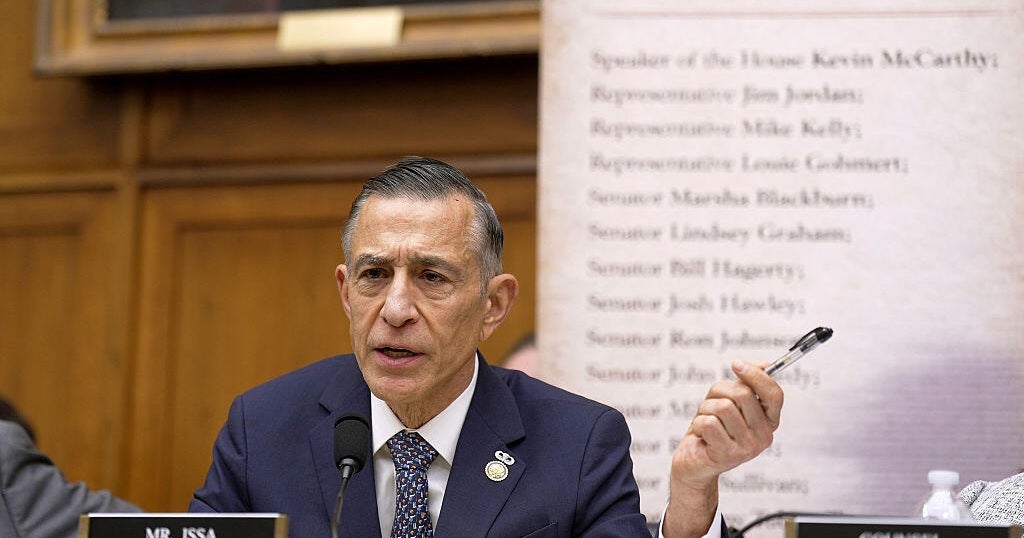

California Congressman Darrell Issa’s Surprise Retirement Shakes Up Political Landscape
A Sudden Change of Heart
In a stunning reversal that caught political observers off guard, California Republican Representative Darrell Issa announced his retirement from Congress in January 2026, just three months after publicly declaring his commitment to stay and fight for his seat. “I’m not quitting on California,” he had boldly stated in October 2025, yet by the new year, Issa was singing a different tune entirely. In his retirement announcement, the veteran lawmaker framed his departure more diplomatically, saying it was “the right time for a new chapter and new challenges” and reflecting that “serving in Congress has been the honor of my life.” The about-face came as Issa faced the prospect of a grueling reelection battle in California’s newly redrawn 48th District, which had been significantly altered to favor Democratic candidates. For a politician who had built a reputation as a fighter—particularly during his years leading aggressive investigations into the Obama administration—the decision to step away rather than face a tough campaign marked an unexpected end to this chapter of his political career.
The Man Behind the Headlines
Darrell Issa came to Congress not as a career politician but as a successful businessman who had made his fortune in the car alarm industry, becoming one of the wealthiest members of Congress in the process. His business background shaped his approach to politics, bringing an entrepreneurial mindset to legislative work. However, Issa became most well-known to the American public for his role as chairman of the House Oversight and Government Reform Committee from 2011 to early 2015, a position he used to become one of the most prominent thorns in the side of President Barack Obama’s administration. During those years, Issa led numerous high-profile investigations, including probes into the Benghazi attack and the IRS targeting scandal, often clashing with then-Secretary of State Hillary Clinton and other administration officials. His aggressive oversight style made him a hero to conservative voters who felt the Obama administration needed closer scrutiny, while making him a villain to Democrats who saw his investigations as politically motivated witch hunts. This prominence also made him a higher-profile target when the political winds shifted and his district became less reliably Republican territory.
Redistricting Reshapes the Political Battlefield
The catalyst for Issa’s retirement was the dramatic redrawing of California’s congressional districts, approved by voters in November 2025 under a plan championed by Democratic Governor Gavin Newsom. This wasn’t just a minor adjustment of district lines—it was a wholesale reshaping designed with clear partisan intent. The new map was specifically crafted to flip as many as five Republican-held seats to Democratic control, a bold counter-move to similar efforts being undertaken in Texas at the urging of President Donald Trump, who was pushing to gain five seats for Republicans in the Lone Star State. California’s 48th District, which Issa had represented and which was anchored in San Diego County, was drastically altered under the new map, transforming what had been competitive but winnable territory for a Republican into a district tilted significantly toward Democratic voters. Faced with this new political reality, Issa initially considered an unusual option: leaving California entirely to run for Congress in Texas, where the redistricting was moving in Republicans’ favor. He ultimately decided against that move, choosing instead to stay and fight for his California seat—or so everyone thought at the time.
The Broader Battle Over Congressional Maps
Issa’s retirement announcement highlighted a larger story playing out across America: a fierce, state-by-state battle over congressional redistricting that was reshaping the political landscape ahead of the midterm elections. In states across the country, partisan mapmakers were redrawing district lines to maximize their party’s advantage, a practice known as gerrymandering that has become increasingly sophisticated and aggressive in recent election cycles. By the time of Issa’s announcement, voters in Texas and North Carolina had already cast ballots in primary elections for newly redrawn House districts that were created at Trump’s urging to benefit Republicans. Meanwhile, the situation remained uncertain and chaotic in other states. In Missouri, candidates were filing for office even though the final boundaries of the voting districts they hoped to represent hadn’t been finalized. Virginia faced perhaps the most complex situation, with new congressional district boundaries potentially hinging on both a voter referendum and court rulings. The stakes were enormous: Virginia currently had six Democrats and five Republicans representing the state in the House, but redistricting plans offered by Democratic leaders were designed to shift those lines dramatically, potentially resulting in a 10-1 Democratic advantage in the state’s congressional delegation. Former President Obama even weighed in, posting a video to social media urging Virginia voters to support the redistricting effort, underscoring just how important these redistricting battles had become to national political strategy.
Implications for Republican House Majority
Issa’s decision to retire rather than fight for reelection injected significant uncertainty into the race for California’s 48th District and had potentially serious implications for Republicans’ control of the House of Representatives. When an incumbent retires, their party typically faces a more difficult path to holding the seat, as incumbents enjoy significant advantages including name recognition, fundraising networks, and the ability to point to their record of constituent service. Without Issa on the ballot, Republicans would need to find a new candidate capable of winning in a district that had been specifically redrawn to favor Democrats—a tall order by any measure. The timing couldn’t have been worse for Republicans, who were defending a fragile majority in the House and could ill afford to lose seats, particularly in a state like California where they were already significantly outnumbered. Every seat mattered in the closely divided House, where even a handful of losses could flip control to Democrats and fundamentally alter the legislative landscape. Issa’s retirement meant that Republicans would need to play defense in yet another district that might otherwise have been secure, stretching the party’s resources and attention across more battlegrounds at a time when they needed to be focused on offense.
Looking Ahead: A Seat Up for Grabs
In his retirement statement, Issa attempted to shape the race to replace him by endorsing San Diego County Supervisor James Desmond as his preferred successor. Such endorsements from retiring incumbents can carry significant weight, potentially helping a chosen successor consolidate support among party officials, donors, and voters who trusted the departing representative. However, primary endorsements don’t guarantee victory, and other Republican candidates might well enter the race, leading to a competitive primary that could drain resources and potentially nominate a candidate less well-positioned for the general election. On the Democratic side, the newly favorable district lines were certain to attract strong candidates who saw a genuine opportunity to flip a Republican seat. The race for California’s 48th District would serve as a test case for whether aggressive redistricting could actually deliver the results that partisan mapmakers intended, or whether strong candidates and effective campaigns could overcome even unfavorable maps. More broadly, Issa’s retirement symbolized the larger political realignment taking place across America, where demographic changes, geographic sorting of voters by political ideology, and aggressive partisan redistricting were combining to reshape the congressional map in fundamental ways. The career politician who had once proudly declared he wouldn’t quit on California had ultimately decided that discretion was the better part of valor, choosing to exit the stage rather than risk an ignominious defeat in a transformed district. His departure marked the end of an era and the beginning of a new, uncertain chapter in the ongoing battle for control of Congress.