
The Hawk Tuah Girl Returns: A Deep Dive into the Memecoin Controversy That Won’t Go Away
The Comeback Nobody Expected
Haliey Welch, the internet personality who became an overnight sensation as the “Hawk Tuah” girl, has resurfaced after nearly a year of staying out of the public eye, and her return has been anything but quiet. In a candid interview with Channel 5’s Andrew Callaghan, Welch addressed the elephant in the room – the cryptocurrency scandal that sent her into hiding – but her comments have only added fuel to an already raging fire. Rather than offering the apology or accountability many expected, Welch took a controversial stance, suggesting that memecoin scams have become so commonplace that they should essentially be considered “normalized” by now. “It’s done every single day… like it’s normal at this point,” she stated matter-of-factly, a comment that has sent shockwaves through the cryptocurrency community and reignited debates about accountability, celebrity influence, and the wild west nature of digital currencies. The interview revealed a young woman seemingly unprepared for the consequences of her actions, yet simultaneously unwilling to fully accept responsibility for the financial losses suffered by her followers and fans who trusted her enough to invest in a cryptocurrency bearing her name.
The Rise and Spectacular Fall of $HAWK
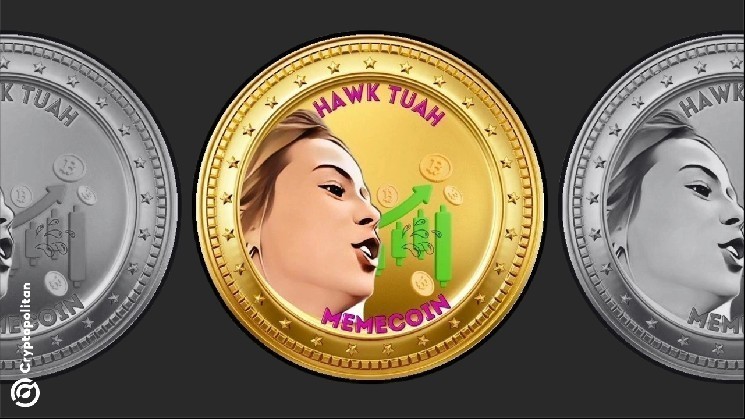
The story of the $HAWK token is a cautionary tale that perfectly encapsulates both the potential and peril of cryptocurrency investments, particularly those tied to internet celebrities. In December 2024, Welch announced the launch of her own cryptocurrency, the Hawk Tuah coin, abbreviated as $HAWK. The launch generated immediate buzz, with the coin’s market value skyrocketing to an eye-watering $500 million almost instantly, driven largely by her social media following and the viral nature of her internet fame. However, what goes up must come down, and in the world of cryptocurrencies, that descent can be breathtakingly fast. Within just 24 hours, the value of $HAWK plummeted from that half-billion-dollar peak to a mere $25 million – a catastrophic loss of 95% that left thousands of investors holding essentially worthless digital tokens. This dramatic collapse immediately triggered accusations that the coin was a classic “pump and dump” scheme, where insiders artificially inflate a cryptocurrency’s value before selling their holdings at the peak, leaving ordinary investors with massive losses. The situation became serious enough that the Securities and Exchange Commission (SEC) launched an investigation into Welch’s role in the failed project, though ultimately no charges were filed. Speaking to TMZ after the investigation concluded, Welch stated, “For the past few months, I’ve been cooperating with all the authorities and attorneys, and finally, that work is complete,” suggesting she viewed the matter as closed even as her investors’ losses remained very real.
Playing the “I Knew Nothing” Card
Throughout the Channel 5 interview, Welch maintained a consistent defense strategy: portraying herself as woefully ignorant about cryptocurrency and therefore not culpable for what happened. When questioned about the FBI investigation into $HAWK, her response painted a picture of complete financial illiteracy: “He asked about a phantom wallet and types of coins, how much this one’s worth, like one cent, this one’s five cents. I don’t know anything about it. I have no clue. I’m dumb as a bag of rocks.” This self-deprecating admission raised more questions than it answered for many observers. If she truly knew nothing about cryptocurrency, why did she attach her name and reputation to a coin launch? Her account of learning about the crash is equally troubling. According to Welch, she only discovered her cryptocurrency had collapsed after finishing podcast recordings: “After we finished all the podcasts, everybody went out of the room and looked concerned, and I’m like, what is going on? I don’t understand what’s happened. They said oh nothing, don’t worry about it. I pull up my TikTok, and the next thing I know, there are all these posts saying I’m going to jail.” Her central defense remains unwavering: “I was not controlling the coin.” This statement suggests she was merely a figurehead or spokesperson for a project managed by others, yet critics argue that lending her name and platform to promote the coin made her equally responsible for its consequences. Welch also opened up about the personal toll the scandal took on her mental health, stating, “This traumatised me, I wouldn’t come out of the house for like months,” a claim that generated little sympathy from those who lost money investing in her coin.
The Crypto Community’s Furious Response
If Welch hoped that breaking her silence would help repair her reputation within the cryptocurrency world, she was sorely mistaken. The reaction on X (formerly Twitter) has been swift, harsh, and unforgiving. Prominent crypto investigator ZachXBT, known for exposing fraudulent schemes, didn’t mince words: “She starts posting about meme coins […] entirety of CT [Crypto Twitter] tells her not to launch a token […] she launches meme coin anyway […] after she blames partners and disappears off social media with followers losing funds […] no one should feel bad for the ‘trauma.'” His summary captured the sentiment of many in the community who had warned against the launch from the beginning. Other users dissected her interview comments with surgical precision. One observer noted, “She’s not wrong about the reality — scams happen daily. But ‘normalized’ is the wrong take,” highlighting the problematic nature of suggesting that widespread fraud should simply be accepted as business as usual. User Metric, identified as a PENGU bull, pointed to what many saw as Welch’s transparent strategy: “Really leaning into the ‘I’m so dumb you couldn’t possibly blame me’ trope.” This comment reflects widespread skepticism about her claimed ignorance, with many viewing it as a calculated legal defense rather than genuine confusion. The question on many people’s minds remains unanswered: how is she not facing criminal charges? The current state of $HAWK tells its own story of failure. According to on-chain data, the token is down 75% over the past year alone, currently trading at just $0.00002975. The coin reached an all-time high of $0.0009016 before plummeting to an all-time low of $0.058921. Today, it trades 96.70% below its peak value, representing near-total losses for anyone who bought in during the initial hype. The trading volume of $6,101.41 in the last 24 hours, while representing a 32.20% increase from the previous day, is minuscule compared to the hundreds of millions in market cap the coin once claimed.
The Bigger Picture: Memecoin Madness and Market Manipulation
The $HAWK disaster is far from an isolated incident; it’s actually representative of a much larger problem plaguing the cryptocurrency space, particularly in the memecoin sector. The statistics are sobering and reveal an ecosystem riddled with fraud and manipulation. According to industry reports, up to 99% of new memecoins listed on platforms such as DexScreener are believed to be “potential scams” or “rug pulls” – a term referring to when developers abandon a project and run away with investors’ funds. The problem appears particularly acute on the Solana network, which has become a preferred platform for these questionable launches due to its low transaction costs and ease of token creation. Analysis of platforms like Pump.fun, which facilitates easy memecoin creation, reveals that approximately 98-99% of tokens listed exhibit behavior consistent with fraudulent schemes, including supply control by insiders, wash trading (where the same parties buy and sell to create false volume), and liquidity draining (removing funds that allow people to sell their holdings). Despite these alarming fraud rates, the memecoin market remains substantial, with a current market capitalization of $33.2 billion, though this represents a 0.3% decrease over the last 24 hours. Even more concerning, estimates suggest that crypto scams overall have attracted inflows of $14-17 billion in 2025 alone. These figures demonstrate that despite countless warnings, exposés, and high-profile failures like $HAWK, people continue to invest in highly risky and often fraudulent cryptocurrency projects, driven by a combination of FOMO (fear of missing out), the allure of quick riches, and the persuasive power of celebrity endorsements.
Lessons Learned and the Path Forward
The Hawk Tuah memecoin saga offers important lessons for investors, influencers, and regulators alike. For potential investors, the most critical takeaway is simple: celebrity endorsement does not equal legitimacy or safety. When an internet personality with no financial expertise or cryptocurrency background launches a coin, extreme skepticism is warranted. The fact that Welch herself admits to knowing nothing about cryptocurrency should have been a massive red flag from the start. Her claim that she wasn’t “controlling the coin” actually makes the situation worse, not better – it suggests she was willing to promote a financial product to her followers without understanding what she was selling or who was really in control. For influencers and celebrities, the $HAWK disaster should serve as a warning about the legal and reputational risks of lending their names to cryptocurrency projects. While Welch avoided criminal charges, her reputation has been severely damaged, and civil lawsuits may still be pending. The temporary financial gain from launching a memecoin is rarely worth the long-term consequences when that coin inevitably fails. For regulators, cases like this highlight the urgent need for clearer rules governing celebrity cryptocurrency endorsements and the launch of tokens marketed primarily through social media. The fact that 99% of new memecoins are potential scams suggests that current regulations are woefully inadequate to protect retail investors from predatory schemes. Perhaps most troubling is Welch’s suggestion that memecoin scams should be “normalized” simply because they’re common. This represents a dangerous mindset that could perpetuate a cycle of fraud and victimization. The prevalence of crime doesn’t make it acceptable; rather, it should inspire greater efforts at prevention and enforcement. Until the cryptocurrency industry, platforms that host these tokens, and regulatory bodies take decisive action to address the scam epidemic, stories like that of $HAWK will continue to repeat themselves, with different celebrities and different victims, but the same tragic outcome: ordinary people losing money while insiders walk away unscathed.