



A Secret Passage Through Time: NYC’s Newly Discovered Underground Railroad Site
A Century-Defining Discovery Hidden in Plain Sight
In an extraordinary revelation that has captivated historians and the public alike, a fully intact Underground Railroad site has been discovered in New York City—the first such finding in over a century. What makes this discovery even more remarkable is its location: concealed within the walls of the Merchant’s House Museum in Manhattan, a site that thousands of visitors have walked through over the decades without realizing they were passing by a crucial piece of American history. The museum itself is already significant as the only 19th-century home in Manhattan that has preserved both its interior and exterior in their original condition, offering a genuine window into life during that era. But now, this historical treasure has revealed an even deeper secret—one that speaks to the courage and ingenuity of those who risked everything to help others find freedom.
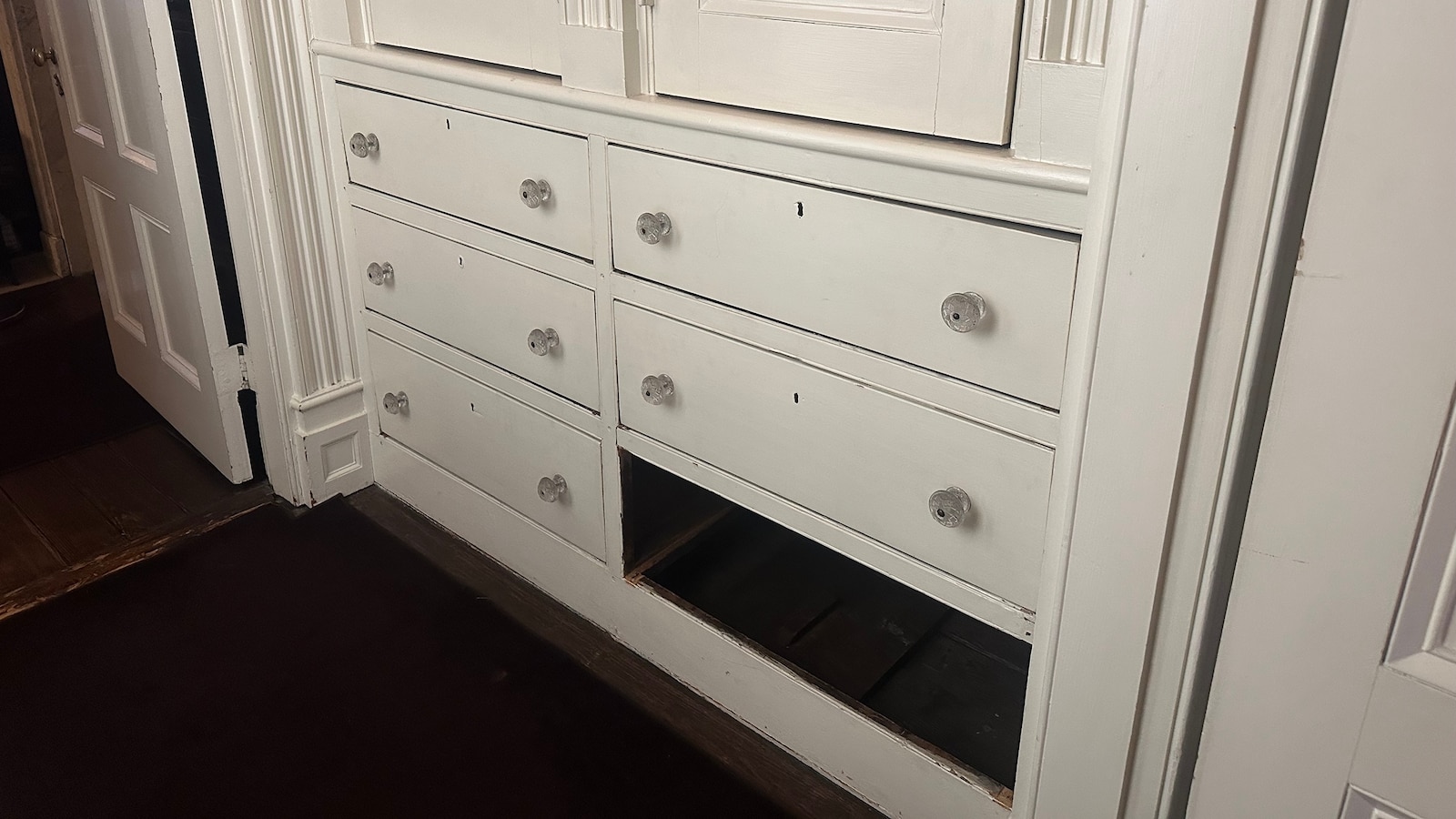
The hidden passage sits inconspicuously within a chest of drawers on the museum’s second floor, a piece of furniture that has been examined by countless visitors over the years. Behind one of the drawer shelves lies a passageway barely large enough for a person to stand upright in, descending 15 feet underground into darkness. Museum staff have actually known about this passage since the 1930s, but they lacked the historical evidence to definitively connect it to the Underground Railroad until recently. After years of painstaking research, cross-referencing historical documents, architectural records, and personal histories, they’ve finally been able to confirm what this secret space truly represented: a lifeline for people fleeing slavery, hidden in the heart of a city that was, paradoxically, deeply hostile to their freedom.
The Detective Work Behind the Discovery
The journey to authenticate this site as part of the Underground Railroad began just two years ago with a discovery by Ann Haddad, the museum’s historian. She uncovered evidence that Joseph Brewster, the man who built and designed the house in the 1830s, was an abolitionist—someone actively opposed to slavery and willing to take risks to support that conviction. This single revelation sparked an extensive, multi-faceted research project that involved museum staff, dedicated volunteers, and outside experts, all working together to piece together fragments of history from nearly two centuries ago. They dove into New York City’s general history during that period, examined every detail of Brewster’s life they could find, and studied the architectural practices of the time to understand how and why such a passage might have been constructed.
Camille Czerkowicz, the museum’s Curator and Collections Manager, described the passionate determination that drove their research efforts. She recalled reaching out to academics she’d never met before, essentially cold-calling them to say, “I have this thing—will you listen to me talk and give me your feedback on it?” The magnitude of what they might have discovered felt so significant that they wanted to consult every possible expert, to ask questions again and again until they were certain of their conclusions. This grassroots approach to historical research demonstrates not only the museum staff’s dedication but also the collaborative nature of uncovering hidden histories. Sometimes the most important discoveries require not just dusty archives but human connections, conversations, and the willingness to pursue a hunch until it either proves true or leads to an even more interesting question.
A Pattern of Courage and Concealment
One of the most compelling pieces of evidence emerged when researchers discovered Brewster’s connections to integrated churches in New York—a significant detail considering that most religious institutions at the time were segregated. The research revealed that Brewster sold the very house containing the hidden passage in order to become an elder at one of these churches. Even more remarkably, church archives showed that Brewster had approved the construction of a false floor in that church building—another hidden space, another secret refuge. As Emily Hill-Wright, the museum’s Director of Operations, explained, this discovery was particularly powerful because it demonstrated that the hidden passage in the Merchant’s House wasn’t a one-time anomaly. Instead, it revealed a pattern of behavior: Brewster deliberately incorporated concealed spaces into buildings he constructed, spaces that could shelter those seeking freedom.
Understanding the context of 1830s New York City makes Brewster’s actions even more extraordinary. Although slavery had been abolished in New York State by this time, the city itself remained staunchly pro-slavery in its sympathies and economic interests. The cotton trade and financial ties to Southern plantations meant that many New York business leaders and politicians actively supported slavery, even if they couldn’t legally practice it in their own state. In this hostile environment, helping freedom seekers wasn’t just morally controversial—it was illegal and genuinely dangerous. Pro-slavery riots erupted regularly, and kidnappings of free Black people to be sold into slavery in the South were a constant threat. As Hill-Wright pointed out, anyone with known connections to anti-slavery work or the abolitionist movement became a target. Your property could be destroyed, your business ruined, your life threatened. Brewster and others like him operated their Underground Railroad activities knowing full well that discovery could mean personal catastrophe.
Honoring the True Heroes of the Underground Railroad
While Joseph Brewster’s actions deserve recognition and study, the museum staff have been careful to emphasize an essential historical truth: the anti-slavery efforts of that era were primarily led by the Black community itself. Free Black Americans, many of whom had themselves escaped slavery or were descended from enslaved people, formed the backbone of the Underground Railroad network. They provided the knowledge, the connections, the safe houses, and often risked the most in helping others to freedom. White abolitionists like Brewster played supporting roles in a movement that Black Americans conceived, organized, and sustained, often at tremendous personal cost. Czerkowicz and Hill-Wright emphasized that the museum’s ongoing research includes efforts to identify which organizations and individuals from the Black community may have been involved in assisting Brewster with the construction and operation of this safe house. This represents a crucial shift in how we tell these historical stories—centering the experiences and agency of Black Americans rather than focusing primarily on white allies.
The Merchant’s House now holds the distinction of being the earliest known site of Underground Railroad activity in New York City. Hill-Wright spoke about the profound significance of this discovery, particularly the physical nature of the evidence. By necessity, Underground Railroad operations were extraordinarily secretive. People’s lives depended on silence and discretion, which means that documentation was often minimal or deliberately destroyed. Today, historians typically rely on oral histories passed down through families, or in rare cases, written records that somehow survived. Physical spaces like this hidden passage are exceptionally uncommon, and to find one as intact and well-preserved as this is almost unprecedented. The passage itself—barely wide enough for a person, descending into the earth, constructed with careful attention to concealment—tells a story that no document could fully capture about the fear, hope, and determination of both those who built it and those who used it.
Sharing History, Inspiring Future Discoveries
The Merchant’s House Museum has always offered visitors a fascinating glimpse into domestic life for a merchant-class family in 19th-century Manhattan, with period furnishings, personal belongings, and architectural details that transport you to another era. Now, with this discovery, the museum is working to expand its educational offerings to incorporate this new layer of historical significance. The research continues, with staff members pursuing new leads and connections that might further illuminate how this Underground Railroad site operated and who it served. Czerkowicz and Hill-Wright have expressed their hope that by sharing this discovery with the public, they’ll create opportunities for new information to emerge. Perhaps someone will recognize a family story that connects to this house, or an amateur historian will uncover a document that provides another piece of the puzzle. History is never really finished; each generation reexamines, rediscovers, and reinterprets the past.
The museum remains open to the public, and plans are underway to install plexiglass around the Underground Railroad site so that visitors can safely view this remarkable piece of history. Imagine standing in that second-floor room, looking at what appears to be an ordinary chest of drawers, and knowing that behind it lies a passage that once represented the difference between bondage and freedom, between danger and safety, between past and future for people whose names we may never know. This discovery reminds us that history isn’t just found in grand monuments or famous battlefields—sometimes it’s hidden in plain sight, waiting patiently in the walls of an old house for someone curious enough to ask the right questions. It challenges us to look more carefully at the world around us and to remember that the places we pass every day may hold secrets and stories far more profound than we imagine.