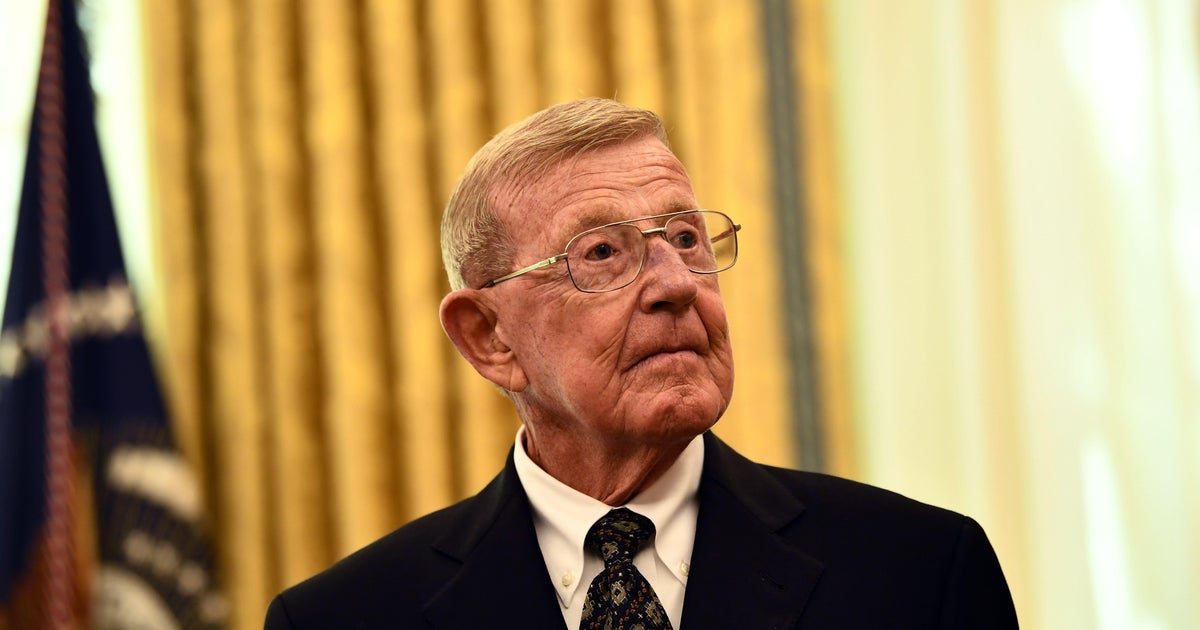

Remembering Lou Holtz: A Legendary Coach Whose Impact Extended Far Beyond the Football Field
A Beloved Coach Passes Away
The world of college football lost one of its most iconic figures when Lou Holtz, the legendary Notre Dame head coach who brought the Fighting Irish their last consensus national championship, passed away at the age of 89 in Orlando, surrounded by his loving family. The announcement, made jointly by the University of Notre Dame and the Holtz family, marked the end of an era for a man whose influence stretched far beyond the sidelines and into the hearts of countless players, colleagues, and communities. His family remembered him not just for his coaching accomplishments, but for the enduring values he embodied throughout his life: faith, family, service, and an unwavering belief in the potential of others. Through the Holtz Charitable Foundation and the many lives he touched, Holtz created a legacy that will continue to inspire future generations. His son Skip, himself a football coach, perhaps said it best when he noted that his father was not just successful, but more importantly, he was “significant” – a distinction that captures the essence of a man who valued character and impact above wins and losses.
Reviving the Glory of Notre Dame
When Lou Holtz arrived at Notre Dame in 1986, the storied program was struggling, a shadow of the powerhouse built by legendary coaches like Knute Rockne and Ara Parseghian. The Fighting Irish needed someone who could restore the pride and excellence that had become synonymous with the Golden Dome and Touchdown Jesus. Holtz proved to be exactly the right person at the right time. With remarkable speed, he transformed the program, leading Notre Dame to a Cotton Bowl appearance in just his second year. Then came the unforgettable 1988 season, when Holtz orchestrated a perfect 12-0 campaign that culminated in victory at the 1989 Fiesta Bowl and a consensus national championship – Notre Dame’s first in years. During his tenure from 1986 to 1996, Holtz compiled an impressive 100-30-2 record, including a remarkable 23-game winning streak and the school’s first back-to-back 12-win seasons. His impact was so profound that current Notre Dame coach Marcus Freeman, who recently led the Irish back to a national championship game that Holtz attended, spoke of the special relationship they shared. Freeman admired the values Holtz used to build the foundation of his coaching career: love, trust, and commitment – principles that transcended the game itself.
A Coaching Career Spanning Decades and Programs
Holtz’s brilliance wasn’t confined to South Bend. Over a remarkable 33-year college coaching career, he won 249 games across multiple prestigious programs, including William & Mary, North Carolina State, Arkansas, Minnesota, and South Carolina. He had the rare distinction of leading four different schools into the AP Top 25, with his teams making 18 total appearances there, eight in the top 10. His journey included a brief, unsuccessful stint with the NFL’s New York Jets in 1976, where he resigned with one game left in a dismal 3-10 season, famously declaring that “God did not put Lou Holtz on this earth to coach in the pros.” That detour led him to Arkansas, where he continued his winning ways. After leaving Notre Dame, Holtz initially moved to television broadcasting with CBS, vowing never to coach again and joking that his promise could be “put in granite.” But the lure of the sidelines proved too strong, and he returned to South Carolina, where he had once served as an assistant coach. Despite an 0-11 debut season with the Gamecocks – the worst record of his career – Holtz characteristically bounced back, going 17-7 over the next two seasons and notching impressive victories over ranked opponents like Georgia and Ohio State. He finally left coaching for good after the 2004 season, returning to broadcasting for an 11-year stint with ESPN.
Unconventional Methods and Unwavering Standards
What made Lou Holtz such an effective coach wasn’t just his strategic mind, but his unique ability to motivate players and maintain incredibly high standards, even when it meant making difficult decisions. He believed in holding people accountable and never wavered from his core values of trust, commitment to excellence, and genuine care for others. His methods were sometimes unconventional and controversial – he once tackled his own quarterback, Tony Rice, during practice after a failed play, and in 1991 he grabbed a player by the facemask and dragged him to the sideline while yelling at him following a personal foul, an incident for which he later apologized. But Holtz’s most famous disciplinary decisions showed his commitment to team rules over individual talent. Before facing then-No. 2 Southern California in 1988, he suspended his leading rusher, Tony Brooks, and leading receiver, Ricky Watters, because they were 40 minutes late to a team meal. The Irish still won 27-10. Similarly, at Arkansas, he suspended three starting offensive players before facing then-No. 2 Oklahoma in the Orange Bowl, despite being 18-point underdogs. Arkansas still won 31-6. These decisions sent clear messages about priorities and accountability. Despite being demanding, Holtz balanced his tough love with charm and positivity. He recruited exceptional talent, including Notre Dame’s legendary 1990 recruiting class that featured five future first-round NFL draft picks. He greeted every practice by saying, “Boy, what a great day to work,” regardless of weather conditions, and joked with players that he traveled the world giving paid speeches to corporations, but spoke to them for free without requiring notes.
The Man Behind the Whistle
Louis Leo Holtz was born on January 6, 1937, in Follansbee, West Virginia, with the modest aspiration of becoming a high school football coach. He was a small but determined 150-pound linebacker at Kent State when his future took an unexpected turn after his fiancée broke off their engagement in 1960. He took a graduate-assistant position at Iowa, and a year later married Beth Barcus, beginning a partnership that would last more than 50 years until her death in 2020. Beth proved instrumental in shaping Lou’s ambitions. In 1966, when he was unemployed and she was eight months pregnant with their third child, she bought him a book about goal-setting. This inspired Holtz to create his famous wish-list of 107 dreams – including attending a White House dinner, appearing on “The Tonight Show,” and meeting the Pope. Beth jokingly suggested he add a 108th goal: getting a job. That list became a roadmap for his remarkable life, and he eventually accomplished nearly all of those goals. In 2008, Holtz was inducted into the College Football Hall of Fame, and Notre Dame honored him with a statue outside its home stadium. With characteristic humor, he said he planned to be buried on campus, noting that “the alumni buried me here every Saturday” during difficult seasons.
A Lasting Legacy Beyond Football
Lou Holtz’s impact extended well beyond his impressive win-loss record. He touched lives through his charitable work, his motivational speaking, and the countless players he mentored who went on to successful careers both in and out of football. His philosophy was simple but profound: have a vision of where you want to go, create a plan to get there, hold people accountable, and believe it can be done. These principles applied not just to football, but to life itself. In his later years, Holtz remained active in public life. A longtime Republican, he spoke at the 2020 Republican National Convention, and President Trump awarded him the Presidential Medal of Freedom in December 2020, the nation’s highest civilian honor. Even in his final years, Holtz maintained his connection to Notre Dame, attending the 2025 national championship game and good-naturedly trolling the Ohio State program that defeated the Irish that day. His death closes a chapter in college football history, but his influence lives on through the Holtz Charitable Foundation, the players whose lives he shaped, and the programs he built. Lou Holtz proved that coaching was about more than X’s and O’s – it was about developing character, instilling values, and believing in people’s potential to achieve greatness. He was, as his son said, not just successful but significant, and that significance will endure for generations to come.