


The Discovery of a Lost Treasure: Finding the Lac La Belle After Nearly 150 Years
A Six-Decade Quest Comes to Fruition
After nearly 60 years of searching, the maritime mystery of the Lac La Belle has finally been solved. Last week, Shipwreck World, an organization dedicated to locating shipwrecks around the globe, announced that a team led by veteran Illinois shipwreck hunter Paul Ehron had discovered the remains of this luxury steamer that vanished in Lake Michigan’s treacherous waters almost 150 years ago. The wreck was located in October 2022, resting about 20 miles offshore between Racine and Kenosha, Wisconsin. The delay in announcing this remarkable find wasn’t due to secrecy or skepticism, but rather the team’s commitment to documenting their discovery properly. Ehron explained that they wanted to create a detailed three-dimensional video model of the ship before going public, but challenging weather conditions and scheduling conflicts prevented his dive team from returning to the site until the summer of 2024. This patience and dedication to proper documentation reflects the professionalism that separates serious maritime archaeologists from treasure hunters, ensuring that these underwater time capsules are studied and preserved for future generations.
The Tragic Story of a Magnificent Vessel
The Lac La Belle was no ordinary ship—she was considered one of Lake Michigan’s most popular and impressive steamers in her day. Built in 1864 in Cleveland, Ohio, this massive 217-foot vessel initially operated routes from Cleveland to Lake Superior, carrying passengers and cargo across the Great Lakes during a period of rapid industrial expansion. Her career nearly ended prematurely in 1866 when a collision sent her to the bottom of the St. Clair River in just 25 feet of water. However, she was raised three years later in 1869 and underwent complete reconditioning, giving the ship a second lease on life. Milwaukee’s Englemann Transportation Company purchased the refurbished steamer and put her to work in the passenger trade running between Milwaukee and Grand Haven, Michigan. On October 13, 1872, the Lac La Belle departed Milwaukee carrying 53 passengers and crew along with a cargo hold filled with barley, pork, flour, and whiskey—typical goods of the era. Approximately two hours into what should have been a routine voyage, disaster struck when the ship began leaking uncontrollably from an unknown source, with water rushing in faster than the crew could manage.
A Desperate Fight Against Lake Michigan’s Fury
As the captain frantically attempted to turn the struggling vessel back toward Milwaukee, Lake Michigan revealed why sailors have long respected and feared her waters. The weather rapidly deteriorated, transforming manageable conditions into a life-threatening gale with massive waves that crashed over the decks. These towering waves eventually extinguished the ship’s boiler fires—the very heart of the steam-powered vessel—leaving the Lac La Belle helpless and adrift in the storm. At approximately 5 a.m., with passengers and crew watching helplessly from lifeboats they had managed to launch, the magnificent steamer went down stern first, her bow rising toward the sky one final time before she slipped beneath the waves. The tragedy didn’t end with the sinking of the ship. As the survivors attempted to row toward shore through the violent waters, one of the lifeboats capsized, claiming eight more lives. These victims joined the countless others who have perished in the Great Lakes, bodies of freshwater so vast they behave like inland seas, complete with storms that rival ocean tempests in their ferocity.
The Relentless Pursuit of an 80-Year-Old Shipwreck Hunter
Paul Ehron’s story is one of remarkable dedication and passion. At 80 years old, this shipwreck hunter has spent 65 years of his life searching for lost vessels beneath the Great Lakes’ waters, having started this unusual hobby when he was just 15. The Lac La Belle had been on his radar since 1965, representing one of those elusive targets that kept calling him back year after year. In 2022, fellow wreck hunter and author Ross Richardson provided Ehron with a crucial clue that allowed him to narrow down his search grid to a manageable area. Armed with this information and side-scan sonar technology, Ehron and his team found the ship after just two hours on the water—a remarkably quick discovery given the decades of searching that preceded it. “It’s kind of a game, like solve the puzzle,” Ehron explained with the enthusiasm of someone who clearly still loves what he does. “Sometimes you don’t have many pieces to put the puzzle together but this one worked out and we found it right away.” He described feeling “super elated” at the discovery, though both he and Richardson remain tight-lipped about the specific clue that led to success, citing the increasingly competitive nature of shipwreck hunting and not wanting to give away research methods to others searching for these underwater treasures.
What Remains of a Once-Proud Steamer
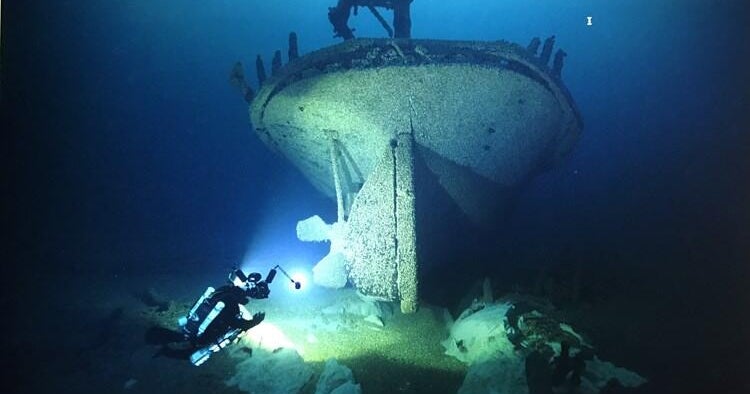
When divers finally reached the Lac La Belle in the depths of Lake Michigan, they found a vessel transformed by nearly a century and a half underwater. The wreck’s exterior is now completely covered with quagga mussels—an invasive species that has fundamentally altered the Great Lakes ecosystem and now threatens to slowly destroy these historical artifacts. The ship’s upper cabins, once filled with passengers enjoying the journey across the lake, have disappeared, likely destroyed by the initial sinking, deterioration over time, or the powerful currents that sweep across the lake bottom. However, Ehron reported that the hull appears to remain intact, and remarkably, the oak interiors are still in relatively good condition. The stern clearly shows one of her propellers missing, likely lost during the sinking or removed at some point over the past 150 years. The massive wooden steamer’s longitudinal hogging arches—structural reinforcements necessary to give vessels of this size and construction adequate strength—are still visible, silent testament to 19th-century shipbuilding techniques. These preserved features offer maritime historians and archaeologists valuable insights into how these ships were constructed and how they have weathered more than a century beneath the waves.
An Underwater Museum and the Race Against Time
The Great Lakes represent one of the world’s most remarkable collections of shipwrecks, with estimates ranging from 6,000 to 10,000 vessels resting on the bottom, according to the University of Wisconsin-Madison’s Wisconsin Water Library. Most of these wrecks remain undiscovered, scattered across the lakes’ vast underwater landscapes. The cold, fresh water of the Great Lakes acts as a natural preservative, keeping wooden ships in far better condition than their saltwater counterparts, creating what amounts to an enormous underwater museum of maritime history. However, shipwreck hunters like Ehron have been searching with increasing urgency in recent years, driven by concerns that invasive quagga mussels are slowly destroying these irreplaceable historical artifacts. Recent discoveries have been coming at a remarkable pace: in May 2025, a Wisconsin angler fishing in fog stumbled upon the wreck of the J.C. Ames, an abandoned tugboat that had been underwater for more than a century. Maritime historians Brendon Baillod and Bob Jaeck announced in September 2024 that they had found the John Evenson, a towing tug lost in June 1895, and the schooner Margaret A. Muir in June 2024. In March 2024, searchers located the steamship Milwaukee, which collided with another vessel and sank in 1886. For Paul Ehron, the Lac La Belle represents his 15th shipwreck discovery—an impressive tally that speaks to decades of dedication. “It was one more to put a check mark by,” he said with characteristic modesty. “Now it’s on to the next one. It’s getting harder and harder. The easier ones have been found.” At 80 years old, Ehron shows no signs of stopping, driven by the same passion that sent him searching for lost ships when he was just a teenager, ensuring that these stories from the depths continue to resurface and remind us of the thousands who worked, traveled, and sometimes perished on these vast inland seas.