


Speaker Nancy Pelosi Reflects on the “Personally Devastating” Loss of Pope Francis
A Personal Loss for One of America’s Most Prominent Catholic Leaders
The passing of Pope Francis has sent shockwaves throughout the global Catholic community, and few feel the loss more acutely than Speaker Nancy Pelosi, one of the highest-ranking Catholics in American politics. In an emotional interview with ABC’s Linsey Davis, Pelosi opened up about what she described as a “personally devastating” moment, reflecting on her relationship with the beloved pontiff and the profound legacy he leaves behind for both the Church and the world at large. For Pelosi, who has navigated the complex intersection of faith and politics throughout her distinguished career, the death of Pope Francis represents not just the loss of a spiritual leader, but the passing of someone she considered a personal inspiration and moral compass during turbulent times in both American and global affairs.
Pelosi’s connection to Pope Francis went beyond the typical relationship between a political figure and a religious leader. Throughout his papacy, which began in 2013, Francis became known for his progressive stances on social justice, climate change, economic inequality, and compassion toward marginalized communities—issues that have been central to Pelosi’s own political agenda. The Speaker, who has represented San Francisco in Congress since 1987 and has been a trailblazer as the first woman to serve as Speaker of the House, found in Pope Francis a kindred spirit who understood that faith must be lived through action and service to others, particularly the poor and vulnerable. Their shared commitment to these principles created a bond that transcended the usual formalities of diplomatic relations between church and state, developing into what Pelosi describes as a meaningful spiritual connection that influenced her approach to leadership and public service.
A Legacy of Compassion and Progressive Catholic Values
During her conversation with ABC News, Pelosi emphasized the transformative nature of Pope Francis’s leadership within the Catholic Church and his impact on global consciousness. She spoke passionately about how Francis reshaped the conversation around what it means to be Catholic in the modern world, moving away from an exclusive focus on doctrinal rigidity and instead emphasizing mercy, inclusion, and the church’s responsibility to address systemic injustice. “He reminded us that our faith calls us to action,” Pelosi reflected, noting how the Pope’s encyclicals on climate change and economic inequality provided moral authority to political movements seeking to address these critical challenges. For Pelosi and many progressive Catholics who have sometimes felt at odds with church hierarchy on certain social issues, Francis offered a vision of Catholicism that prioritized Jesus’s teachings about caring for the least among us over culture war battles that have dominated religious discourse in recent decades.
The Speaker was particularly moved by Pope Francis’s commitment to what he called a “church for the poor,” his willingness to challenge entrenched power structures, and his emphasis on dialogue over division. She recalled moments from his papacy that resonated deeply with her own values: his washing of the feet of prisoners and refugees, his pointed critiques of economic systems that leave people behind, his urgent calls for environmental stewardship, and his efforts to make the Church more welcoming to those who had felt excluded. Pelosi noted that Francis’s approach wasn’t always politically convenient or universally popular, even within the Church itself, but that his moral courage in standing firm on issues of human dignity and social justice provided a model for political leaders trying to do the right thing in the face of opposition. His passing, she suggested, leaves a void not just in religious leadership but in the global moral conversation about humanity’s collective responsibilities to one another and to future generations.
Navigating Faith and Politics in a Divided America
For Nancy Pelosi, being a prominent Catholic in American politics has never been without complications. Throughout her career, she has faced criticism from some conservative Catholic bishops and organizations for her support of abortion rights and other positions that conflict with official Church doctrine. Yet Pelosi has consistently articulated a nuanced understanding of her faith, one that acknowledges these tensions while maintaining that her commitment to social justice, healthcare access, and support for vulnerable populations flows directly from Catholic social teaching. In Pope Francis, Pelosi found a leader whose emphasis on the totality of Catholic social doctrine—not just a narrow focus on specific hot-button issues—validated her own approach to integrating faith and public service. While Francis didn’t change church teaching on abortion, his consistent message that the Church must be equally concerned with poverty, immigration, capital punishment, environmental destruction, and economic injustice expanded the conversation in ways that allowed Catholics like Pelosi to feel more fully seen and understood within their faith community.
In her interview, Pelosi didn’t shy away from acknowledging the complicated relationship many progressive American Catholics have with their Church, nor did she claim that Pope Francis resolved all these tensions. However, she emphasized that his leadership style—marked by listening, dialogue, and a genuine pastoral concern for people’s lived experiences—created space for Catholics with diverse perspectives to remain engaged with their faith rather than feeling pushed away. “He showed us that you could ask hard questions, that you could wrestle with doctrine, and still be deeply, authentically Catholic,” Pelosi observed. This aspect of Francis’s legacy may be particularly important in the American context, where political polarization has increasingly mapped onto religious identity, with some conservative Catholics questioning whether progressives like Pelosi can legitimately claim Catholic identity while holding certain political positions. Francis’s broader vision of what constitutes faithful Catholic citizenship offered an important counternarrative to this exclusionary approach, one that Pelosi clearly found both personally meaningful and politically significant.
The Global Impact of Pope Francis’s Message
Beyond the personal connection, Speaker Pelosi spoke eloquently about Pope Francis’s impact on global issues and international relations. She highlighted his role as a bridge-builder between nations, his advocacy for peace in conflict zones, his moral leadership on the refugee crisis, and his unprecedented encyclical “Laudato Si'” which framed environmental protection as a sacred duty and climate change as a moral crisis requiring urgent action. For political leaders like Pelosi who have worked to advance climate legislation and humanitarian policies, having the moral authority of the Pope behind these efforts provided crucial support, particularly in reaching voters and communities for whom religious leadership carries significant weight. Francis’s willingness to speak truth to power—whether addressing the United Nations, the U.S. Congress, or gatherings of world leaders—demonstrated that religious leadership could be a force for challenging the status quo rather than simply blessing existing power structures.
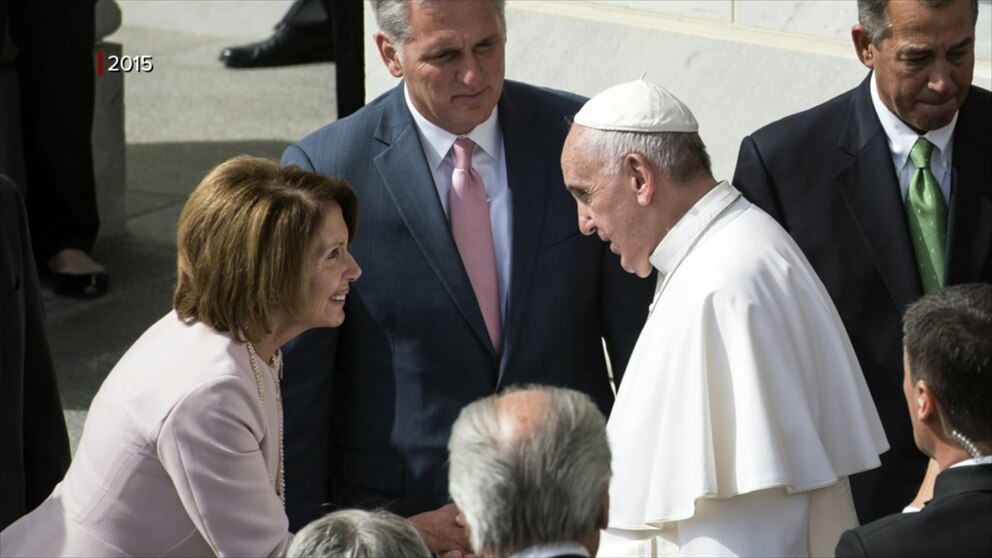
Pelosi specifically recalled Pope Francis’s 2015 address to a joint session of the U.S. Congress, a historic moment when she, as Speaker of the House, had the honor of hosting him. She described the profound impact of his words that day as he called on American lawmakers to reject polarization, to remember their responsibility to the common good, and to see the face of God in every person, especially the poor, the migrant, and the marginalized. “It was one of the most meaningful moments of my career,” Pelosi shared, her voice catching with emotion as she remembered how Francis’s message cut through partisan divisions, at least temporarily, to remind everyone present of the higher purpose of public service. That address encapsulated what made Francis such an extraordinary leader: his ability to speak uncomfortable truths with genuine love, to challenge without condemning, and to call people toward their better selves rather than simply reinforcing their existing beliefs.
Looking Forward: The Challenge of Continuing His Work
As the Catholic Church and the world grapple with the loss of Pope Francis, Speaker Pelosi emphasized that the most fitting tribute would be to continue the work he championed. She stressed that his legacy isn’t just about remembering his words or celebrating his example, but about actively carrying forward his commitment to the poor, to environmental stewardship, to peace and dialogue, and to building a more just and inclusive world. For Pelosi and other political leaders who were inspired by Francis’s message, this means redoubling efforts on climate legislation, immigration reform, economic justice initiatives, and healthcare access—the concrete policy areas where faith meets action. “He would want us not to mourn for too long, but to get back to work,” Pelosi suggested, noting that Francis was always more interested in practical results than in accolades or recognition.
The Speaker also acknowledged the uncertainty facing the Catholic Church as it enters a new chapter. Pope Francis brought a unique perspective to the papacy, shaped by his experiences in Latin America, his Jesuit formation, and his outsider status within the traditional Vatican power structure. Whoever succeeds him will face the question of whether to continue his reforms and his emphasis on a more pastoral, less institutional Church, or to move in a different direction. For Catholics like Pelosi who have found Francis’s papacy deeply meaningful, there is understandable anxiety about what comes next. Yet she expressed hope that the seeds Francis planted—the conversations he started, the perspectives he elevated, the people he empowered—will continue to grow regardless of who next leads the Church. “You can’t put the toothpaste back in the tube,” she observed with a slight smile, suggesting that Francis’s impact on Catholic consciousness, particularly among younger Catholics and those in the Global South, has fundamentally shifted expectations about what papal leadership can and should be. His passing is indeed personally devastating for those who loved him, but his life’s work—rooted in the simple but revolutionary message of the Gospel—endures as both comfort and challenge to all who seek to follow in his footsteps.