
Trump ‘Can’t Stop Us’ On Fighting Climate Change: Jay Inslee
A Climate Champion’s Defiant Message
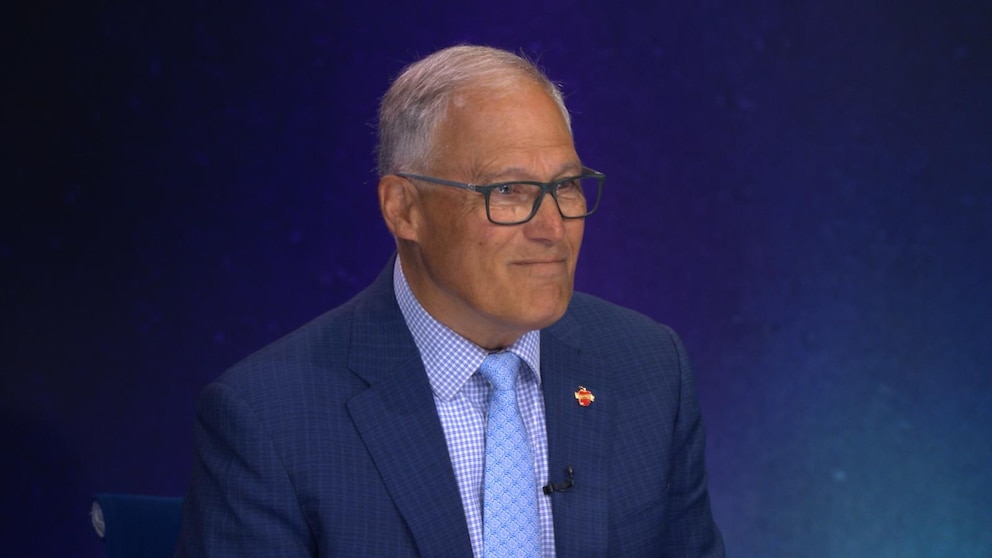
Former Washington Governor Jay Inslee, who has spent decades at the forefront of America’s climate fight, is refusing to let the current political climate dampen his environmental activism. Speaking on Earth Day 2025, Inslee delivered a powerful message of resilience and determination, insisting that despite President Trump’s aggressive rollback of environmental protections, the momentum toward clean energy and climate action has grown too strong to be derailed by any single administration. His words come at a critical time when environmental advocates across the nation are grappling with what many see as systematic attempts to dismantle years of progress on climate policy. Inslee, who made climate change the centerpiece of his 2020 presidential campaign and served as one of the nation’s most progressive governors on environmental issues, argues that the transition to renewable energy has reached a tipping point where economic forces and public will are now driving change more powerfully than federal policy alone.
The former governor’s optimism stems from tangible changes he’s witnessed at the state and local levels, where cities, counties, and states are independently committing to ambitious climate goals regardless of federal direction. During his tenure in Washington, Inslee championed some of the nation’s most aggressive climate legislation, including the Climate Commitment Act, which established a cap-and-trade program for carbon emissions, and initiatives to transition the state toward 100% clean electricity by 2045. These state-level achievements have created a blueprint that other jurisdictions are following, building a patchwork of climate action that Inslee believes has become self-sustaining. He points to the fact that renewable energy installations continue to break records, electric vehicle sales are climbing despite federal policy uncertainty, and major corporations are maintaining their sustainability commitments not because regulations require it, but because their customers, employees, and investors demand it. This grassroots and market-driven momentum, Inslee argues, represents a fundamental shift in how climate action happens in America—one that no president can simply reverse with executive orders.
The Battle Against Federal Rollbacks
Inslee doesn’t mince words when describing what he sees happening at the federal level under the Trump administration. He characterizes the current approach as a deliberate attempt to “destroy our climate laws,” referencing the administration’s efforts to withdraw from international climate agreements, roll back vehicle emission standards, eliminate clean energy incentives, and open protected lands to fossil fuel extraction. These actions represent a sharp reversal from previous policies aimed at reducing greenhouse gas emissions and transitioning America’s economy toward sustainability. For someone who has dedicated much of his political career to environmental protection, watching these rollbacks unfold is undoubtedly frustrating. However, rather than succumbing to despair, Inslee is channeling that frustration into a rallying cry for continued action at every other level of government and society.
The former governor acknowledges the real damage that hostile federal policies can inflict on climate progress. Federal incentives for renewable energy development, national efficiency standards, and America’s participation in global climate frameworks all play important roles in the transition to a low-carbon economy. When these are weakened or eliminated, it genuinely slows progress and sends discouraging signals to the international community about America’s commitment to addressing what scientists agree is the defining challenge of our time. Yet Inslee maintains that the situation, while serious, is far from hopeless. He points to historical precedents where environmental progress continued even during periods of federal inaction or hostility, noting that some of the most important environmental victories in American history came from state-level innovation and public pressure rather than top-down federal mandates. This historical perspective informs his current strategy: build an unstoppable movement from the ground up that will outlast any single presidential term.
State and Local Leadership Filling the Void
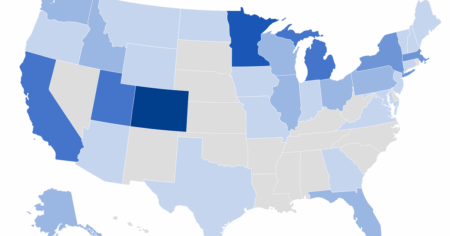
The heart of Inslee’s optimism lies in what’s happening in states and cities across America, where leaders are stepping up to fill the leadership vacuum left by federal retreat. Following Trump’s return to office, governors from states representing more than half of America’s population and economy have reaffirmed their commitment to climate goals, many pledging to meet or exceed the emissions reduction targets outlined in the Paris Agreement regardless of federal participation. Organizations like the U.S. Climate Alliance, which Inslee helped found during Trump’s first term, have grown stronger and more coordinated, creating networks of states that share best practices, coordinate policies, and present a united front in maintaining climate ambition. California continues to set vehicle emission standards that effectively become national standards because of the state’s market size, while northeastern states maintain their Regional Greenhouse Gas Initiative, creating a carbon pricing system that covers multiple states.
Beyond state governments, cities are proving to be laboratories of climate innovation. Mayors across the political spectrum are investing in public transportation, updating building codes to improve energy efficiency, committing to clean energy for municipal operations, and creating resilience plans to protect their communities from climate impacts already underway. These local efforts are often motivated by immediate, practical concerns—cleaner air means healthier children, energy efficiency means lower utility bills, and climate resilience planning protects property values and local economies—which creates political support that transcends the partisan divisions paralyzing federal action. Inslee emphasizes that this distributed approach to climate action, while perhaps less tidy than a comprehensive federal program, has the advantage of being more resilient to political changes in Washington. When climate policy is woven into the fabric of state and local governance, embedded in local economies, and supported by citizens who see direct benefits in their communities, it becomes much harder to undo.
Economic Forces Driving the Clean Energy Transition
Perhaps the most compelling reason for Inslee’s confidence is the fundamental shift in energy economics that has occurred over the past decade. Renewable energy sources, particularly solar and wind power, have become the cheapest forms of new electricity generation in most of the United States, undercutting not just new fossil fuel plants but increasingly competing with existing coal and natural gas facilities. This economic reality is driving utilities and businesses to choose clean energy not primarily for environmental reasons, but because it makes financial sense. Battery storage technology, while still developing, has improved dramatically in both capability and cost, addressing the intermittency challenges that once made renewable energy less practical for baseload power. Major corporations from tech giants to manufacturers to retailers have made substantial commitments to renewable energy, with hundreds of companies pledging to reach 100% renewable electricity—commitments they’re keeping because it improves their bottom line and their brand value.
The clean energy economy has also become a significant job creator, employing hundreds of thousands of Americans in solar installation, wind turbine manufacturing and maintenance, energy efficiency retrofitting, and electric vehicle production. These jobs tend to be local—they can’t be outsourced—and often pay well, creating economic constituencies with a vested interest in continued clean energy growth. Inslee points to this employment dimension as creating political durability for climate action, as workers and businesses that depend on the clean energy economy become advocates for its continued expansion. Even in conservative-leaning states, elected officials are finding that supporting renewable energy development brings jobs and investment to their districts, creating support that crosses traditional partisan lines. The transition is also being driven by investor pressure, with major financial institutions increasingly viewing climate risk as financial risk, directing capital toward sustainable investments, and away from fossil fuel projects seen as potential “stranded assets” in a carbon-constrained future.
The Role of Public Will and Generational Change
Underlying all these structural factors is a significant shift in public opinion, particularly among younger Americans who will live with the consequences of today’s climate decisions for decades to come. Polling consistently shows that majorities of Americans, including substantial portions of Republican voters, support action on climate change, investment in renewable energy, and policies to reduce pollution. This support is strongest among younger generations, who increasingly view climate action as a non-negotiable priority and are making decisions about where to live, work, and invest based partly on climate considerations. This generational shift creates long-term pressure on institutions—corporations, universities, local governments—to take climate seriously, regardless of the current federal political climate.
Inslee notes that this public engagement goes beyond abstract concern about future climate impacts; people are connecting climate change to issues they experience directly, like air quality, extreme weather events, water availability, and energy costs. When communities experience record-breaking heat waves, devastating wildfires, unprecedented flooding, or other climate-related disasters, the issue becomes personal and immediate rather than distant and theoretical. This direct experience is creating a constituency for climate action that includes people who might not identify as environmentalists but who want practical solutions to protect their families and communities. The former governor emphasizes that this broad-based support is crucial for sustaining climate action through political changes, as it means climate policy isn’t confined to one party or ideology but increasingly represents mainstream common sense. As this public will grows stronger and more informed, it becomes harder for elected officials at any level to ignore or actively oppose climate action without facing political consequences.
Looking Forward With Determined Hope
Jay Inslee’s message on Earth Day 2025 is ultimately one of determined hope grounded in practical realities rather than wishful thinking. He acknowledges the genuine obstacles created by a federal government hostile to climate action but argues convincingly that the transformation underway is bigger than any single administration. The combination of economic factors making clean energy competitive, state and local governments filling leadership roles, corporate commitments to sustainability, technological improvements making solutions more practical, and growing public demand for action creates momentum that will continue regardless of who occupies the White House. This doesn’t mean the current federal rollbacks don’t matter—they absolutely slow progress and inflict real damage—but it does mean they can’t stop the transition entirely.
For Inslee and the many advocates, officials, and citizens who share his commitment to climate action, the current moment requires redoubling efforts at every accessible level while maintaining focus on the long-term trajectory. Every solar panel installed, every electric vehicle purchased, every building made more efficient, every local climate plan adopted, and every person educated about climate solutions represents progress that accumulates over time. The former governor’s career demonstrates the power of persistent advocacy; many policies he championed that seemed radical when first proposed have become mainstream or even conservative positions as public understanding and economic realities evolved. His confidence that “Trump can’t stop us” reflects an understanding that social and economic transitions, once they reach sufficient momentum, become largely self-sustaining. The clean energy transition has reached that point, driven by forces more powerful and durable than any single political leader—economic self-interest, technological innovation, local problem-solving, and the determination of people who refuse to accept a degraded planet as their children’s inheritance. The fight continues, but Inslee’s message makes clear that the outcome, while its timing remains uncertain, is increasingly inevitable.