

Hakeem Jeffries Challenges Trump on Economic Leadership as Democrats Plan Cost of Living Campaign
Democrats Launch Economic Counter-Offensive
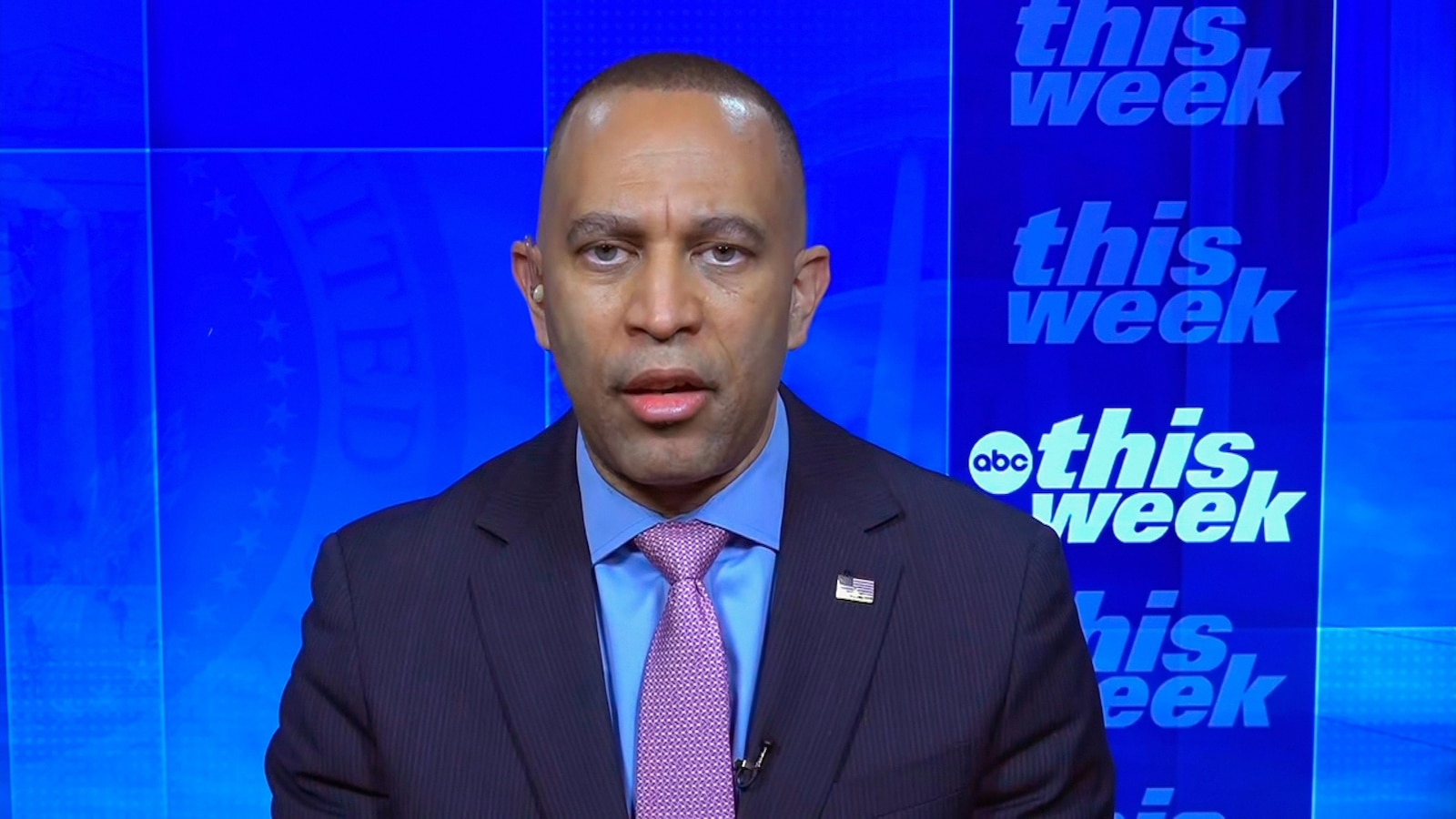
In a pointed critique of the Trump administration’s handling of America’s economic challenges, House Minority Leader Hakeem Jeffries announced that Democrats would be launching a dedicated “cost of living week of action” to address the financial pressures squeezing American families. Speaking on ABC News’ “This Week” with co-anchor Jonathan Karl, the New York Democrat didn’t mince words about the economic struggles facing ordinary Americans and what he sees as President Trump’s failure to provide meaningful solutions. Jeffries outlined a comprehensive list of concerns that resonate with millions of households across the country: housing costs that have spiraled beyond reach for many families, grocery bills that continue to climb, utility expenses that strain monthly budgets, child care that consumes enormous portions of family income, and insurance premiums that seem to rise without end. His simple but powerful summary captured the frustration many Americans feel: “America is too expensive.”
What makes Jeffries’ critique particularly sharp is his observation about the dramatic shift in public perception of Trump’s economic stewardship. The Democratic leader pointed out that when Trump took office on January 20th, his approval ratings on economic matters represented his strongest asset with the American public. However, in the months since, that strength has transformed into what Jeffries characterizes as Trump’s “greatest weakness.” This reversal suggests that whatever economic promises the president made during his campaign have not translated into tangible relief for Americans struggling with daily expenses. For Democrats, this represents an opening—a chance to present themselves as the party with real solutions to the problems that matter most to voters when they sit down at their kitchen tables to pay bills or plan their monthly budgets.
Competing Narratives on Economic Trust
The conversation between Jeffries and Karl touched on a sensitive subject for Democrats: recent polling data that appears to show Americans have more faith in Republican leadership when it comes to fixing economic problems. A Gallup poll had suggested that trust in Democratic economic stewardship had fallen significantly compared to confidence in GOP leaders. However, Jeffries pushed back against this narrative, refusing to accept it as the final word on public sentiment. He pointed to alternative polling data that tells a different story, specifically highlighting a Morning Consult poll that showed congressional Democrats being trusted more than their Republican counterparts on economic issues for the first time in four years. This discrepancy between different polls highlights an important reality in modern politics: polling can tell vastly different stories depending on how questions are asked, who is surveyed, and when the survey is conducted.
Regardless of which poll more accurately captures public sentiment, Jeffries made clear that Democrats aren’t backing down from the economic debate. Instead, they’re doubling down on their message, continuing to make their case to the American people about who can better manage the economy and protect the financial security of working families. Beyond just general economic management, Jeffries emphasized two specific policy areas where he believes Democrats stand in stark contrast to Republicans: Social Security and healthcare. On Social Security, Jeffries accused Republicans of trying to “detonate Social Security as we know it,” while positioning Democrats as the party committed to protecting and strengthening the program that millions of seniors depend on for their retirement security. Similarly, on healthcare, he pledged that Democrats would continue fighting to protect Americans’ access to medical care, suggesting that Republican policies threaten to undermine healthcare protections that people rely on.
The Democratic Party’s Leadership Question
Karl didn’t shy away from asking Jeffries about one of the most contentious internal debates within the Democratic Party: whether the party needs fundamentally new leadership to move forward. The question became particularly pointed when Karl referenced recent comments from Senator Bernie Sanders, the Vermont independent who caucuses with Democrats and has long been a voice for the party’s progressive wing. Sanders had expressed skepticism about the future roles of prominent Democrats like Kamala Harris and Joe Biden in the party’s national leadership, suggesting that “the future of the Democratic Party is not going to rest with the kind of leadership that we’ve had.” It was a blunt assessment from one of the party’s most influential figures, and it demanded a response from Jeffries as one of the party’s highest-ranking elected officials.
Jeffries handled the question diplomatically but decisively, choosing to shift focus from internal party debates about personalities to the concrete electoral challenges ahead. Rather than engaging in speculation about which individual Democrats should or shouldn’t play leadership roles, he emphasized the importance of winning the immediate battles on the horizon. He specifically highlighted two gubernatorial races—in New Jersey and Virginia—that will take place in November and characterized them as “critically important” for the party’s momentum. Beyond those governor’s races, Jeffries set his sights on the ultimate prize: winning back control of the House of Representatives in the next congressional elections. His message was clear: Democrats should be less concerned with internal leadership debates and more focused on winning elections and building power. He pointed to a track record of Democratic success in special elections “month after month after month,” including what he described as a decisive victory in Wisconsin earlier in the month for a state Supreme Court seat, as evidence that the party’s approach is working where it counts—at the ballot box.
Primary Challenges and Party Unity
Perhaps the most delicate moment in the interview came when Karl raised the issue of David Hogg, the vice chair of the Democratic National Committee who has become known for his activism following the Parkland school shooting. Hogg has recently made waves by advocating for primary challenges against some sitting Democratic incumbents, particularly those in safe Democratic seats. His argument is provocative and potentially divisive: that some Democrats who represent districts where they face little or no threat from Republican challengers have become complacent, engaging in what Hogg calls “a culture of seniority politics” that doesn’t serve the party well. In characteristically blunt language, Hogg had stated that Democrats need to “get rid of the Democrats in safe seats who do not understand what is at stake now, who are asleep at the wheel not meeting the moment, and are a liability now into the future of our party.”
Jeffries’ response to this challenge demonstrated the balancing act required of party leadership—acknowledging the reality of primary challenges while maintaining unity and focus on the larger goal of defeating Republicans. He began by expressing his intention to support every Democratic incumbent, pointedly noting that this support extends across the party’s ideological spectrum, “from the most progressive, to the most centrist, and all points in between.” He then praised Democratic members for their hard work in their communities and their efforts to rise to the current moment’s challenges, citing specific examples of recent activism including a “Medicaid Matters Day of Action” and a “save Social Security Day of Action.” Jeffries painted a picture of a party engaged in relentless grassroots organizing—rallies, town hall meetings in both Democratic and Republican districts, site visits, press conferences, and more. His phrase “we are in a more is more environment” captured his belief that the current political moment demands maximum effort from all Democrats.
While acknowledging that primaries are simply “a fact of life” in democratic politics—an unavoidable reality in a system where elections happen every two years for House members—Jeffries made clear where his priority lies. Rather than focusing energy on intra-party battles over safe Democratic seats, he emphasized that his real focus would be on “trying to defeat Republican incumbents so we can take back control of the House of Representatives and begin the process of ending this national nightmare that’s being visited upon us by far-right extremism.” That final phrase—”national nightmare” caused by “far-right extremism”—revealed Jeffries’ view of what’s at stake and why Democrats need to maintain unity rather than turn their fire on each other.
A Strategy for Democratic Revival
What emerges from Jeffries’ interview is a multi-layered strategy for Democratic revival that operates on several fronts simultaneously. First, there’s the policy front, where Democrats are working to position themselves as the party that truly understands and addresses the economic pain of ordinary Americans. By focusing on tangible, kitchen-table issues like housing costs, grocery prices, and child care expenses, Democrats are attempting to connect with voters on the issues that affect their daily lives most directly. This represents a deliberate effort to move beyond abstract ideological debates and speak to concrete concerns that transcend traditional political divisions. Second, there’s the messaging front, where Democrats are actively working to counter narratives about Republican economic superiority and to highlight their own proposals for protecting Social Security and healthcare—programs with broad popular support.
Third, there’s the electoral front, where Jeffries is clearly focused on winning specific, winnable races in the near term while building toward retaking the House majority. His emphasis on upcoming gubernatorial races and special election victories suggests a party that’s trying to build momentum through a series of smaller wins rather than waiting for one big national wave. Fourth, there’s the organizational front, represented by the various “days of action” and community organizing efforts Jeffries described, which aim to build grassroots energy and engagement. And finally, there’s the unity front, where Jeffries is working to keep Democrats focused on their common opponent—Republicans and what he characterizes as far-right extremism—rather than on their internal differences. Whether this multifaceted strategy will succeed in returning Democrats to power remains to be seen, but it represents a comprehensive approach to the challenges the party faces in opposition. The coming months will test whether Democrats can translate economic discontent into political support, whether they can maintain unity while allowing for internal debate, and whether they can build the kind of momentum that leads to victory in 2026 and beyond.