



The Staggering Cost of America’s First Week at War with Iran
Initial Estimates Reveal Massive Financial Burden
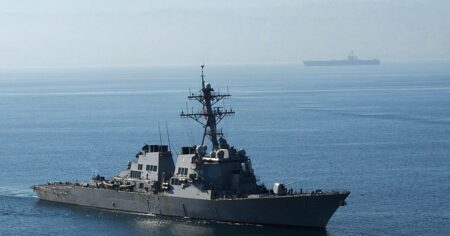
The financial toll of America’s military engagement with Iran is already reaching eye-watering levels, with the first week alone costing an estimated $11.3 billion, according to military officials who briefed members of Congress this week. This figure, while substantial, represents only a conservative baseline estimate and doesn’t account for the extensive preparatory costs involved in positioning military assets before operations officially commenced on February 28th. The run-up to the conflict saw a significant months-long military buildup, including the strategic deployment of two complete U.S. aircraft carrier strike groups along with their accompanying escort vessels to the volatile Middle East region. Senator Chris Coons, the leading Democrat on the Senate subcommittee responsible for defense appropriations, confirmed to reporters that the $11.3 billion figure appeared “roughly accurate” based on the information provided during the classified congressional briefing. However, he was quick to caution that this number likely represents just the tip of the financial iceberg, suggesting that the actual operational costs are “significantly above that” initial estimate.
Daily Expenses Could Exceed $1.5 Billion
The daily financial burden of maintaining military operations against Iran appears to be staggering in its own right, with Senator Coons suggesting it would be a “fair guess” that each day of warfare is costing well over $1.5 billion, though he noted these costs fluctuate considerably depending on the intensity and nature of military operations on any given day. Perhaps even more concerning from a budgetary standpoint is the cost of replacing the vast quantities of munitions being expended during the conflict. Coons estimated that the expense of replenishing the missiles, bombs, and other ordnance already used has “already well beyond $10 billion,” a figure that underscores the resource-intensive nature of modern warfare. These weapons systems, from precision-guided missiles to advanced air-to-air munitions, carry hefty price tags individually, and when deployed by the thousands, their collective cost becomes astronomical. The Pentagon, maintaining its characteristic discretion regarding sensitive operational matters, declined to provide detailed commentary on these figures, stating only that they don’t discuss “closed-door discussions or matters” and that the true cost of what they’re calling “Operation Epic Fury” won’t be known until the mission reaches its conclusion.
Conflicting Estimates and the Challenge of Transparency
Various sources have offered differing estimates of the conflict’s financial impact, highlighting the challenges inherent in calculating the true cost of military operations in real-time. A U.S. official with access to Pentagon estimates shared with CBS News that just the first two days of combat operations in Iran consumed $5.6 billion worth of munitions alone—a figure that speaks to the intensity of the initial strikes and the sophisticated, expensive nature of modern weaponry. Meanwhile, the Center for Strategic and International Studies, a respected think tank specializing in defense analysis, provided a somewhat more conservative projection, calculating that the war’s first 100 hours cost approximately $3.7 billion, which breaks down to roughly $891.4 million per day. This more modest estimate factors in the operational costs of keeping fighter aircraft aloft, maintaining naval vessels on station, and supporting ground units throughout the region, while also accounting for upwards of $3 billion needed to replenish expended munitions and hundreds of millions more to replace three F-15 fighter jets that were lost in combat operations. The variance between these estimates illustrates how difficult it can be to pin down exact figures during ongoing military operations, particularly when different methodologies are used to calculate costs.
The Scale and Scope of Military Operations
The military campaign that began eleven days ago has been nothing short of massive in its scale and ambition, with U.S. forces conducting strikes against more than 5,000 targets across Iran, according to information released by U.S. Central Command. These targets have included a diverse array of Iranian military infrastructure: dozens of naval vessels, critical military bases, missile launch facilities, and intelligence gathering sites have all found themselves in American crosshairs. The operation has also involved a significant defensive component, with the United States working in concert with Israel and several Arab allies to intercept and destroy scores of Iranian missiles and drones launched in response to the American attacks. This multi-layered approach to the conflict—combining offensive strikes with defensive measures and coalition coordination—adds additional layers of complexity and cost to the overall operation. The involvement of advanced missile defense systems, which fire interceptor missiles costing millions of dollars each to knock down incoming threats, contributes substantially to the operation’s total price tag.
Uncertainty About Duration and Future Costs
One of the great unknowns surrounding this conflict is its ultimate duration, which makes long-term financial planning exceptionally challenging for both military planners and congressional budget writers. President Trump has offered somewhat contradictory signals about the timeline, having previously suggested the operation might extend for about a month, while more recently telling CBS News that the operation is “very complete” and could potentially wrap up soon, based on his assessment that Iran’s military capabilities have already been severely degraded. However, Defense Secretary Pete Hegseth struck a notably different tone during a “60 Minutes” interview, cautioning that “this is only just the beginning,” suggesting a potentially longer and more involved military engagement lies ahead. This uncertainty about duration makes it difficult to project total costs, though it’s clear that at some point in the near future, the Trump administration will need to approach Congress with a supplemental funding request to cover the war’s expenses. Representative Tom Cole, the Republican chairman of the House Appropriations Committee, indicated last week that he anticipates a “very robust request” from the military, though House Speaker Mike Johnson acknowledged that lawmakers don’t yet know the full scope of what will be requested.
Congressional Concerns and the Path Forward
The prospect of approving what will likely be a massive supplemental funding package has prompted some members of Congress, particularly Democrats, to demand greater transparency and accountability from the administration regarding both the costs incurred and the strategic objectives being pursued. Senator Coons articulated this position clearly, stating that before he would even consider supporting additional war funding, the administration “owe us an accounting of how much has been expended.” He noted that while there were “some lengthy exchanges” about costs during the classified briefing, he remained “not satisfied with the information I’ve got so far.” This tension between the executive branch’s operational security concerns and Congress’s constitutional responsibility to oversee military spending and authorize the use of force represents a familiar dynamic in American governance, but one that takes on heightened importance given the enormous sums involved and the potential for the conflict to expand or extend beyond initial projections. As the war continues and costs mount, the pressure for greater transparency and a clear articulation of strategic goals will likely intensify, particularly if the administration returns to Congress seeking tens of billions of additional dollars to sustain operations. The coming weeks will test both the administration’s ability to achieve its military objectives and Congress’s willingness to continue funding an operation whose ultimate cost and duration remain frustratingly unclear to those responsible for appropriating the necessary funds.