


A Nation on Edge: Echoes of the 1960s in Modern Political Violence
When History Repeats Itself at the Washington Hilton
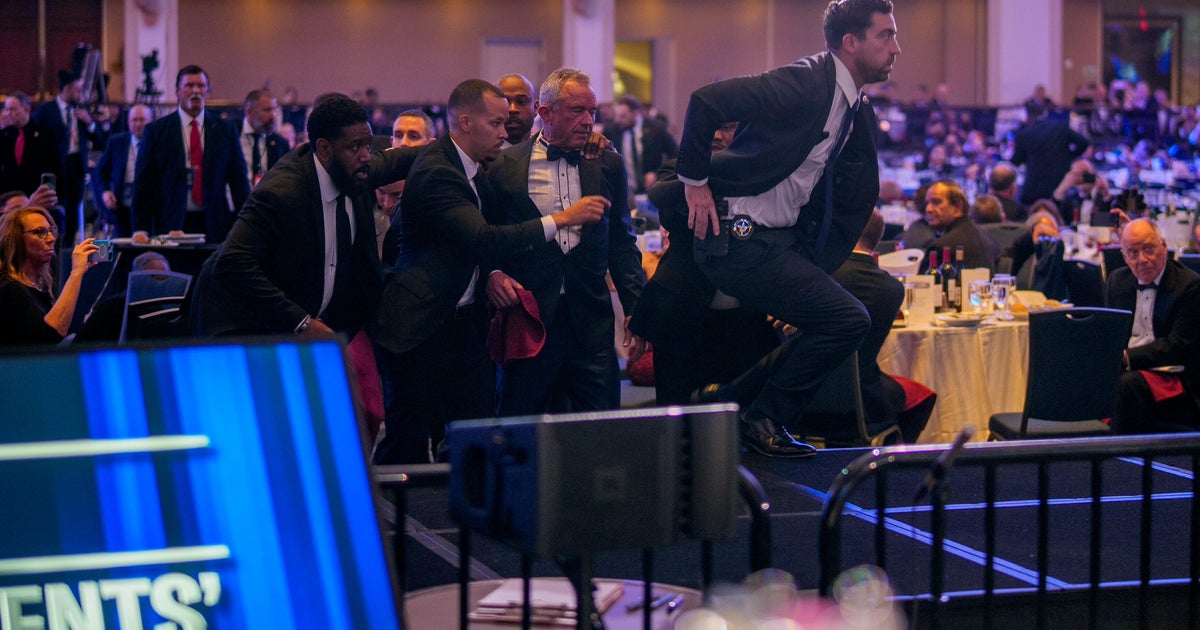
The scene at the Washington Hilton on April 25, 2026, felt like a nightmare ripped from the pages of American history. Robert F. Kennedy Jr., serving as Secretary of Health and Human Services, was enjoying pleasant conversation with fellow guests at the annual White House Correspondents’ Association dinner when gunfire shattered the evening’s festivities. In an instant, the elegant ballroom descended into chaos. Security agents moved with practiced precision, one throwing his body over Kennedy while others formed a protective cordon, rushing him through a labyrinth of service corridors to safety. For those familiar with American history, the location and circumstances carried a haunting resonance—Kennedy’s father, Senator Robert F. Kennedy, had been assassinated in a hotel ballroom in Los Angeles in 1968. The parallel was impossible to ignore, and for a nation already grappling with deep divisions and uncertainty, this incident served as a chilling reminder that we may be reliving one of the darkest chapters in American history.
The alleged shooter, Cole Tomas Allen, had traveled across the country by train—a detail that seemed almost anachronistic, reminiscent of conspirators from a different century. According to court documents, Allen’s plot allegedly targeted not just one individual but President Trump and other Cabinet members, suggesting a broader campaign of terror against the foundations of government itself. Allen appears to fit a disturbing pattern that has emerged in recent years: disaffected men harboring political grievances, operating as lone wolves, and seeking to strike at the heart of democratic institutions. What makes this incident particularly alarming is that President Trump has now survived three assassination attempts—a number believed to exceed attempts on any previous president’s life. This unprecedented statistic should force Americans to engage in serious soul-searching about the current climate of political violence and what it means when such acts become disturbingly routine rather than shocking aberrations.
Uncomfortable Parallels to a Turbulent Past
Historians and political scientists have noted striking similarities between our current moment and the volatile period spanning the late 1960s through the mid-1970s. Steven Hahn, a New York University history professor and author of “Illiberal America,” observes that “violence and politics have been central to the American experience since the birth of the republic,” but certain periods stand out for their intensity and frequency of political violence. Both then and now, America finds itself torn apart by bitter political divisions that extend beyond policy disagreements into fundamental questions about national identity and values. The loss of faith in institutions that followed the twin traumas of Vietnam and Watergate created a pervasive sense that government had become unresponsive and politics irreparably broken. Economic instability—stagflation and energy crises in the 1970s, persistent inflation and skyrocketing gas prices today—deepened the feeling that America was losing its moorings. Even the timing of missions to the moon in both eras suggests a nation seeking inspiration and unity in extraordinary achievements while struggling with divisions at home.
Julian Zelizer, a Princeton historian and co-author of “Fault Lines,” explains that “throughout American history there have been periods where tensions became so great and as a nation, our focus on those tensions became so central that you have these bursts of violence against our political leaders.” He identifies the late 1960s through mid-1970s as one such period, and argues convincingly that we are living through another one today. The crisis of confidence many Americans experience today—marked by deep alienation from political institutions, distrust of traditional authority, and a sense that the system is rigged against ordinary people—mirrors the disillusionment that characterized the earlier era. Then, as now, this alienation created fertile ground for violence to take root, as individuals convinced themselves that conventional political participation was futile and that dramatic, destructive action was justified or even necessary.
When Violence Was Even More Pervasive
While the parallels between then and now are undeniable, the differences are equally instructive and, in some ways, offer a glimmer of hope. The scale of political violence in the 1960s and 1970s actually exceeded what we’re experiencing today, as difficult as that may be to believe. The cascade of political assassinations began with President John F. Kennedy in 1963, followed by Malcolm X in 1965, Martin Luther King Jr. in 1968, and Senator Robert F. Kennedy later that same year. These weren’t isolated incidents carried out by disconnected individuals; they represented a pattern that seemed to be tearing the nation apart at its seams. Soon, the impulse toward violence permeated militant groups across the ideological spectrum, from those advocating race wars to radical environmentalists, from anti-war activists to various separatist movements.
The summer of 1975 alone witnessed two separate attempts on President Gerald Ford’s life within the span of just three weeks. Lynette “Squeaky” Fromme, a member of both the Manson family and an extremist environmental group, pointed a loaded Colt .45 at Ford from just feet away; the gun failed to discharge only because there was no bullet in the chamber. Shortly thereafter, Sarah Jane Moore, connected to San Francisco’s militant underground, managed to fire a shot at Ford as he left the St. Francis Hotel, missing only because a Marine in the crowd lunged at her, disrupting her aim. Between 1970 and 1971, approximately 2,500 bombings occurred across the country, perpetrated by radical groups including the Weather Underground and the Symbionese Liberation Army, the latter infamous for kidnapping newspaper heiress Patricia Hearst. During the same period, from 1968 to 1972, more than 100 skyjackings were carried out by groups like the Black Liberation Army and Puerto Rican Nationalist organizations. While many of these acts of terrorism were designed to be symbolic rather than lethal—the Weather Underground, for instance, typically targeted empty buildings they viewed as symbols of injustice—the cumulative effect was a pervasive sense that American society was coming apart.
The Dangerous Mainstreaming of Extremism
Despite the greater frequency of violent incidents in that earlier era, scholars of the period note a crucial difference: most Americans viewed the perpetrators as existing deep within the fringe of American culture. Political violence had not been normalized, and conspiratorial thinking had not been mainstreamed into everyday political discourse. The political establishment, for all its flaws, was still trying to hold the country together through appeals to shared values and common ground. As Zelizer observes, “In the 70s, a majority of elected officials were still pushing against the divisions in the country. Maybe it was hopeless, but there was still a mindset of a president trying to appeal to broad majorities, and most members of Congress didn’t appeal to voices on the American extremes.” Political leaders, regardless of party affiliation, generally agreed that violence was unacceptable and that extremist views should be marginalized rather than amplified.
Today’s landscape looks disturbingly different. American politics are in the grip of a polarization that has fomented violent rhetoric from conservatives and liberals alike, creating an environment where political opponents are increasingly viewed not as fellow citizens with different ideas but as existential enemies who must be destroyed. This toxic dynamic has been supercharged by an increasingly partisan information ecosystem and an online culture that privileges anger over empathy, outrage over understanding, and conflict over constructive dialogue. While the vast majority of people carrying out acts of political violence today do not belong to organized extremist groups or subversive cells—a key difference from the 1970s—they are often connected to online movements that affirm their extreme views and provide perceived permission structures that encourage them to act out violently in the real world. The algorithms that govern social media platforms tend to reward and amplify the most inflammatory content, creating echo chambers where extremist views are normalized and reinforced rather than challenged.
“Today we almost expect violence to be part of this highly polarized era,” Zelizer notes with concern. “When these events happen there isn’t even a national conversation anymore, there is no more water cooler. The violence has been normalized.” This normalization represents perhaps the most troubling difference between then and now. In the 1970s, each incident of political violence prompted widespread soul-searching and genuine efforts at national dialogue, however imperfect. Today, such events are quickly absorbed into existing partisan narratives, with each side retreating to their respective corners to blame the other rather than engaging in honest reflection about how we reached this point. The fragmentation of the media landscape means that Americans no longer share a common set of facts or even a common understanding of events, making it nearly impossible to build the kind of consensus necessary to address the root causes of political violence.
An Unexpected Moment of Unity Amid Chaos
Ironically, the intrusion of violence into the White House Correspondents’ Dinner—an event explicitly designed to gather Washington’s political class for an evening of setting aside the tribalism that defines the other 364 days of the year—managed to galvanize a brief sense of comity between bitter political rivals. Amid the mayhem and confusion, lawmakers and officials from both sides of the political aisle found themselves united by fear and concern for one another’s safety. They could see colleagues who had themselves been victimized by political violence being traumatized again, creating a moment of genuine human connection that transcended partisan differences. House Majority Leader Steve Scalise, who was rushed out of the ballroom by his security detail, moved with the distinctive heavy-gaited limp that resulted from being shot at a 2017 practice for the annual congressional softball game. Despite his own trauma and physical limitations, Scalise helped Democratic Rep. Jared Moskowitz, who had himself been the target of an assassination plot in late 2024.
Perhaps most wrenching was the sight of Erika Kirk, widow of political activist and Trump confidant Charlie Kirk, who was assassinated the previous year. As she was escorted out of the ballroom in her floor-length evening gown, witnesses heard her tearfully saying, “I just want to go home”—a simple, human plea that cut through all the political posturing and partisan rhetoric to reveal the real cost of political violence. These moments of shared humanity serve as painful reminders that behind the political personas and policy debates are real people with families, hopes, and fears. They also raise the question of whether it will take repeated tragedies to break through the polarization that has come to define American politics, or whether we can find the wisdom and courage to change course before more lives are lost. The challenge facing the nation is whether this moment of unity can be sustained and translated into meaningful action to address the underlying causes of political violence, or whether it will fade as quickly as it emerged, leaving us to await the next tragedy.