


Bad Bunny’s Historic Super Bowl LX Halftime Show: A Celebration of Puerto Rican Culture
A Spectacular Opening Rooted in Heritage
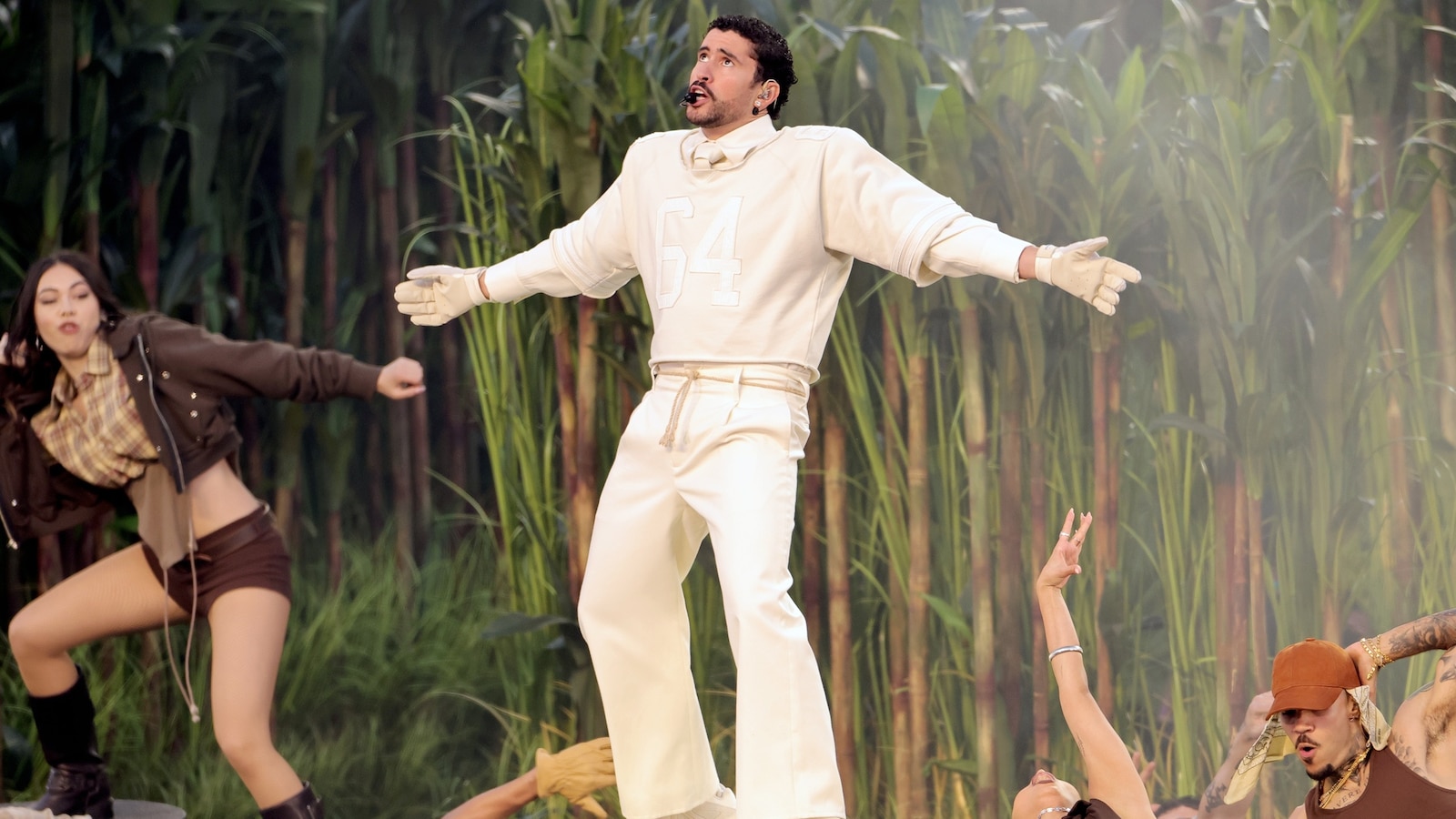
The moment millions had been waiting for finally arrived on Sunday as Bad Bunny took center stage at Levi Stadium in Santa Clara, California, delivering a halftime performance that will be remembered for years to come. Stepping into the spotlight wearing an all-white jersey-style outfit emblazoned with “Ocasio”—his actual last name—the global superstar immediately set the tone for what would be a deeply personal and culturally significant performance. The show opened with a breathtaking visual sequence showing Bad Bunny walking through towering sugar cane fields, a powerful nod to Puerto Rico’s agricultural heritage and the laborers who have worked those fields for generations. Surrounded by backup dancers dressed as field workers, this opening wasn’t just theatrical—it was a statement about where he came from and the people who shaped his identity. As the opening notes of “Tití Me Preguntó” filled the stadium, it became clear that this wasn’t going to be just another halftime show; it was going to be a celebration of Puerto Rican culture on one of the world’s biggest stages.
A Journey Through Bad Bunny’s Musical Evolution
Following the stunning opening, Bad Bunny launched into an energetic medley of his biggest hits, giving the audience a masterclass in his musical range and creativity. The stage transformed into “La Marqueta,” a beautifully designed set resembling a traditional Puerto Rican market, complete with vibrant colors and authentic details that transported viewers straight to the streets of San Juan. Against this backdrop, he performed crowd favorites including “BAILE INoLVIDABLE” and “NUEVAYoL,” with the energy in the stadium reaching fever pitch. One of the most jaw-dropping moments came when Bad Bunny literally crashed through a roof onto a completely new set, continuing his performance without missing a single beat—a testament to both his showmanship and the meticulous planning that went into every second of the production. The performance also included a touching tribute to his recent Grammy success, as the artist handed a Grammy award to a young boy on stage, symbolizing the passing of dreams to the next generation. The segment concluded with an explosion of fireworks during a powerful rendition of “DtMF,” illuminating the California sky. Throughout it all, Bad Bunny wore a Puerto Rican flag draped across his back for a portion of the show, ensuring that his homeland remained front and center in this momentous occasion.
Star-Studded Collaborations Elevate the Experience
The halftime show reached new heights when Lady Gaga made a surprise appearance, joining Bad Bunny for a salsa-infused version of their hit “Die with a Smile.” Dressed in a striking light blue dress with a red flower pinned near her shoulder, Gaga perfectly complemented the tropical aesthetic Bad Bunny had established. The chemistry between the two artists was undeniable as they shared a dance while backup dancers in matching all-white outfits moved in perfect synchronization around them. A band wearing red suits with blue undershirts provided live accompaniment, adding yet another layer of authenticity and cultural richness to the performance. The surprises didn’t end there—Puerto Rican icon Ricky Martin took the stage to perform a portion of Bad Bunny’s politically charged song “Lo Que Le Paso a Hawaii,” bringing generations of Latin music together in a powerful moment of solidarity. The celebration grew even larger as Cardi B, Jessica Alba, Karol G, and Pedro Pascal made appearances, turning the halftime show into a true cultural event. The diverse lineup of celebrities participating wasn’t just about star power; it represented the broad coalition of support for Bad Bunny’s message and the growing influence of Latin culture in mainstream American entertainment.
Breaking Barriers and Making History
Bad Bunny’s Super Bowl halftime performance represents far more than just an entertaining fifteen minutes—it marks a watershed moment for Spanish-language music and Latin representation in American popular culture. Just days before taking the Super Bowl stage, Bad Bunny had already made history at the Grammy Awards when his album became the first fully Spanish-language project ever to win Album of the Year, the music industry’s most prestigious honor. This groundbreaking achievement set the stage for what many are calling a cultural shift in how mainstream American audiences engage with non-English music. For decades, the Super Bowl halftime show has served as a barometer of American popular culture, and Bad Bunny’s selection as headliner—the first artist to perform a predominantly Spanish-language set—signals a recognition that American culture is evolving and expanding. The significance wasn’t lost on Bad Bunny himself, who in his Grammy acceptance speech dedicated the award “to all the people that had to leave their homeland, their country, to follow their dreams,” directly addressing the immigrant experience that shapes so many American stories. His willingness to use these massive platforms to speak to issues of identity, displacement, and cultural pride has resonated deeply with millions who see their own experiences reflected in his journey.
Navigating Controversy with Grace and Determination
Despite the overwhelming support for Bad Bunny’s selection, the announcement wasn’t without controversy. Some conservative groups and commentators voiced opposition, particularly taking issue with his outspoken advocacy for immigrants in the United States and his willingness to address political issues through his platform. Turning Point USA, a conservative advocacy organization, went so far as to stream its own counterprogrammed halftime show featuring Kid Rock, attempting to provide an alternative for viewers who disagreed with Bad Bunny’s selection. However, the NFL stood firmly behind its choice, with Commissioner Roger Goodell publicly reaffirming the league’s support at a press conference ahead of the game, calling Bad Bunny “one of the great artists in the world.” This backing from the NFL’s leadership sent a clear message that merit, popularity, and cultural significance—not political pressure—would determine who takes the Super Bowl stage. In the lead-up to his performance, Bad Bunny himself remained characteristically focused on the art rather than the controversy. At a February 5th press conference, when asked about what viewers could expect, he kept things simple: “I’m just trying to enjoy it. I know I’m gonna have fun. All the crew, all the people, they’re going to have fun that day.” This approach—letting the work speak for itself while remaining true to his values—has been a hallmark of his career and only added to the anticipation surrounding his performance.
From Vega Baja to the World’s Biggest Stage
The journey that brought Bad Bunny to the Super Bowl halftime show is as remarkable as the performance itself. Born Benito Antonio Martínez Ocasio in Bayamón, Puerto Rico, and raised in the town of Vega Baja, his upbringing was firmly rooted in working-class Puerto Rican life. His father, Tito Martínez, worked as a truck driver, while his mother, Lysaurie Ocasio, dedicated herself to teaching. These humble beginnings kept him grounded even as he achieved unprecedented global success, and his decision to wear “Ocasio” on his Super Bowl jersey was a direct tribute to his mother and the values she instilled in him. What makes Bad Bunny’s rise particularly unique is that he achieved global superstardom while singing almost exclusively in Spanish and refusing to compromise his cultural identity for broader commercial appeal. In an industry that has historically pressured Latin artists to record in English to reach wider audiences, Bad Bunny’s success represents a paradigm shift—proof that audiences are ready to embrace authentic cultural expression without requiring translation or assimilation. Reflecting on his unexpected journey, Bad Bunny has remained humble and focused on the creative process: “I was never looking for this. My biggest pleasure is to create, have fun doing it and connect with the people.” That genuine connection with his audience, combined with undeniable talent and cultural authenticity, has made him not just a musical phenomenon but a cultural ambassador for Puerto Rico and the broader Latin community. His Super Bowl performance wasn’t just entertainment—it was a declaration that Latin culture, Spanish-language music, and Puerto Rican pride have earned their place at the very center of American popular culture, and they’re not going anywhere.