



How Long Will the Bitcoin Bear Market Last? Understanding Price and Time Pain
The cryptocurrency market has been testing the patience of investors worldwide, with two critical questions dominating every discussion: how much further can Bitcoin fall, and more importantly, how much longer will this painful bear market persist? While most analysts have focused extensively on the price decline itself, the temporal aspect of this downturn deserves equal attention. These two dimensions of market suffering—price pain and time pain—affect investors in fundamentally different ways and understanding both is crucial for anyone holding or considering entering the cryptocurrency market.
Price pain is the more visible and immediately traumatic of the two. It manifests through sharp drawdowns and extreme volatility that can shake even experienced investors out of their positions. When Bitcoin plunges 10% or 20% in a matter of days, the psychological impact is immediate and visceral. Investors watch their portfolios shrink in real-time, triggering fear responses that often lead to panic selling. This type of pain is acute but often short-lived—it forces decisive action, whether that means capitulating and selling at a loss or doubling down with additional purchases at lower prices.
Time pain, however, operates on an entirely different psychological frequency. This is the slow, grinding erosion of confidence that comes from prolonged periods of range-bound, directionless price action. During these extended periods, the market neither crashes dramatically nor rallies significantly. Instead, it meanders sideways, exhausting both bulls who keep expecting a recovery and bears who anticipate further declines. This type of market condition is particularly brutal because it offers no resolution, no catharsis, and no clear signal about what comes next. Investors find themselves in a state of suspended animation, uncertain whether to cut losses, hold steady, or buy more. The monotony of watching prices drift without purpose can be more psychologically taxing than a sudden crash because it extends the uncertainty indefinitely.
Current Market Conditions and Historical Context
As of the latest data, Bitcoin is trading below $66,000, representing a decline of more than 3% in just the past 24 hours. More significantly, the leading cryptocurrency now sits approximately 45% below its all-time high reached in October, marking nearly six months of bear market conditions. This extended downturn has left many investors wondering whether we’re approaching the bottom or if there’s still further to fall. The combination of substantial price decline and extended duration has created a perfect storm of both price pain and time pain, testing the resolve of even the most committed Bitcoin believers.
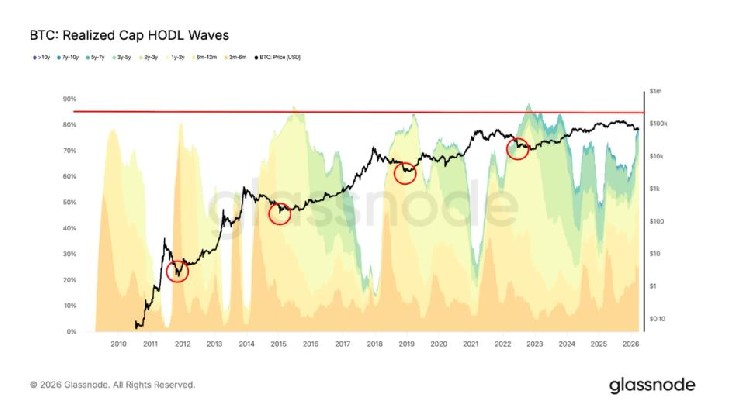
To gain perspective on where we might be in this cycle, analysts are turning to sophisticated on-chain metrics that examine actual blockchain data rather than just price charts. One particularly revealing indicator is the Realized Cap HODL Waves from Glassnode, a metric that provides insight into the composition of Bitcoin holders and their behavior patterns. This sophisticated analysis groups Bitcoin’s entire supply according to when coins last moved on the blockchain, creating bands that represent different holding periods. What makes this metric especially valuable is that it weights these holdings by their realized price—essentially the average price at which these coins last changed hands on the blockchain. This provides a much more nuanced picture than simply looking at current market price, as it reveals the cost basis and conviction level of different cohorts of investors.
What Historical Data Tells Us About Market Bottoms
Historical analysis of previous Bitcoin bear markets reveals a consistent pattern that offers hope for patient investors while also suggesting that more waiting may be required. Across multiple bear market cycles, the bottom has consistently coincided with long-term holders—defined as those who have held their Bitcoin for six months or more without moving it—controlling at least 85% of the total supply. This threshold appears to represent a critical mass of committed believers who have accumulated Bitcoin at depressed prices and demonstrated their conviction by refusing to sell despite continued uncertainty.
Interestingly, the data shows that price bottoms typically form first, with the long-term holder supply percentage reaching its peak levels only several months later. This lag makes intuitive sense when you consider investor psychology and behavior. When prices first bottom, many investors are still traumatized by the decline and reluctant to buy. Those who do accumulate at these levels need time to cross the six-month threshold to be classified as long-term holders. Additionally, some existing holders who bought at higher prices may finally capitulate near the bottom, temporarily reducing the long-term holder percentage even as price begins to stabilize. Only after several months of base-building, during which weak hands exit and strong hands accumulate and hold, does the long-term holder percentage reach the levels historically associated with durable market bottoms.
Where We Stand Now and What It Means for Investors
Currently, long-term holders account for approximately 80% of Bitcoin’s supply—a significant figure, but still short of the 85% threshold that has historically marked definitive bear market bottoms. This 5% gap might seem small, but in the context of Bitcoin’s $1+ trillion market capitalization, it represents a substantial amount of supply that still needs to either move into stronger hands or be held for longer periods before crossing into long-term holder status. If historical patterns hold true, this suggests that while the market may indeed be approaching a bottoming phase, we likely haven’t reached the final bottom yet.
More importantly for investors trying to time their entry or manage their existing positions, this data suggests that several more months of consolidation are likely still ahead. This means more time pain—more sideways trading, more uncertainty, and more testing of investor patience. The market may need to continue grinding through this process as remaining weak hands are shaken out and new accumulation occurs at these levels. For those hoping for a quick recovery and new all-time highs, this analysis suggests that patience will be essential. Bear markets don’t end with a bang but with a whimper, slowly building a foundation of strong hands that can support the next bull market.
For practical purposes, this means investors should mentally prepare for an extended period of unremarkable price action. Rather than obsessively checking prices hoping for a dramatic turnaround, it may be more productive to focus on accumulation strategies for those who believe in Bitcoin’s long-term value proposition, or simply to reduce the emotional energy invested in daily market movements. The time pain of bear markets serves an important function in cryptocurrency cycles—it exhausts the last remnants of weak conviction and excessive leverage, clearing the way for a healthier foundation for future growth. While neither price pain nor time pain is pleasant to experience, understanding where we are in the cycle can help investors maintain perspective and make more rational decisions rather than emotional ones driven by fear or impatience.