
President Trump Honors Fallen Service Members at Dover Air Force Base
A Solemn Return Home
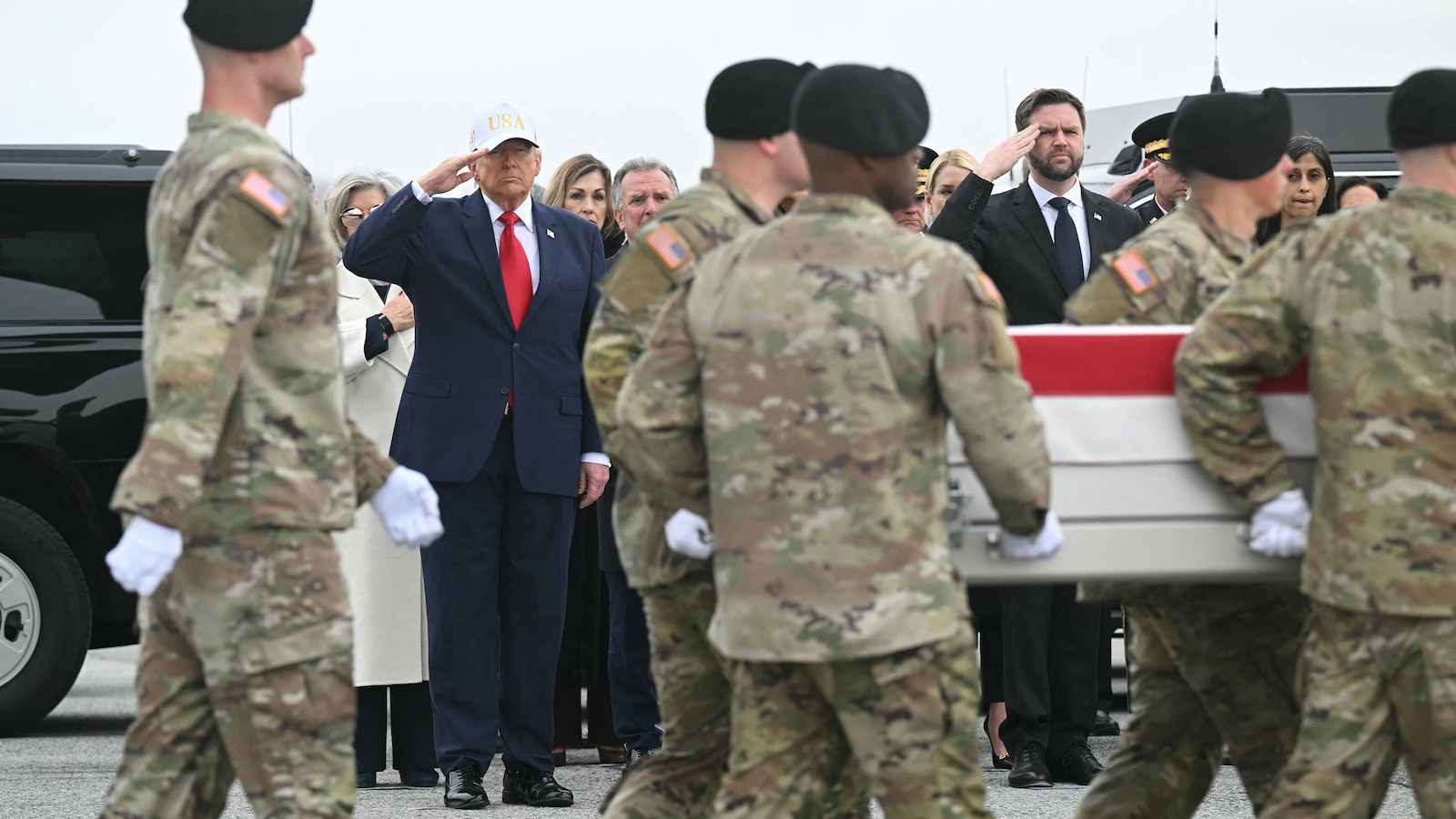
In one of the most somber moments of his presidency, President Donald Trump traveled to Dover Air Force Base in Delaware on Saturday to witness the dignified transfer of six American service members who lost their lives during military operations connected to the conflict with Iran. The fallen soldiers were killed in Kuwait during an Iranian drone attack at the Shuaiba port facility, marking the first American casualties in the escalating conflict. The dignified transfer ceremony, a time-honored military tradition, represents the moment when the remains of fallen service members are returned to American soil with full honors, attended by military officials, family members, and often the nation’s highest leaders.
Before attending the ceremony, President Trump spoke to Latin American leaders at the “Shield of the Americas” summit in Florida, where he acknowledged the gravity of the situation. “Very sad situation, to greet the families of the heroes coming home from Iran, coming home in a different manner than they thought they’d be coming home,” Trump said, his words carrying the weight of a commander-in-chief who would soon face the families of those who had made the ultimate sacrifice. “But they’re great heroes in our country, and we’re going to keep it that way,” he added, recognizing that casualties are an inevitable aspect of armed conflict while expressing his commitment to minimizing such losses. The president was joined by Vice President JD Vance, Defense Secretary Pete Hegseth, First Lady Melania Trump, White House Chief of Staff Susie Wiles, special envoy Steve Witkoff, and Attorney General Pam Bondi in paying respects to the fallen.
Remembering the Fallen Heroes
The Pentagon identified the six service members who perished in the attack, each representing different backgrounds and stages of life, yet united in their service to the nation. They were: Sgt. 1st Class Nicole M. Amor, 39, from White Bear Lake, Minnesota; Sgt. Declan J. Coady, 20, from West Des Moines, Iowa; Capt. Cody A. Khork, 35, from Winter Haven, Florida; Chief Warrant Officer 3 Robert Marzan, 54, from Sacramento, California; Maj. Jeffrey R. O’Brien, 45, from Indianola, Iowa; and Sgt. 1st Class Noah L. Tietjens, 42, from Bellevue, Nebraska. All six were assigned to the 103rd Sustainment Command, an Army Reserve unit headquartered in Des Moines, Iowa, highlighting the crucial role that reserve forces play in America’s military operations.
These soldiers died together during the opening hours of the conflict last weekend when an Iranian drone struck the Shuaiba port in Kuwait. This location serves as both a commercial harbor and a vital logistics hub for U.S. military operations in the region, making it a strategic target. The attack not only claimed these six lives but also wounded an additional 18 service members, underscoring the dangerous reality faced by American forces stationed abroad. The fact that these were reservists—citizen soldiers who balance civilian lives with military service—makes their sacrifice particularly poignant, as they represent everyday Americans from communities across the heartland who answered the call to serve when needed.
Families Remember Their Loved Ones
In the days following the tragic loss, families of the fallen service members began sharing public statements that painted intimate portraits of the people behind the uniforms. The family of Sgt. Declan Coady, the youngest of the fallen at just 20 years old, released a heartfelt statement remembering him as “a rock in all of our lives” and “the most amazing brother and son my family could have asked for.” The youth of Sergeant Coady serves as a stark reminder that those who serve in uniform are often at the beginning of their adult lives, with dreams and futures cut tragically short. His family’s words conveyed not just grief but pride in the young man he had become and the choice he made to serve his country.
Captain Cody Khork’s family also released a touching tribute to their fallen loved one. In their statement issued on Wednesday, they described how his life “was defined by devotion, character, and service.” They painted a picture of a man whose impact extended far beyond his military duties: “Cody was truly the life of the party, known for his infectious spirit, generous heart, and deep care for those who served alongside him and for everyone blessed to know him.” At 35, Captain Khork was in the prime of his life, someone who clearly brought joy and meaning to those around him while serving his nation with dedication. These personal remembrances transform statistics and ranks into real people—sons, daughters, brothers, sisters, parents, and friends whose absence will be deeply felt in their communities and among their fellow service members.
The President’s Response and Commitment
Following the dignified transfer ceremony, President Trump spoke briefly with reporters, describing the experience as emotionally difficult but necessary. “It’s very sad day, and glad we paid our respects, tough situation, great people, great parents, wives, family and a beautiful ceremony,” Trump said, acknowledging both the solemnity of the occasion and the strength of the families who had lost their loved ones. Before the arrival of the flag-draped transfer cases, Trump had met privately with the families of the fallen, offering condolences and spending time with those experiencing unimaginable grief. These private moments, away from cameras and public scrutiny, represent some of the most challenging duties any president must perform as commander-in-chief.
When a reporter asked whether witnessing the dignified transfer might change his thinking about the ongoing war or the deployment of troops to the Middle East, Trump’s response was resolute. “We’re winning the war by a lot,” he stated, adding, “We’ve decimated their whole evil empire. It’ll continue, I’m sure, for a little while.” His comments indicated that despite the human cost of the conflict, the president remained committed to the current military strategy and confident in its outcomes. When asked aboard Air Force One whether he would return to Dover for additional dignified transfers should more casualties occur, Trump didn’t hesitate: “Sure, I hate to do it, but it’s a part of war.” This acknowledgment reflects the grim reality that military conflict inevitably brings casualties, and that the commander-in-chief must be prepared to honor those who fall in service to the nation, regardless of how painful that duty may be.
The Broader Context of Conflict
The deaths of these six service members occurred during what appears to be an escalating conflict between the United States and Iran, with Kuwait serving as a staging ground for American military logistics operations. The Shuaiba port, where the fatal drone attack occurred, represents the kind of vulnerable but essential infrastructure that modern military operations depend upon. Supply chains, logistics hubs, and sustainment operations—the very mission of the 103rd Sustainment Command—are critical to maintaining military readiness and operational capability, yet they can also present targets for adversaries employing asymmetric warfare tactics like drone strikes. The fact that Iran chose to strike at this location demonstrates both strategic targeting and the evolving nature of modern warfare, where unmanned systems can deliver lethal force against personnel who may not be in direct combat roles but are nonetheless essential to military operations.
The timing of these casualties, described as occurring “in the opening hours of the conflict,” suggests that tensions between the United States and Iran have moved from diplomatic standoff or limited engagement to more sustained military action. President Trump’s characterization of American forces having “decimated their whole evil empire” indicates significant military operations against Iranian assets or proxies, though the full scope of the conflict remains unclear from the available information. The president’s willingness to acknowledge that the conflict will “continue, I’m sure, for a little while” suggests an expectation that military operations will persist, bringing with them the possibility of additional casualties. This reality makes the Dover ceremony not just a memorial for six fallen service members, but potentially the first of several such solemn occasions, as the president himself acknowledged when stating he would return to honor additional fallen troops if necessary. For the families, communities, and fellow soldiers of those who have already paid the ultimate price, the grief is immediate and personal, while for the nation, these losses serve as a reminder of the true cost of military engagement and the sacrifices made by those who volunteer to serve.