


Trump’s Science Council: A New Era for AI, Crypto, and Big Tech in Federal Policy
Bridging Technology and Government Leadership
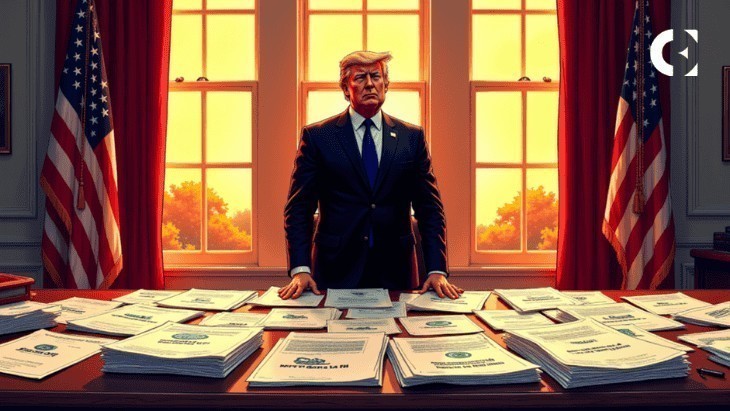
In a move that signals a significant shift in how emerging technologies will shape federal policy, President Donald Trump is assembling a powerhouse science council that brings together some of the biggest names in artificial intelligence, cryptocurrency, and technology. This isn’t just another advisory board filled with academic voices—it’s a strategic gathering of industry titans who are actively building the technologies that will define the next decade. The Presidential Council of Advisors on Science and Technology is taking shape as a critical junction where Silicon Valley innovation meets Washington policymaking, and the composition of this group suggests that digital assets and artificial intelligence will no longer be afterthoughts in national technology strategy.
The announcement has generated considerable buzz across social media and technology circles, particularly after detailed posts on X (formerly Twitter) brought attention to the caliber of individuals being nominated. What makes this council particularly noteworthy is its explicit inclusion of cryptocurrency advocates alongside AI pioneers, suggesting that the administration views these technologies as interconnected pieces of America’s competitive future rather than separate domains. At a time when crypto markets face continued pressure and regulatory uncertainty has clouded the industry’s prospects, having direct representation at the highest levels of government advisory structures represents a meaningful validation of digital assets as a legitimate component of national innovation policy.
An All-Star Lineup of Technology Innovators
The roster of nominees reads like a guest list for an exclusive technology summit. Jensen Huang, the visionary CEO of NVIDIA who has become synonymous with the AI revolution through his company’s dominance in graphics processing units essential for machine learning, is joining the council. Mark Zuckerberg, the Meta founder who has pivoted his company toward the metaverse and AI integration, will lend his perspective on social platforms and next-generation internet infrastructure. Google co-founder Sergey Brin brings decades of experience in search, artificial intelligence, and autonomous systems. Oracle’s Larry Ellison, one of the original Silicon Valley success stories, adds his expertise in enterprise software and cloud infrastructure that powers modern AI applications.
The council also includes Lisa Su, the CEO of AMD who has led her company’s remarkable turnaround and positioned it as a serious competitor in the AI chip market. Michael Dell, whose company bears his name and remains a force in computing infrastructure, rounds out the hardware perspective. Safra Catz from Oracle provides additional insight into enterprise technology and cloud services. This collection of leaders represents not just different companies but different approaches to technology—from chips and hardware to platforms and software to cloud infrastructure and enterprise systems. Together, they command influence over technologies that touch billions of lives daily and generate trillions in economic value.
Leading this remarkable assembly will be two co-chairs: David Sacks, who serves as the White House AI and crypto czar, and Michael Kratsios, the former U.S. Chief Technology Officer. Sacks brings a unique combination of venture capital experience, entrepreneurial success, and explicit advocacy for both artificial intelligence development and cryptocurrency adoption. His appointment as co-chair signals that crypto will not be treated as a fringe topic but as central to the council’s mission. Kratsios, meanwhile, brings government experience and a track record of working across agencies to advance technology policy. The council initially includes thirteen members but has the potential to expand to as many as twenty-four, suggesting that additional voices from various technology sectors may join in the future.
Cryptocurrency Earns a Seat at the Policy Table
Perhaps the most significant aspect of this council from the perspective of the digital asset industry is the explicit inclusion of cryptocurrency advocates. Two names stand out in this regard: Fred Ehrsam, co-founder of Coinbase, the largest cryptocurrency exchange in the United States, and Marc Andreessen, co-founder of the influential venture capital firm Andreessen Horowitz, which has become one of the most significant investors in blockchain and cryptocurrency projects. Their presence on the council is more than symbolic—it represents a formal acknowledgment that cryptocurrency and blockchain technology deserve consideration alongside artificial intelligence, quantum computing, and other frontier technologies that will shape America’s competitive position.
For years, the cryptocurrency industry has struggled with an uncertain regulatory environment, with different agencies taking conflicting approaches and legislation stalling in Congress. Advocates have long argued that this uncertainty puts American innovation at a disadvantage compared to other nations that have established clearer frameworks for digital assets. Having direct representation within a presidential advisory council creates a channel for cryptocurrency perspectives to reach policymakers before regulations are written rather than after. It positions digital assets not as a problem to be managed but as an innovation opportunity to be harnessed as part of broader technology competitiveness.
This development is particularly significant given the timing. The cryptocurrency market has faced substantial headwinds, including high-profile exchange failures, regulatory crackdowns, and questions about the practical utility of blockchain technology beyond speculation. The inclusion of crypto voices in this council suggests a longer-term view that looks past current market conditions to the potential role of decentralized technologies in future financial infrastructure, digital identity systems, and new forms of value transfer. For investors and entrepreneurs in the space, this represents a meaningful shift in how government views the industry—not as a temporary phenomenon or speculative bubble, but as a legitimate component of America’s technology ecosystem that deserves a place in strategic planning conversations.
Market Realities: Short-Term Pain Despite Long-Term Positioning
While the political and policy developments represent positive long-term signals for the cryptocurrency industry, the immediate market reality tells a different story. At the time these council nominations gained attention, Bitcoin was trading near $69,170, having declined approximately 2.4% over the previous 24 hours. Ethereum, the second-largest cryptocurrency, had fallen to around $2,070, and Solana, a popular smart contract platform, was trading near $88. These price movements reflect broader market pressure that has weighed on risk assets, with factors including macroeconomic uncertainty, rising oil prices, and reduced risk appetite among investors affecting digital assets alongside technology stocks and other growth-oriented investments.
This disconnect between positive policy developments and negative price action is not unusual in cryptocurrency markets, which have historically exhibited volatility that often seems disconnected from fundamental developments. Traders and short-term speculators respond to immediate supply and demand dynamics, leverage liquidations, and technical chart patterns, while long-term investors focus on adoption trends, regulatory clarity, and institutional acceptance. The council appointments clearly fall into the category of long-term structural developments rather than immediate price catalysts. They suggest improving conditions for cryptocurrency companies to operate, innovate, and integrate with traditional financial systems, but they don’t change the immediate trading environment or resolve near-term uncertainties about interest rates, economic growth, or global risk sentiment.
For market participants trying to interpret these mixed signals, the key takeaway is that policy positioning and price movements can diverge significantly, especially over short time horizons. The fact that cryptocurrency leaders are joining a presidential science council doesn’t prevent a sell-off driven by technical factors or broad market risk aversion. However, it does potentially improve the environment in which the industry operates over months and years, which matters more for builders, long-term investors, and companies planning multi-year strategies. The challenge for anyone involved in cryptocurrency is maintaining perspective about which developments matter for which timeframes and not expecting immediate market reactions to validate every positive policy development.
Strategic Implications: Technology Competition and National Security
The formation of this council reflects broader strategic concerns about America’s position in critical technologies. Artificial intelligence has become a focus of geopolitical competition, with nations racing to develop capabilities that could provide military, economic, and intelligence advantages. Cryptocurrency and blockchain technology, while less immediately connected to national security concerns, relate to questions about the future of the dollar’s global reserve status, financial infrastructure resilience, and whether decentralized technologies might challenge centralized control in ways that affect governance. By bringing together leaders in both AI and crypto, the council acknowledges these technologies as interconnected elements of 21st-century competition.
China’s aggressive development of AI capabilities and its experimentation with a central bank digital currency have created pressure on U.S. policymakers to develop coherent strategies rather than reactive regulations. The European Union has moved forward with comprehensive AI regulations and frameworks for digital assets, creating clear rules that provide certainty for businesses even as American companies navigate fragmented state and federal approaches. This council could potentially help coordinate a more strategic approach that considers how different technologies interact and how regulatory decisions in one domain might affect innovation in another. The presence of industry leaders who understand these technologies deeply could help policymakers avoid unintended consequences and design frameworks that protect important values while enabling continued innovation.
The expansion potential of the council—from thirteen to potentially twenty-four members—suggests that additional perspectives may be incorporated as specific needs emerge. This could include voices from cybersecurity, quantum computing, biotechnology, or other domains where rapid technological advancement creates both opportunities and challenges. The ultimate effectiveness of the council will depend not just on who serves but on how seriously their advice is taken and whether it translates into coherent policy that helps American companies and researchers maintain leadership in critical technologies. For the cryptocurrency industry specifically, success would mean regulatory clarity that allows compliant innovation to flourish while addressing legitimate concerns about fraud, money laundering, and consumer protection without stifling the technology’s potential to create new forms of value and financial inclusion.