
Trump’s Insurance Offer Fails to Calm Maritime Industry as Strait of Hormuz Crisis Deepens
A Presidential Proposal Meets Skepticism
In the wake of escalating tensions following a US military strike on Iran, President Donald Trump has put forward an unconventional solution to reassure the global shipping industry. Taking to Truth Social on Tuesday, Trump announced that the United States would offer insurance coverage “at a very reasonable price” to protect maritime trade passing through the strategically vital Strait of Hormuz. This ambitious proposal extends beyond just financial coverage, as the president also floated the idea of deploying naval escorts to shepherd oil tankers and cargo vessels safely through the Persian Gulf. This narrow waterway serves as the gateway for approximately one-fifth of the world’s oil supply, making it an economic chokepoint of global significance. However, despite the administration’s attempt to project confidence and stability, the maritime insurance market has responded with caution rather than relief, with premiums skyrocketing as the strait has effectively become a no-go zone for commercial shipping.
Lloyd’s of London Raises Red Flags
The reaction from Lloyd’s of London, the venerable insurance marketplace that has been assessing maritime risks for centuries, has been decidedly underwhelming toward Trump’s initiative. Industry experts operating within this historic institution have expressed significant concerns about both the practicality and desirability of the proposed American intervention. Neil Roberts, who serves as secretary of the Joint War Committee (JWC) representing Lloyd’s market participants, made it clear that the insurance industry remains uncertain about the details of Trump’s plan. “I don’t think the details of such a scheme have been given to anyone, so far as we know, and it will take time to work it out, and the appetite is unknown,” Roberts explained to Sky News. More fundamentally, he emphasized that the private insurance market continues to function effectively despite the crisis, stating bluntly that “there isn’t a perception here that there’s a need for intervention at this time.” The JWC has already taken its own protective measures, expanding its designated “high-risk” area to encompass the entire Persian Gulf, a move that reflects the gravity of the current situation and allows underwriters to reassess their exposure on a case-by-case basis.
The Paradox of Naval Protection
Perhaps most troubling for the shipping industry is the suggestion from insurance experts that Trump’s proposed naval escorts might actually increase rather than decrease the dangers facing commercial vessels. This counterintuitive assessment stems from the specific nature of the current conflict and Iran’s apparent targeting priorities. As Roberts pointed out, “There will be those who think it might increase the target, because the Iranians are targeting US military.” In other words, a tanker traveling under American naval protection might find itself transformed from a neutral commercial vessel into a legitimate military target in Iranian eyes. Furthermore, the evolving nature of modern warfare presents challenges that traditional naval escorts may be ill-equipped to handle. “It’s not known how capable they would be against the new drone and missile threats that we’re seeing. This is not the same as the 80s,” Roberts cautioned, referring to an earlier period when US Navy ships protected Kuwaiti tankers during the Iran-Iraq War. Today’s threat environment involves sophisticated unmanned aerial vehicles and precision missiles that can strike with little warning, making the protective value of surface warships questionable at best.
Insurance Premiums Reflect New Reality
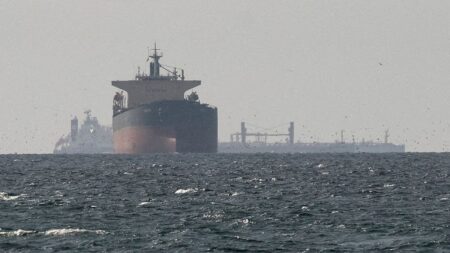
As underwriters scramble to recalculate their exposure to Middle Eastern shipping lanes, the cost of insuring vessels traveling through the region has experienced dramatic increases. Reports suggest that war-risk insurance premiums have jumped as much as twelvefold compared to pre-crisis levels, reflecting the genuine danger that shipping companies now face when contemplating voyages through the Persian Gulf. These increases aren’t arbitrary panic reactions but rather calculated responses to fundamental changes in the risk environment. Multiple tankers have already suffered direct attacks since hostilities began, and critical energy infrastructure in Saudi Arabia, Qatar, and the United Arab Emirates has also been targeted, demonstrating that the Iranian response extends across the entire Gulf region. Satellite tracking data shows a telling picture of the crisis: scores of vessels sitting stationary at anchor on both sides of the Strait of Hormuz, their captains and owners unwilling to risk passage through waters that have become a potential war zone. This maritime traffic jam has immediate consequences for global energy markets, with both crude oil and natural gas prices spiking in response to supply concerns.
Ripple Effects Across Global Economy
While the most immediate impact of the Strait of Hormuz closure has been felt in commodity markets, particularly for energy products, the potential for broader economic disruption looms large if the crisis continues. The 20% of global oil supply that normally transits this narrow waterway represents a significant enough portion of world energy needs that any prolonged interruption could begin drawing down strategic petroleum reserves maintained by major economies. Should those reserves become depleted, the consequences would extend far beyond elevated fuel prices at the pump, potentially affecting everything from manufacturing costs to agricultural production that depends on petroleum-based fertilizers and diesel-powered equipment. Additionally, the Persian Gulf states themselves face supply challenges, as the same shipping routes that carry their oil exports to market also bring in essential imports of food, consumer goods, and other products from Europe, Africa, and Asia. The United Arab Emirates government has already felt compelled to issue public advisories about the situation, informing citizens that while the country maintains stockpiles sufficient for four to six months, residents should avoid panic buying and purchase only what they genuinely need to ensure equitable distribution.
Uncertain Path Forward
The current standoff in the Strait of Hormuz represents a collision between traditional commercial interests, modern insurance practices, and great power military posturing, with no clear resolution in sight. Trump’s offer of government-backed insurance and naval protection, while perhaps well-intentioned from a political standpoint, has failed to address the fundamental concerns of an industry that deals in concrete risk assessment rather than diplomatic assurances. Tanker owners and operators find themselves in an impossible position: delighted that assistance has been offered but simultaneously uncertain whether accepting American protection might paint a target on their vessels rather than provide genuine security. The insurance market, meanwhile, continues to do what it has done for centuries—carefully pricing risk based on observable conditions rather than political promises. As underwriters recalculate their exposure and adjust premiums accordingly, the message to the shipping industry is clear: the Persian Gulf has become genuinely dangerous, and no presidential announcement will change that underlying reality. Until the military tensions that sparked this crisis are resolved through diplomacy or otherwise, the world’s most important oil shipping lane will remain a high-stakes gamble that fewer vessel operators are willing to take, regardless of what insurance options might be available.