



Wall Street’s Blockchain Revolution: DTCC Takes Corporate Actions Onchain
The Unglamorous Yet Critical Shift in Capital Markets Infrastructure
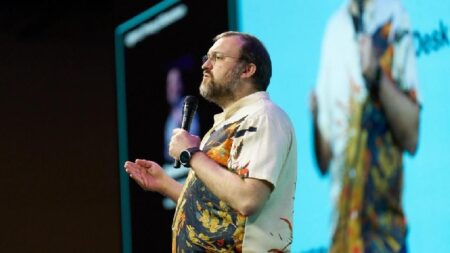
In a development that could fundamentally transform how Wall Street operates behind the scenes, the Depository Trust and Clearing Corporation (DTCC) is pioneering an ambitious initiative to modernize one of finance’s most essential yet least understood processes. Frank La Salla, the organization’s CEO, revealed at the Consensus 2026 conference in Miami that his team is actively partnering with blockchain developers to revolutionize corporate actions—the routine but operationally intensive tasks like dividend payments and tender offers that keep capital markets functioning smoothly. While this might not sound like headline-grabbing news to the average investor, it represents a seismic shift in market infrastructure that could reshape how trillions of dollars move through the financial system daily.
The DTCC isn’t just another financial institution; it’s the backbone of American capital markets, processing an astounding $20 trillion in Treasury and corporate securities transactions every single day. When La Salla talks about bringing corporate actions onchain, he’s speaking about potentially revolutionizing processes that affect virtually every stock, bond, and security traded in the United States. Corporate actions might sound mundane, but they encompass everything from quarterly dividend distributions that reach millions of shareholders to complex restructuring events that can involve billions of dollars. Getting these processes right isn’t optional—it’s essential to maintaining trust and efficiency in the world’s largest capital markets.
The Performance Challenge: Why Current Blockchains Aren’t Quite Ready
Despite the excitement surrounding blockchain technology, La Salla was refreshingly candid about the current limitations preventing immediate widespread adoption. The fundamental problem is speed and scale. Right now, most blockchain networks simply can’t match the performance requirements of institutional finance. La Salla pointed out that processing corporate actions on current blockchain infrastructure could take several days—an eternity in modern finance where settlement times are measured in hours or even minutes. This bottleneck is particularly problematic when you consider the sheer volume the DTCC handles: millions of dividend payments processed and distributed to the financial industry every single day.
This is where the DTCC’s collaboration with layer-1 blockchain networks becomes crucial. La Salla emphasized that his organization is working specifically with “very good L1s” that are focused on dramatically improving processing speeds and building greater system resilience. The technical challenge isn’t trivial—these blockchain networks need to handle institutional-grade volumes while maintaining the security, finality, and reliability that traditional clearinghouses have spent decades perfecting. It’s not enough for a blockchain to work well in theory or handle moderate transaction volumes; it needs to perform flawlessly when processing millions of complex financial events simultaneously, with zero tolerance for errors or delays that could cascade through the entire financial system.
From Exploration to Implementation: DTCC’s Blockchain Journey
The DTCC hasn’t rushed into blockchain technology overnight. La Salla revealed that the organization has spent nearly a decade exploring potential blockchain applications, carefully studying the technology and waiting for the right moment to commit significant resources. According to him, blockchain only became “commercially meaningful” once genuine, practical use cases began emerging in recent years—a stark contrast to the hype-driven approaches that characterized earlier blockchain adoption attempts. This patient, methodical approach reflects the conservative nature necessarily adopted by institutions that serve as critical infrastructure for the entire financial system, where mistakes can have systemic consequences.
Recently, however, the pace has accelerated dramatically. The DTCC announced this week that it will begin testing its tokenized securities platform in July, with plans for a broader rollout scheduled for October. This timeline represents a significant acceleration in blockchain adoption at the institutional level, signaling that the technology has finally matured to the point where it can meet the demanding requirements of real-world financial infrastructure. The move from exploratory research to active testing and implementation marks a watershed moment not just for the DTCC but for the entire tokenization movement, demonstrating that blockchain has evolved beyond experimental pilot programs to become a viable technology for mission-critical financial operations.
Tokenized Collateral: The First Killer App for Institutional Blockchain
Among the various potential applications, La Salla identified one that could become blockchain’s breakthrough use case in institutional finance: collateral movement. In the current system, when firms need to post collateral to secure loans or meet margin requirements, they’re constrained by traditional settlement windows and banking hours. This creates inefficiencies, especially for global firms operating across different time zones. Tokenized collateral could eliminate these constraints entirely, allowing financial institutions to access liquidity in real-time, regardless of what time it is in New York or whether markets are officially open.
La Salla painted a compelling picture of this future: imagine a financial firm in Asia needs U.S. dollars on a Sunday—when New York markets are closed and traditional settlement infrastructure is essentially offline. With tokenized collateral on blockchain, that firm could post digital assets instantly and receive immediate access to the liquidity they need, without waiting for Monday morning in New York. “That is incredibly powerful,” La Salla emphasized, and it’s easy to see why. This capability would fundamentally change how global financial institutions manage their capital and liquidity, enabling 24/7 operations in markets that have historically been constrained by geography and business hours. For firms managing trillions in assets across multiple jurisdictions, this kind of operational flexibility could translate into significant competitive advantages and capital efficiencies.
The Challenges Ahead: Scalability, Fragmentation, and the Concentration Paradox
Despite his optimism about specific use cases, La Salla was equally clear-eyed about the substantial hurdles that still need to be overcome before blockchain can become the foundation of market infrastructure. He highlighted three major challenges: scalability, liquidity fragmentation, and risk management. Each of these represents a complex technical and operational problem that can’t be solved simply by increasing computing power or network speed. Scalability issues go beyond just processing more transactions per second—they encompass the ability to handle increasingly complex financial instruments and corporate actions while maintaining security and finality.
Perhaps most interestingly, La Salla pointed out a fundamental tension between blockchain’s decentralized architecture and the efficiency gains that traditional financial infrastructure achieves through centralization. One of the key functions the DTCC performs is transaction netting—taking massive volumes of individual trades and compressing them into much smaller net settlement obligations. For example, if Bank A sells securities to Bank B in one trade and Bank B sells different securities to Bank A in another trade, netting allows these transactions to be offset against each other, dramatically reducing the amount of capital that needs to physically change hands. This concentration of liquidity creates enormous efficiencies and reduces systemic risk.
However, as La Salla noted, “Blockchain is decentralized. Many of the efficiencies that we get in our industry are through concentration of liquidity.” This observation cuts to the heart of a critical question facing blockchain adoption in finance: how do you preserve the efficiency benefits of concentrated, centralized systems while gaining the advantages of decentralized, distributed technology? The answer likely isn’t a simple binary choice between centralization and decentralization but rather a hybrid approach that combines the best aspects of both paradigms. Finding that balance will be essential to creating blockchain-based infrastructure that isn’t just technologically interesting but actually superior to existing systems in practical, measurable ways that justify the massive investment and operational risk involved in transformation.
The DTCC’s measured but committed approach to blockchain adoption offers a roadmap for how critical financial infrastructure can evolve without creating unacceptable risks. By focusing on specific, high-value use cases like tokenized collateral while candidly acknowledging current limitations, the organization is charting a course that balances innovation with the prudent risk management that systemically important institutions must maintain. As testing begins this summer and broader implementation approaches, the financial world will be watching closely to see whether blockchain can finally fulfill its promise of transforming not just the trendy edges of finance but its essential core infrastructure.