

Tragic Loss: 40-Ton Whale Dies on Washington Shores
A Heartbreaking Discovery on Samish Island
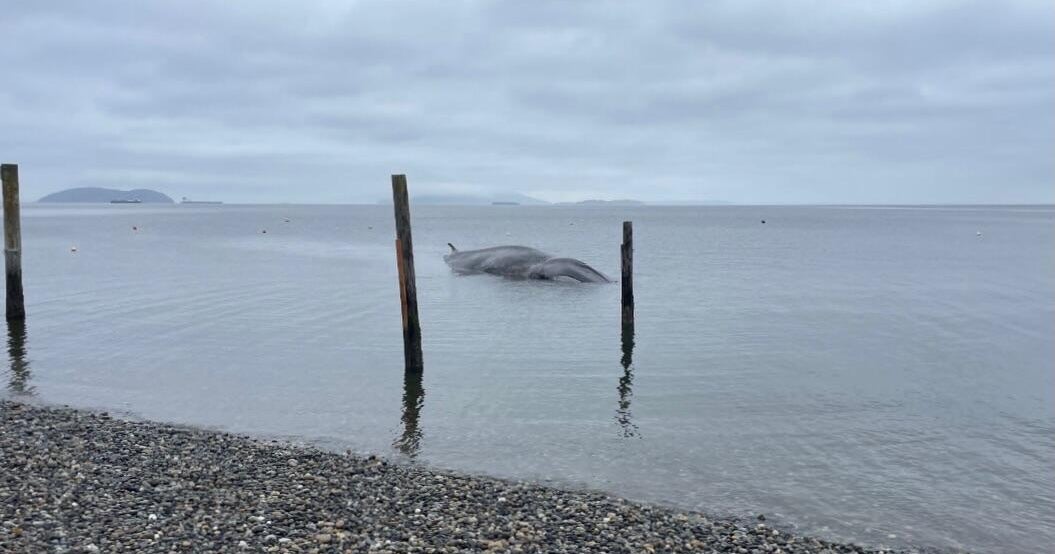
The peaceful shores of Samish Island in Washington became the site of a devastating natural tragedy this week when a massive fin whale—weighing approximately 40 tons and stretching over 61 feet long—was found stranded on the island’s gravel beach. The National Oceanic and Atmospheric Association (NOAA) first received reports of the stranded marine giant on Monday night, prompting an urgent response from local marine researchers and wildlife experts. By the time rescue teams arrived on Tuesday morning, however, the magnificent creature had already succumbed to its fate. The haunting image of this enormous mammal lying helplessly in shallow water serves as a stark reminder of the increasing challenges facing marine wildlife along the Pacific Northwest coastline. Fin whales, recognized as the second-largest animals on our planet after blue whales, represent one of nature’s most awe-inspiring creations, making this loss particularly poignant for both the scientific community and animal lovers everywhere.
Understanding the Magnitude of the Loss
The sheer size of the stranded whale presented unique challenges for potential rescue efforts. At more than 61 feet in length—roughly the size of a six-story building laid on its side—and weighing about 40 tons (equivalent to approximately six full-grown elephants), this male fin whale represented one of nature’s most impressive specimens. However, by the time researchers reached the animal, its condition told a troubling story. NOAA officials noted that the whale’s overall health had significantly deteriorated, and the animal appeared severely emaciated, suggesting it had been struggling for survival long before it washed ashore. The reality of dealing with such an enormous stranded animal is that rescue options are extremely limited. Unlike smaller marine mammals that can sometimes be transported back to deeper waters, the massive size and weight of fin whales make physical intervention nearly impossible. This harsh reality meant that rescue teams could only document the whale’s condition and prepare for the next steps in understanding what led to this tragic death.
The Next Steps: Understanding Through Science
Following the whale’s death, NOAA announced plans to conduct a comprehensive necropsy—essentially an animal autopsy—to determine the exact cause of death and gather valuable scientific data about the whale’s health, diet, and life history. These examinations are crucial for marine biologists and conservationists working to understand the threats facing whale populations. Tissue samples, stomach contents, and physical measurements can reveal important information about everything from the whale’s recent feeding patterns to potential exposure to toxins or disease. After the necropsy is completed, NOAA indicated that the massive carcass will be left in place to decompose naturally. While this might seem unusual, allowing nature to take its course actually serves an important ecological purpose. The decomposing whale will provide nutrients to the local ecosystem, feeding scavengers and eventually enriching the marine environment. This natural process, though difficult to witness, represents the circle of life in action and ensures that even in death, the whale continues to contribute to the environment it called home.
An Alarming Trend Along Washington’s Coast
What makes this recent death even more concerning is that it’s far from an isolated incident. According to CBS affiliate KIRO, Washington state has experienced at least 16 whale deaths over the past year—a significant spike that has marine experts deeply worried. Since March alone, there have been at least 13 whale strandings reported along the state’s coastline. This pattern represents a disturbing trend that suggests something more systemic may be affecting the health and survival of whales in Pacific Northwest waters. Marine biologists who have studied these deaths are noticing consistent patterns that point toward underlying environmental issues rather than random individual tragedies. The frequency and concentration of these deaths in Washington waters over such a relatively short period cannot be dismissed as mere coincidence. Instead, researchers are working to understand what environmental factors, human activities, or ecosystem changes might be creating deadly conditions for these majestic creatures who have navigated Earth’s oceans for millions of years.
Climate Change: A Silent Killer in Our Oceans
John Calambokidis, founder of the Cascadia Research Collective and a respected voice in marine mammal research, has offered a troubling explanation for the recent surge in whale deaths: starvation linked to climate change. According to Calambokidis’s observations, many of the deceased whales showed signs of severe malnutrition and emaciation, suggesting they had been unable to find adequate food sources. The connection to climate change involves the complex relationship between ocean temperatures, food chain dynamics, and whale feeding patterns. Fin whales and other species that frequent Washington waters traditionally rely on rich food supplies from Arctic and Alaskan regions. However, as our planet’s climate continues to warm, these cold-water ecosystems are undergoing dramatic transformations. Rising ocean temperatures affect the distribution and abundance of krill, small fish, and other prey species that form the foundation of whale diets. When these food sources diminish or migrate to different areas in response to changing water conditions, whales must travel farther, expend more energy, and sometimes simply cannot find enough nutrition to survive. The emaciated condition of the Samish Island whale aligns perfectly with this starvation hypothesis, adding one more data point to a growing body of evidence that climate change is creating life-or-death consequences for marine mammals.
What We Can Do: Community Response and Conservation
In response to the ongoing crisis, NOAA and other marine wildlife organizations are urging coastal communities to remain vigilant and report any sightings of stranded or distressed whales immediately. The agency has emphasized that members of the public should never attempt to move a stranded whale or interact with it directly, as this can be dangerous for both humans and the animal. Instead, observers should contact authorities right away, providing location details and any relevant observations about the whale’s condition. Quick reporting allows trained professionals to assess the situation and take appropriate action, whether that means attempting rescue for animals that might still be saved or properly documenting deaths for scientific research. Beyond immediate response to strandings, addressing the broader crisis requires collective action on climate change and ocean conservation. Supporting policies that reduce greenhouse gas emissions, protect marine habitats, and establish sustainable fishing practices all contribute to creating healthier ocean ecosystems where whales can thrive. Educational initiatives that help communities understand the connection between human activities and marine wildlife health are also crucial. As witnesses to these tragic deaths continue to accumulate along Washington’s beautiful coastline, the message becomes increasingly clear: the health of our oceans and the survival of creatures like fin whales are intimately connected to the choices we make about our planet’s future. Each stranded whale represents not just an individual loss but a warning sign that demands our attention and action.