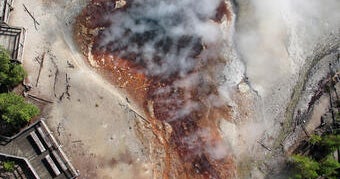

The Awakening of Yellowstone’s Sleeping Giant: Echinus Geyser Returns to Life
A Rare Natural Phenomenon Springs Back to Activity
After more than five years of relative silence, one of Yellowstone National Park’s most distinctive geological features has roared back to life, capturing the attention of scientists and nature enthusiasts alike. Echinus Geyser, holding the unique distinction of being the world’s largest acidic geyser, has resumed its spectacular eruptions, offering visitors and researchers a rare opportunity to witness a natural wonder that had been largely dormant since 2017. Located in the remote back basin of the Norris Geyser Basin at Yellowstone, this geological marvel spans approximately 66 feet in width and stands as a testament to the dynamic and unpredictable nature of our planet’s geothermal activity. The recent revival of Echinus has sparked excitement throughout the scientific community and among park officials, who announced the news on Monday, reminding us all that nature operates on its own timeline, indifferent to human expectations or schedules.
The Unique Character and History of Echinus Geyser
What makes Echinus truly special isn’t just its size or sporadic activity—it’s the remarkable chemistry that sets it apart from virtually every other geyser on Earth. The name “Echinus” itself tells a story of scientific observation and poetic naming. When mineralogist Albert Charles Peale visited the site way back in 1878, he was struck by the peculiar rock formations surrounding the geyser pool. These rocks, with their spiny, irregular surfaces, reminded him of sea urchins, and since “echinus” is the Greek word for sea urchin, the name stuck. This wasn’t merely creative wordplay; it was an accurate description of a geological feature shaped by unique chemical processes. The geyser’s acidity comes from an intriguing combination of acidic gases mixing with neutral waters deep beneath the earth’s surface. Unlike many other acidic geysers that essentially destroy themselves over time—their acidic waters eating away at the very rock structures that allow them to function—Echinus has found a delicate balance. Its acidity level, comparable to common household items like orange juice or vinegar according to park officials, is strong enough to create distinctive features but not so corrosive that it breaks down the geyser’s essential plumbing system. This “somewhat unique water chemistry,” as Yellowstone describes it, produces fascinating visual effects including the striking red coloring around the geyser pool and those distinctive spiny rock formations that first caught Peale’s attention nearly 150 years ago.
The Glory Days: When Echinus Was Yellowstone’s Most Accessible Geyser
There was a time, not so long ago in geological terms, when Echinus was one of Yellowstone’s most reliable and visitor-friendly attractions. During the latter half of the 20th century, this geyser performed with remarkable regularity, erupting so frequently and predictably that park officials installed special viewing platforms and benches, allowing tourists to get closer to an active geyser than anywhere else in the park. The 1970s represented Echinus at perhaps its most consistent, with eruptions occurring like clockwork every 40 to 80 minutes—frequent enough that visitors could plan their schedules around witnessing this natural spectacle. By the 1980s and 1990s, while the frequency had decreased somewhat, the eruptions themselves became even more dramatic and impressive. Some eruptions during this period would last for an astonishing 90 minutes, with water shooting as high as 75 feet into the air. What made these eruptions particularly memorable for visitors was their occasional unpredictability in direction—some eruptions would shoot horizontally rather than vertically, drenching unsuspecting spectators in warm, slightly acidic water. For many tourists, getting soaked by Echinus became a badge of honor, a unique Yellowstone experience they couldn’t get anywhere else. Those were the glory days when Echinus was a must-see attraction, featured prominently in park brochures and tour guides, a reliable performer in Yellowstone’s geological theater.
The Long Slumber: Tracking Echinus Through Its Quiet Years
As often happens with geothermal features, Echinus began to change its behavior in ways that puzzled scientists and disappointed visitors. The early 2000s marked the beginning of what would become an extended period of diminished activity. The reliable eruptions that had characterized the geyser for decades became less frequent, less predictable, and eventually almost nonexistent. Recognizing the scientific value of understanding these changes, Yellowstone officials installed a sophisticated temperature monitoring system in the geyser’s outflow channel in 2010. This technology allowed researchers to track the geyser’s activity with unprecedented precision, even when visual observations might miss subtle signs of life. The data collected painted a picture of a geyser in decline but not entirely dormant. Between October 2010 and January 2011, the monitoring system recorded 15 sporadic eruptions—enough to show that Echinus was still alive, but a far cry from its former regularity. For the next several years, eruptions remained “few and far between,” as the park described it, each one becoming something of a minor event for the geologists and park rangers who tracked such things. Then, in October 2017, something changed. Echinus suddenly awakened, producing consistent eruptions for several weeks, raising hopes that perhaps the geyser was returning to its old patterns. But just as suddenly as this activity began, it stopped, leaving researchers puzzled. Over the following years through early 2024, there were occasional eruptions—tantalizing hints of life—but nothing sustained, nothing that suggested the geyser was truly back.
The 2024 Revival: Signs of New Life
February 2024 marked what appears to be a genuine turning point in Echinus’s modern history. The geyser began showing unmistakable signs of renewed activity, behaviors that suggested something more significant than the sporadic bursts of previous years. On February 7, 2024, Echinus erupted, and then it erupted again throughout the following week—not just once or twice, but repeatedly. By February 16, the pattern had become clear and consistent: regular eruptions reaching heights of 20 to 30 feet were occurring every few hours. For scientists who had monitored this geyser through its long quiet period, this represented the most sustained activity in years. The temperature monitoring systems installed over a decade earlier proved their worth, capturing detailed data about each eruption and the conditions preceding them. While these recent eruptions haven’t matched the 75-foot giants of the 1980s and 1990s, their consistency and frequency suggested that Echinus might be entering a new active phase. For park visitors lucky enough to be in the right place at the right time during late February, the awakening of Echinus offered a rare privilege—witnessing a geological feature that most recent visitors to Yellowstone had only known as a quiet, steaming pool suddenly transforming into an active, erupting geyser, reconnecting with its dynamic past.
The Uncertain Future: What Lies Ahead for Echinus
As with so much in nature, predicting the future of Echinus Geyser remains an exercise in educated guessing rather than certain science. Recent temperature data shows something intriguing and somewhat frustrating for researchers: the geyser continues to show spikes of activity that typically precede eruptions, but without the actual eruptions following. It’s as if Echinus is gathering energy, preparing for performance, but then holding back at the last moment. Park officials, drawing on decades of experience with geothermal features and the specific history of this geyser, have offered a cautiously pessimistic assessment: it’s unlikely that Echinus will continue its current level of eruption activity into the summer months. However, they’re also quick to acknowledge the fundamental unpredictability of these natural systems—there’s simply no reliable way to forecast what may actually occur. Yellowstone’s geothermal features are connected to vast underground systems of heat, water, and pressure that scientists still don’t fully understand. Changes in one part of the system can affect features miles away in ways that aren’t immediately apparent. Echinus has already surprised researchers multiple times, falling silent when activity seemed promising and awakening after years of dormancy. Whether this recent revival represents a brief flurry of activity before another long slumber or the beginning of a new era of regular eruptions remains to be seen. For now, scientists continue monitoring, visitors hope for a glimpse of an eruption, and Echinus itself continues operating according to the ancient geological rhythms that have governed it for thousands of years, indifferent to our questions and immune to our predictions.