


XRP Teeters on the Edge: A Delicate Balance Between Bulls and Bears
The Current State of Play
Right now, XRP finds itself in an uncomfortable middle ground that’s making seasoned traders nervous. Hovering around the $1.33 mark, the cryptocurrency isn’t exactly crashing, but it’s not bouncing back with any real conviction either. Think of it like a car stuck in neutral on a slight downhill slope – you’re not racing backward, but you’re definitely drifting in a direction you might not want to go. What makes this situation particularly concerning for anyone holding XRP is that this kind of sideways-to-lower drift, especially when it’s happening alongside increasing leverage in the market, rarely ends with a whimper. History has taught us that these setups tend to resolve themselves with a bang, one way or another. The question everyone’s asking isn’t whether something will happen, but when – and in which direction. For now, XRP holders are watching and waiting, knowing that the calm could break at any moment.
Breaking Down What’s Actually Happening
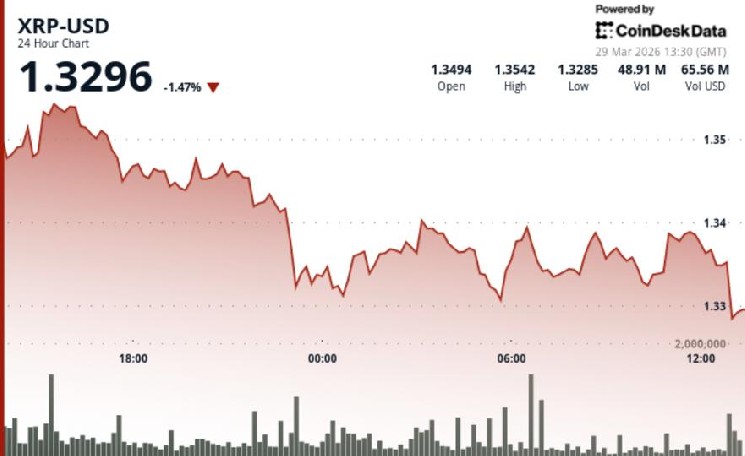
Let’s talk about what the numbers are telling us, because they’re painting an interesting – and somewhat conflicting – picture. Over the past 24 hours, XRP has been playing a game of musical chairs around $1.33, slipping just slightly but never quite breaking down completely. But here’s where things get really interesting: while the price has been treading water, the action behind the scenes has been anything but quiet. Funding rates, which essentially tell us how much traders are paying to hold their positions, have jumped significantly. At the same time, we’ve seen a noticeable uptick in long liquidations – that’s trader-speak for bullish bets getting forcibly closed out because they went wrong. This combination suggests that traders are getting increasingly aggressive with their positioning, doubling down on their bets even as the market shows signs of hesitation. Perhaps most telling of all, there were moments earlier in the trading session when volume absolutely exploded – the kind of spikes that usually signal a big move is coming. But here’s the problem: despite all that activity and energy, the price didn’t actually go anywhere meaningful. That volume spike fizzled out without pushing XRP to new highs, which is like revving your engine loudly but staying parked in the same spot. It’s a warning sign that something isn’t quite right.
The Technical Picture: Reading Between the Lines
When you zoom in on the price action itself, the story becomes even more revealing. XRP made a valiant attempt to push higher, briefly testing the $1.35 to $1.36 zone – but it got slapped down pretty decisively. The sellers were waiting there, and they made it clear they weren’t ready to let go of control. Since that rejection, the market has been rotating lower, grinding back down toward support around $1.33. Now, to be fair, that support level has been holding reasonably well, which is why we haven’t seen a full-blown breakdown yet. But here’s what should concern anyone paying attention: the chart is now showing a pattern of lower highs. Even though the floor is holding, the ceiling keeps getting lower with each attempt to rally. That’s not what you want to see if you’re betting on higher prices. It’s the classic setup of a market that’s losing steam, where the bulls are getting weaker with each attempt to push forward while the bears haven’t yet delivered their knockout punch. The momentum hasn’t completely reversed into bearish territory, but it has undeniably slowed down. It’s like watching a spinning top that’s starting to wobble – it’s still going, but you know it won’t be spinning forever.
The Tension Between Position and Price
Here’s where we get into what makes this setup particularly fascinating – and potentially dangerous. We’re seeing a classic case of what traders call a divergence between positioning and price action, and these situations rarely stay unresolved for long. On one hand, those rising funding rates we mentioned earlier are screaming that traders are leaning bullish. They’re willing to pay a premium to hold their long positions, betting that XRP is going to move higher. But on the other hand, every time the price tries to rally, it runs into a wall of sellers who push it right back down. These repeated rejections are the market’s way of saying “not yet” – or possibly “not at all.” The real red flag here is what happened with those high-volume moves that failed to follow through. When you see big volume without corresponding price movement, it typically means one thing: the demand just isn’t strong enough to absorb the available supply. Buyers are showing up, but not in sufficient numbers or with sufficient conviction to actually move the needle. This mismatch between what traders are positioned for (higher prices, based on funding rates) and what the market is actually doing (rejecting rallies and drifting lower) creates tremendous tension. It’s like a spring being compressed – the more pressure builds without release, the more explosive the eventual move tends to be. Usually in these scenarios, one side gets forced out violently, triggering a cascade of liquidations that fuel a sharp move in one direction.
What Everyone Should Be Watching Right Now
If you’re trading XRP or just holding it and wondering what to look for next, there are some clear signposts that will tell you which way this is likely to break. First and foremost, keep your eyes glued to $1.33. This isn’t just another number on the chart – it’s the line in the sand right now. If that level breaks with conviction, we’re probably not going to see a gentle drift to $1.32. More likely, it would trigger an acceleration toward $1.30, as stop losses get hit and those leveraged long positions we talked about get liquidated. That kind of breakdown could happen quickly and violently, the way these things tend to unfold when overleveraged markets finally crack. On the flip side, for the bulls to regain control and make people believe the uptrend is still alive, XRP needs to reclaim the $1.35 to $1.36 zone that rejected it earlier. Just touching it won’t be enough – it needs to break through, hold above it, and use it as support for the next leg higher. That would signal that the balance of power has shifted back toward the buyers. But perhaps the most important thing to monitor isn’t the price itself, but rather what’s happening with leverage and positioning. If funding rates keep climbing and open interest keeps building while the price continues to go nowhere or drift lower, that’s your warning siren. It means the spring is getting compressed even tighter, and the risk of a violent downside move is increasing. Smart traders are watching this divergence closely because it often provides the clearest signal of what’s coming next.
The Bigger Picture and What It All Means
Taking a step back and looking at the broader context, what we’re seeing with XRP right now is actually a textbook example of a market at a crossroads. These moments of tension and indecision are actually more important than the dramatic moves themselves because they set the stage for what comes next. The sideways-to-lower drift might look boring on the surface, but beneath that calm exterior, forces are building. The market is essentially deciding whether the recent weakness is just a temporary pause before another leg higher, or whether it’s the beginning of something more serious. What makes the current situation particularly precarious is the combination of factors we’ve discussed: deteriorating price structure with those lower highs, increasing leverage, failed breakout attempts, and that telltale divergence between what traders are positioned for and what’s actually happening. None of these things guarantee a particular outcome, but together they create an environment where sharp moves become more likely than continued sideways grinding. For holders of XRP, this isn’t necessarily a time to panic, but it is absolutely a time to pay attention and have a plan. Know your levels, know where you’ll admit you’re wrong if you’re positioned for higher prices, and know what you’ll do if we get that breakdown. For those sitting on the sidelines, this setup is worth watching closely because the eventual resolution – whether it breaks down or breaks out – is likely to create the kind of movement that presents clear trading opportunities. The key is being ready to act when the market finally tips its hand, rather than getting caught off guard when the tension suddenly releases.