
The Spectacular Return of Yellowstone’s Echinus Geyser: Nature’s Unpredictable Wonder Awakens
A Dormant Giant Stirs to Life
After years of relative silence, one of Yellowstone National Park’s most fascinating geological features has roared back to life in spectacular fashion. Echinus Geyser, holding the distinction of being the world’s largest acidic geyser, has begun erupting again following an extended period of dormancy that lasted since 2020. This remarkable natural fountain, which sits in what experts describe as the hottest and most dynamically active area of Yellowstone’s vast thermal landscape, started showing signs of renewed activity in early February when scientists from the U.S. Geological Survey began detecting repeated surges of geothermal energy. The first full eruption since its last active period took place on February 7, marking what many geologists and park enthusiasts hope might be the beginning of a new active phase for this unpredictable natural wonder. Since that initial eruption, Echinus has continued to put on impressive displays, with subsequent eruptions recorded on February 9, 12, and 15, before settling into a more regular pattern starting February 16, when it began erupting every two to five hours—a frequency that has delighted the relatively few winter visitors fortunate enough to witness these spectacular events.
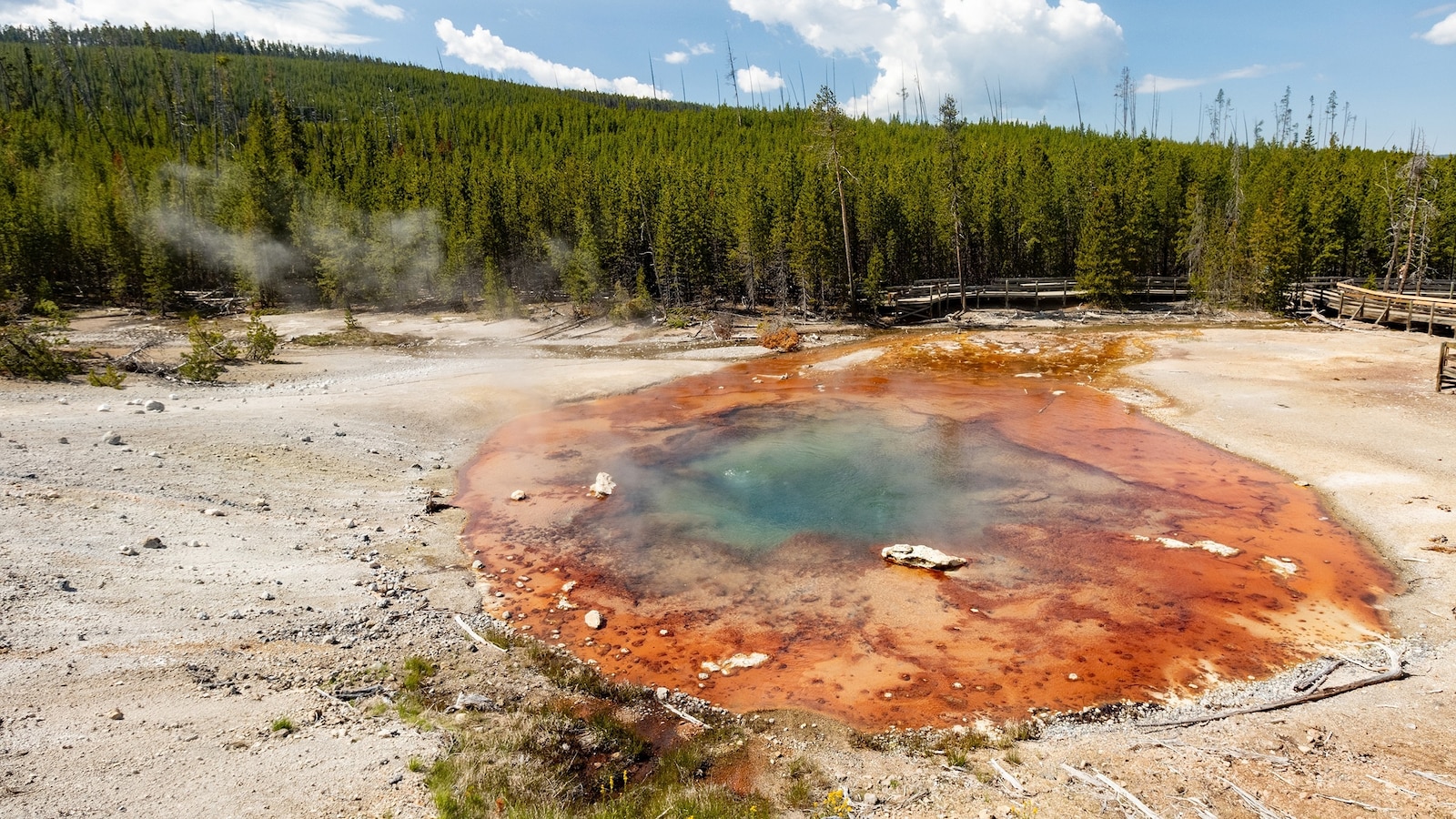
The eruptions themselves have been quite impressive, with most lasting several minutes and some sending columns of steaming, acidic water soaring up to 30 feet into the frigid Wyoming air. The geyser pool itself measures an impressive 66 feet across, creating a substantial stage for these geological performances. What makes witnessing an Echinus eruption particularly special is its unpredictability—the surrounding boardwalk features several benches and viewing platforms that have historically confused visitors who might wait for hours or even days without seeing any activity, not realizing that this particular geyser follows no one’s schedule but its own. According to USGS scientists, this recent burst of activity represents the most consistent pattern of eruptions the geyser has displayed in several years, though whether it will continue remains as mysterious as the forces that control it.
From Consistent Performer to Temperamental Celebrity
The story of Echinus Geyser reads like a biography of a temperamental performer who has alternated between reliable professionalism and complete withdrawal from public life. During the latter half of the 20th century, Echinus was actually one of Yellowstone’s most dependable attractions, earning its reputation as what the National Park Service affectionately called a “perennial crowd-pleaser.” Historical records indicate that before 1948, the geyser was mostly dormant, offering only occasional eruptions that made it more of a curiosity than a destination. However, something shifted in the geyser’s underground plumbing system around mid-century, and by the 1970s, Echinus had transformed into a remarkably regular performer, erupting at intervals of just 40 to 50 minutes—frequent enough that visitors could reasonably plan their schedules around witnessing an eruption.
The geyser’s golden age continued through the 1980s and 1990s, during which some eruptions became even more dramatic and prolonged, with displays lasting up to an hour and a half and shooting water as high as 75 feet into the air. Imagine the spectacle: a geyser erupting for ninety continuous minutes, its acidic waters creating rainbows in the spray as it climbed higher than a seven-story building. These were the years when Echinus cemented its reputation and when many longtime Yellowstone enthusiasts first fell in love with this particular geological feature. However, as the new millennium arrived, something changed once again in the mysterious underground chambers that feed the geyser. Eruptions began to wane by the early 2000s, becoming less frequent and less predictable. Scientists believe this decline was caused by the disappearance of a secondary water source that had been contributing to the geyser’s activity—a water source that “mysteriously” vanished, according to park officials, as if the earth itself had simply closed a valve deep beneath the surface.
The Science of Monitoring an Unpredictable Natural Phenomenon
Recognizing the scientific value of studying Echinus despite—or perhaps because of—its increasingly erratic behavior, researchers established a sophisticated temperature monitoring system in the geyser’s outflow channel in 2010. This equipment allowed scientists to continuously track thermal changes that might indicate impending eruptions or shifts in the geyser’s underground system. Between October 2010 and January 2011, this monitoring system recorded 15 sporadic eruptions, providing valuable data about the geyser’s thermal signatures even as its active periods became increasingly rare. Following this brief flurry of activity, Echinus settled back into quietness, offering visitors and scientists alike very little to observe for several years.
Then, in September 2017, the geyser suddenly “came alive” again, as USGS researchers dramatically described it. What began as increased thermal activity escalated into what scientists classified as “true” eruptions starting in October 2017. For nearly a month, the geyser performed beautifully, erupting every two to three hours in a pattern reminiscent of its glory days in the late 20th century. Visitors who happened to be in the park during this period were treated to regular displays of one of nature’s most unique phenomena. However, just as suddenly as it had awakened, Echinus fell silent again in November 2017, its activity stopping as if someone had flipped a switch. Since then, eruptions have been extremely rare—just one in January 2018, one in January 2019, and two in December 2020—making the current February activity all the more noteworthy and exciting for both researchers and park enthusiasts.
The Fascinating Chemistry of Acidic Waters
What truly sets Echinus apart from most other geysers isn’t just its size or even its unpredictable behavior, but rather its remarkable water chemistry. The geyser produces acidic water, a characteristic that makes it exceptionally rare in the geological world. According to the U.S. Geological Survey, while the water is indeed acidic, it’s not dangerously so—scientists compare its acidity level to that of orange juice or vinegar, household substances we encounter regularly. Measurements have shown the acidity at Echinus ranging from a pH of 3.3 to 3.6, which places it firmly in the acidic category but far from the extreme acidity of, say, battery acid. This specific level of acidity is actually what allows the geyser to function at all, presenting a fascinating geological paradox.
Acidic geysers are extraordinarily rare worldwide precisely because acidic water typically breaks down and dissolves the rock that forms a geyser’s essential underground plumbing system. Without intact rock channels to contain and direct the superheated water, a geyser simply cannot function. The fact that acidic geysers exist at all is remarkable, and the majority of the world’s acidic geysers are found at Yellowstone, making the park a unique laboratory for studying these unusual geological features. At Echinus specifically, the acidic water is created through a mixing process involving acidic gases rising from deep within the earth and neutral waters from other sources. This particular mixture has reached what might be called a “Goldilocks zone” of acidity—acidic enough to create unique mineral deposits and chemical signatures, but not so acidic that it eats away at the geyser’s structural foundation. The delicate balance required to maintain this chemistry adds another layer of complexity to understanding why Echinus behaves so unpredictably.
The Unique Beauty Born from Acid and Heat
The chemical composition of Echinus’s waters creates visual features that are truly “interesting,” as USGS scientists somewhat understatedly describe them. The distinctive red coloring that rims the geyser pool comes from high concentrations of iron, aluminum, and arsenic that have been dissolved from the surrounding rocks and then deposited in colorful mineral formations as the water cools and evaporates. These vibrant red deposits create a striking contrast against the white silica formations and the deep blue of the geyser pool itself, making Echinus visually distinctive even when it’s not actively erupting. Additionally, the silica-covered spiny rocks surrounding the geyser create formations that look almost otherworldly, as if sculpted by an alien artist rather than formed by natural chemical processes.
It was these spiny rocks that actually gave Echinus its name back in 1878, when mineralogist Albert Charles Peale visited the geyser during one of the early scientific expeditions to what would become Yellowstone National Park. Peale thought the rock formations resembled sea urchins, those spiny ocean creatures that belong to the echinoderm family along with starfish, brittle stars, and sand dollars. “Echinus” is actually the scientific name for sea urchins, and Peale’s whimsical naming choice has stuck for nearly 150 years. The geyser’s location in the Norris Geyser Basin places it in impressive company—this area is also home to Steamboat Geyser, which holds the title of the world’s tallest active geyser. The Norris Basin represents the hottest and most dynamic of all Yellowstone’s thermal areas, a place where the earth’s internal heat comes remarkably close to the surface and creates a constantly changing landscape of geothermal features.
A Brief Window into Geological Time
For those hoping to witness Echinus Geyser in its current active state, time may be of the essence. USGS scientists have cautioned that the eruptions likely won’t continue long enough to persist into the summer months when Yellowstone experiences its annual surge of visitors. This prediction means that this remarkable geological event is primarily being witnessed by the relatively small number of hardy winter visitors who brave Yellowstone’s severe cold and snow to experience the park in its quietest season. There’s something poetic about this—nature’s spectacular performances don’t operate on human schedules or tourism calendars. Echinus erupts when geological conditions align in ways we still don’t fully understand, and it falls silent again just as mysteriously.
This unpredictability reminds us that despite all our scientific instruments and monitoring systems, despite our accumulated knowledge and sophisticated models, nature still holds mysteries that resist our attempts to predict and control. The geyser operates on geological time, responding to forces and pressures deep within the earth that follow their own logic. For scientists, each eruption provides valuable data and insights into hydrothermal systems. For visitors lucky enough to witness an eruption, it offers a humbling reminder of the powerful forces constantly at work beneath our feet and the privilege of witnessing natural processes that have been occurring for thousands of years and will likely continue long after we’re gone. Whether Echinus will continue erupting for weeks or suddenly fall silent again tomorrow remains one of Yellowstone’s beautiful mysteries.