



Contender the Great White Shark Makes His Way North: A Fascinating Journey Along the Atlantic Coast
Meet Contender: A Massive Ocean Predator on the Move
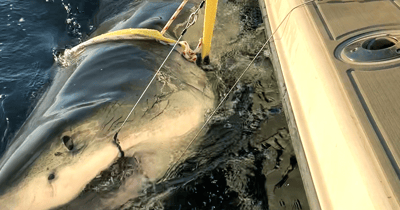
The ocean’s most magnificent predators continue to captivate researchers and ocean enthusiasts alike, and one particular great white shark has been making headlines recently. Contender, an impressively large male great white shark, has been making his presence known in the waters off North Carolina’s coast after spending several months exploring the warmer waters around Florida. This remarkable creature was tagged by OCEARCH, a well-respected marine research organization dedicated to tracking and studying ocean wildlife, in January 2025. Contender is no small fish – he tips the scales at nearly 1,700 pounds and stretches over 13 feet in length, making him a truly formidable presence in the Atlantic waters. The sophisticated tag attached to Contender does more than just track his whereabouts; it provides invaluable real-time data about his location, swimming patterns, and behavior, giving marine biologists and researchers unprecedented insights into the mysterious lives of these apex predators. Most recently, Contender pinged in the Atlantic Ocean approximately 45 miles southeast of Cape Fear, near Wilmington, North Carolina, on a Sunday night, according to OCEARCH’s Instagram announcement, marking another chapter in his ongoing oceanic journey.
Understanding the Great White Migration Pattern
What makes Contender’s journey particularly interesting to scientists is how it perfectly demonstrates the natural migration patterns of great white sharks along the Eastern Seaboard of the United States. According to OCEARCH’s research and social media posts, great white sharks like Contender follow a relatively predictable seasonal pattern that’s driven by water temperature and food availability. During the summer months, these powerful predators prefer the cooler, nutrient-rich waters of the northern Atlantic, typically ranging around Maine and extending up into Canadian waters. These northern regions offer an abundance of prey, including seals and various fish species that great whites rely on for sustenance. As the seasons change and winter approaches, however, these sharks begin their journey southward, seeking the relatively warmer waters off the coasts of Florida and the Carolinas. This migration isn’t just about comfort – it’s a survival strategy that has evolved over millions of years, allowing great whites to optimize their hunting opportunities and maintain their body temperature in environments where they can thrive. Contender’s recent movement from Florida waters back toward North Carolina suggests he may be beginning his northward journey as spring approaches, following the ancient pathways that his species has traveled for countless generations.
Contender Isn’t Swimming Alone: Other Tagged Sharks in the Area
What’s particularly fascinating for researchers is that Contender isn’t the only tagged great white shark currently being monitored in the waters around North Carolina. The ocean off Cape Fear has become something of a meeting point for several of OCEARCH’s tagged sharks, painting a picture of the area as an important corridor or gathering spot for these creatures. Nori, a juvenile female white shark, was recorded approximately 36 miles east of Cape Fear as of Saturday, swimming in relatively close proximity to Contender. Another young female named Cayo was detected about 67 miles to the southeast of the same landmark, suggesting that multiple sharks are using these waters simultaneously. Additionally, a subadult male white shark named Jason was tracked about 32 miles south of Cape Fear earlier in February, adding yet another data point to the growing picture of shark activity in this region. The presence of multiple sharks of different ages and both sexes suggests that these waters serve an important ecological function, possibly as a migration route, feeding ground, or transitional zone between their winter and summer habitats. Even further south, three additional tagged sharks have pinged in the waters near Charleston, indicating that the entire Carolina coast is currently experiencing significant great white shark activity. This concentration of data provides researchers with an incredible opportunity to study not just individual shark behavior, but also potential social interactions and population dynamics.
The Technology Behind Tracking These Ocean Giants
The science behind tracking these magnificent creatures is both sophisticated and somewhat dependent on fortunate timing. Many people wonder how researchers can follow sharks across thousands of miles of open ocean, and the answer lies in the specialized tracking devices attached to their dorsal fins. However, as OCEARCH senior data scientist John Tyminski explained in a video published by the organization, these trackers face a unique challenge – they cannot transmit their signals through water. This means that for a shark’s location to be accurately confirmed and recorded, the tracking device must break the surface of the ocean at precisely the right moment when an Argos satellite happens to be passing overhead. These satellites are only positioned over any given location for approximately 13 minutes, creating a relatively narrow window of opportunity for data transmission. During this brief window, the tracker needs to send multiple messages to the satellite to confirm a precise location. If the shark’s tracker only manages to send a single message to the satellite before the window closes, researchers classify this as a “Z-ping.” These Z-pings are less specific and only provide scientists with a general idea of where the shark might be, rather than pinpointing an exact location. This is why sharks don’t “ping” every day – it requires the perfect combination of the shark surfacing at the right time and a satellite being in position to receive the signal. Despite these limitations, the technology has proven remarkably effective at tracking long-term migration patterns and understanding the extensive ranges these animals cover.
Years of Data Collection and Public Access
One of the most impressive aspects of OCEARCH’s tagging program is the longevity and accessibility of the data collected. Each shark’s tag is designed to provide real-time data for several years, according to the organization, meaning that animals like Contender can be tracked through multiple migration cycles, giving researchers a comprehensive understanding of their life patterns over extended periods. This long-term data collection is invaluable for marine biology, helping scientists understand not just where sharks go, but also how their patterns might change over time, how they respond to environmental changes, and how different life stages might affect their behavior. What makes this research even more remarkable is OCEARCH’s commitment to making this information available to the public online. Anyone with internet access can visit OCEARCH’s website and follow the journeys of Contender and dozens of other tagged sharks in real-time. This transparency serves multiple purposes: it educates the public about these often-misunderstood creatures, it allows citizen scientists and educators to incorporate real-world data into learning experiences, and it helps coastal communities stay informed about shark presence in their local waters. The public tracking also generates interest and support for marine conservation efforts, helping people feel connected to individual animals and invested in their survival and the health of ocean ecosystems.
The Bigger Picture: Why Tracking Sharks Matters
Beyond the excitement of following individual sharks like Contender on their oceanic journeys, this research serves crucial scientific and conservation purposes. Great white sharks are apex predators, meaning they sit at the top of the ocean food chain, and their presence and behavior can tell us enormous amounts about the overall health of marine ecosystems. By understanding their migration patterns, researchers can identify critical habitats that need protection, predict when and where sharks are likely to appear (which helps with both conservation and public safety), and monitor how climate change and other environmental factors might be affecting these animals. The data collected from tagged sharks like Contender, Nori, Cayo, and Jason helps fill in gaps in our understanding of great white shark biology that have persisted for decades. Despite being one of the ocean’s most famous inhabitants, great whites remain somewhat mysterious, spending much of their lives in the open ocean where direct observation is difficult. Every ping, every tracked migration, and every data point adds to our collective knowledge, helping ensure that future generations will also get to share the ocean with these magnificent predators. As Contender continues his journey northward along the Atlantic coast, he’s not just following his instincts – he’s also serving as an ambassador for his species, helping humans better understand and appreciate the complex, beautiful, and vitally important world beneath the waves.