


Tragic Pile-Up in Colorado: When Nature’s Fury Turns Highway Into Disaster Zone
A Morning Drive Turns Deadly
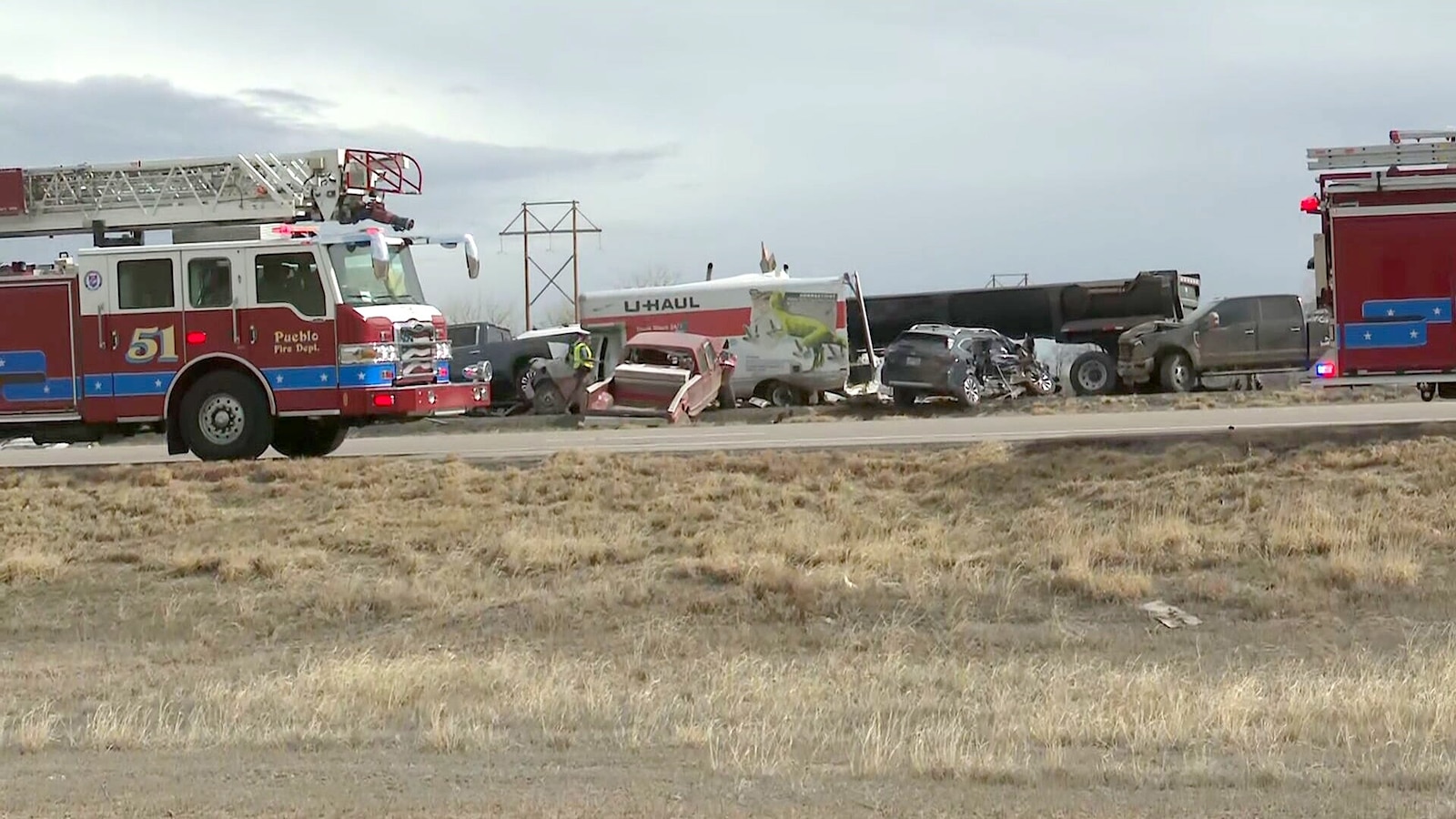
On what seemed like an ordinary Tuesday morning, tragedy struck on Interstate 25 near Pueblo, Colorado, when Mother Nature unleashed her fury in the form of powerful winds and blinding dust. Around 10 a.m., drivers on the northbound lanes found themselves suddenly engulfed in what authorities would later describe as “brownout” conditions—a terrifying phenomenon where visibility essentially drops to zero. In those critical moments, more than thirty vehicles became entangled in a devastating pile-up that would claim four lives and leave nearly thirty others injured. The crash scene, located approximately forty miles south of Colorado Springs, quickly became a tableau of twisted metal, shattered glass, and the sobering reality of how quickly conditions on the road can turn catastrophic. Among the wreckage were seven massive semi-trucks, pickup trucks pulling horse trailers, SUVs, and regular passenger vehicles—a cross-section of everyday travelers who never imagined their journey would end this way.
The Victims and the Injured
The human toll of this disaster is heartbreaking. Four people lost their lives in the crash, each traveling in separate vehicles when catastrophe struck. The victims included two men from the small town of Walsenburg, Colorado, along with two women—one from the community of Rye and another from Pueblo itself. These weren’t just statistics; they were neighbors, family members, friends, and community members whose lives were cut short by circumstances largely beyond anyone’s control. Major Brian Lyons of the Colorado State Patrol, speaking at a press briefing later that day, conveyed the gravity of the situation with a heavy heart. Beyond the fatalities, twenty-nine people were rushed to area hospitals with injuries ranging from critical to minor. One person remained in critical condition, fighting for their life, while seven others suffered what authorities classified as “serious bodily injury.” The remaining victims were treated for moderate to minor injuries, though anyone who has experienced such trauma knows that even “minor” injuries can leave lasting physical and emotional scars. The chaos of accounting for everyone involved in such a massive incident continued throughout the day as first responders worked methodically through the wreckage.
When Weather Becomes the Enemy
The villain in this tragic story wasn’t driver error or mechanical failure—it was the weather itself. Colorado’s high plains are no stranger to powerful winds, but on this particular Tuesday, conditions became especially treacherous. High wind warnings blanketed the region, with the National Weather Service in Pueblo forecasting gusts up to sixty-five miles per hour on the plains and an astonishing eighty-five miles per hour in mountain areas. These weren’t just breezy conditions; these were winds powerful enough to lift dirt and debris, creating what Major Lyons described as visibility that was “next to nothing.” Imagine driving at highway speeds and suddenly finding yourself in what amounts to a thick brown fog, unable to see the vehicle in front of you or even the road beneath your wheels. The “brownout” conditions were so severe that drivers had virtually no time to react before finding themselves either part of the pile-up or desperately trying to avoid becoming the next casualty. This wasn’t the only incident on that stretch of highway either—a separate crash occurred on the southbound lanes of I-25, also involving a semi-truck, caused by the same dirt-blowing conditions. It was a stark reminder that when nature decides to flex its muscles, human technology and infrastructure can seem suddenly fragile.
An Unusual Casualty: The Goat Trailer
Among the more unusual aspects of this already extraordinary crash was the involvement of a pickup truck hauling a gooseneck trailer containing thirty-two goats. This detail, while perhaps seeming minor against the backdrop of human tragedy, speaks to the diverse nature of travel on Colorado’s highways, where ranchers and livestock transporters share the road with commuters and long-haul truckers. Sadly, four of the goats did not survive the crash, though emergency responders managed to safely remove the remaining twenty-eight animals from the damaged trailer. One can only imagine the chaos and confusion these animals must have experienced during and after the collision, and the efforts of first responders to ensure their safety amid the larger human emergency demonstrates the comprehensive nature of the disaster response. This detail also reminds us that crashes like these ripple outward, affecting not just the immediate victims but also the livelihoods of those who depend on their vehicles and cargo for their economic survival.
The Massive Response and Recovery Effort
The scene that greeted first responders was nothing short of overwhelming. More than thirty vehicles spread across the northbound lanes of a major interstate, with the wreckage of seven semi-trucks adding to the complexity of the situation. Colorado State Patrol, local police departments, fire services, and emergency medical personnel descended on the crash site, working under the same challenging conditions that had caused the pile-up in the first place—powerful winds and reduced visibility. The northbound lanes of I-25 were completely closed, and authorities warned that the closure would extend for several hours as crews worked methodically to clear vehicles, investigate the scene, and ensure that all victims had been accounted for and transported to medical facilities. The southbound lanes were temporarily closed as well, though they reopened sooner once the secondary crash involving the semi-truck was cleared. The logistical challenge of such a response cannot be overstated: coordinating ambulances to transport nearly thirty injured people to area hospitals, managing traffic diversions around a major interstate closure, and conducting a thorough investigation while the same dangerous wind conditions persisted. Major Lyons and his team faced the difficult task of not only managing the immediate emergency but also communicating with the public about the ongoing dangers and the need to avoid the area entirely.
Lessons and Looking Forward
In the aftermath of this tragedy, the Colorado State Patrol issued clear and urgent guidance to the public: “Due to low visibility, drivers are urged to delay traveling until conditions improve. If travel is necessary, avoid I-25 in this area, use caution, and reduce speed.” These words carry weight earned through bitter experience. This crash serves as a sobering reminder that sometimes the bravest decision a driver can make is not to drive at all. When weather conditions deteriorate to the point where visibility approaches zero, no amount of careful driving can completely eliminate risk. The pile-up near Pueblo joins a long and unfortunate history of weather-related mass casualty crashes that occur when drivers, either unaware of changing conditions or overconfident in their ability to navigate them, find themselves in situations where reaction time becomes effectively meaningless. For the families of the four victims, no lesson or future prevention can bring back their loved ones. For the twenty-nine injured, recovery will be a long road both physically and emotionally. For the broader community, this tragedy underscores the need for better real-time weather communication, perhaps more aggressive highway closures when conditions become extreme, and a cultural shift toward viewing delayed travel not as an inconvenience but as a potentially life-saving decision. As climate patterns continue to shift and extreme weather events become more common, the challenge of keeping our highways safe will only grow more complex. The lives lost on that windy Tuesday morning in Colorado deserve to be remembered not just as victims of a terrible accident, but as a call to action for all of us who travel the roads.