



A Wisconsin Artist’s Battle Against Big Tech: When AI Development Threatens a Lifetime’s Work
A Landscape Shaped by Decades of Devotion
For nearly four decades, Tom Uttech has called his 52-acre property in Saukville, Wisconsin, his home and artistic sanctuary. At 83 years old, the renowned landscape painter has transformed his land into something far more than just a place to live—it’s become both his canvas and his muse. Standing outside his art studio, Uttech can survey rolling hills carpeted with wildflowers that climb toward the township’s highest point, where rows of evergreen trees he personally planted by hand in 1988 now stand tall and mature. “That kind of scares me because I didn’t think I was that old,” he reflects with a mix of wonder and melancholy as he considers the trees that have grown alongside his career. This carefully curated prairie landscape, shaped by hundreds of hours of maintenance and years of dedicated work, serves as the wellspring of inspiration for his artwork, which has graced museums across the country. What began as an investment in the land has become an investment in his creative soul, each tree and wildflower a brushstroke in a living masterpiece that continues to evolve with the seasons.
When a Letter Changes Everything
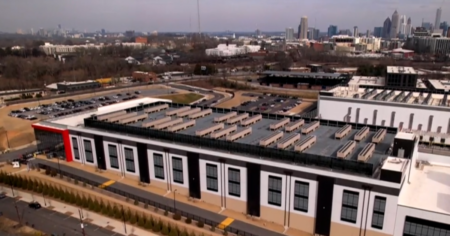
Uttech’s carefully constructed world was upended when he received an unexpected letter from his utility company. The message contained news that seemed almost incomprehensible: a massive power line would need to be built directly through his property, potentially undoing decades of painstaking work and destroying the very landscape that fuels his artistic vision. “I couldn’t believe it, and I still don’t,” Uttech told ABC News, his disbelief palpable even after time to process the information. The scale of the proposed infrastructure staggered him—power lines towering over 300 feet tall, higher than the Statue of Liberty itself, cutting through the prairie he had nurtured for so long. The purpose behind this intrusion soon became clear: the transmission lines would help supply power to a massive $15 billion data center campus being constructed on land equivalent to more than 500 football fields in nearby Port Washington. This data center represents a cornerstone of the Trump administration’s ambitious $500 billion Stargate partnership with OpenAI and Oracle, an initiative President Donald Trump has championed as essential to winning the artificial intelligence race and securing America’s technological future.
The Growing Threat of Eminent Domain in the AI Era
Uttech’s predicament exemplifies a growing tension across America as the rapid expansion of artificial intelligence infrastructure collides with individual property rights. His case puts a human face on the legal concept of eminent domain—the government’s power to seize private property for public use—which is being invoked with increasing frequency to support the construction of AI data centers and their supporting infrastructure. The irony isn’t lost on artists like Uttech: the very technology that threatens to replace human creativity in many fields is now literally threatening to destroy the natural landscapes that inspire human artists. Across the United States, there are currently more than 3,000 data centers, with an additional 1,200 under construction, according to Data Center Map, an industry tracking service. These facilities demand unprecedented amounts of energy to operate. “These facilities are so energy-intensive,” explains Ari Peskoe, who directs the Electricity Law Initiative at Harvard University. “A single sort of warehouse can use as much electricity as a large U.S. city. The amount of new infrastructure that has to be built to power that facility is unlike anything we’ve seen in generations.” The Trump administration has framed this rapid AI development as a matter of national urgency, with the president declaring at a White House event that “we have an emergency, we have to get this stuff built,” and promising to expedite construction through emergency declarations.
A Tale of Two Perspectives: Economic Promise Versus Community Concerns
In Port Washington, where the data center is being built, Mayor Ted Neitzke sees the project through an entirely different lens than residents like Uttech. For the mayor, this represents a transformative opportunity for a community hungry for economic development. “It’s exciting because it’s going to transform our community, it’s going to create a tax base and jobs and secondary and tertiary workforce and opportunities that we have not even envisioned, and it’s going to lead us into a real renaissance,” Neitzke told ABC News, emphasizing that the project would bring thousands of jobs and desperately needed tax revenue. He projects that within a few years, once financing is complete, the data center will shoulder the overwhelming majority of property taxes for Port Washington citizens. The Data Center Coalition echoes these benefits, pointing to “multi-billion-dollar investments across the nation” that create “hundreds of thousands of high-wage jobs” and generate “significant local, state, and federal tax revenue that helps fund schools, transportation, public safety, tax relief for residents and small businesses, and other community priorities.” However, not all residents share the mayor’s enthusiasm. Beyond concerns about eminent domain, many community members worry about the potential impact on their electricity bills. Goldman Sachs economists project that electricity prices jumped 6.9% in 2025—more than double the 2.9% inflation rate—and they “expect data centers to boost electricity demand significantly, accounting for about 40% of total power demand growth over the next five years.” These concerns have galvanized opposition, with the community group Great Lakes Neighbors organizing protests, including a rally at the state capitol. Tensions reached a boiling point at a December city council meeting when multiple anti-data center protesters were arrested, including Christine LeJeune, who was physically removed from the meeting after chanting “Recall, recall, recall” directed at Mayor Neitzke. LeJeune, who maintains she had simply intended to deliver a prepared speech, told ABC News that “the message was if you speak out, then this is what will happen to you.” Mayor Neitzke defended law enforcement’s actions, calling the officers “very kind” and “very cordial” with “multiple warnings,” while noting that such incidents are “not the norm here.” He also revealed the personal cost of his support for the project, saying he’s received voicemail threats to his family’s safety from across the country.
Corporate Promises and the Question of Who Pays
With construction already underway, local activists have focused their efforts on securing firm commitments that companies will cover any electricity cost increases rather than passing them on to residential customers. Both OpenAI and Oracle have publicly pledged to “pay their own way” on energy costs and to invest in renewable energy infrastructure to offset their impact. “In Wisconsin, and across all of our U.S. Stargate sites, we are committed to paying our own way on energy so that our operations do not increase local electricity prices,” OpenAI spokesperson Jamie Radice stated, emphasizing that the Port Washington site would “help support AI services used by millions of people and businesses across the country” while bringing “jobs and long-term investment to the region.” Oracle went further in its statement, explaining their partnership with WE Energies to ensure “ratepayers’ bills and electric grid reliability are never impacted by our data center,” with seventy percent of the campus’s energy coming from zero-emission sources including wind, solar, and batteries. The company claims the project will add approximately 2,000 megawatts of new zero-emission power to Wisconsin’s grid, meaning “more reliable, affordable energy will be available to local families and businesses,” with Oracle—not ratepayers—funding these electrical infrastructure upgrades. Meanwhile, Uttech’s fate hangs on decisions made by the American Transmission Company (ATC) and the Public Service Commission of Wisconsin. ATC has proposed two potential routes for the transmission lines: a “preferred route” and a “preferred alternative route” that follows existing transmission lines. Vantage, the data center operator, has stated support for the alternative route and claims to be “committed to being a good neighbor” while “prioritizing investing in sustainable energy, minimizing local impact” and ensuring that “residents and businesses in Port Washington will not see an increase in their electric bills due to this project.” ATC explains that they consider “several factors such as cost to ratepayers, landowner impacts, environmental sensitivities, and engineering considerations” when studying routes, noting that the route designated as “preferred” offers “a lower cost to ratepayers and maximizes the use of existing corridors,” while acknowledging that “others may favor the alternative route for different considerations.”
An Artist’s Resolve: Fighting to the End
Despite his age and the formidable corporate and governmental forces arrayed before him, Tom Uttech refuses to surrender without a fight. The 83-year-old artist, who still regularly climbs aboard his four-wheeler to traverse his sprawling property in search of inspiration for his paintings, has partnered with the Wisconsin Institute for Law & Liberty, a conservative law firm, to challenge the potential seizure of his land. “The use of eminent domain power must be the absolute last resort… This is not such a case,” the firm wrote in a letter to ATC, vowing to “do all we can to protect the Uttech family’s private property rights.” Lucas Vebber, WILL’s deputy counsel, emphasized that “building the power lines on their land would cause irreparable damage to the natural beauty and wildlife the Uttech family has spent decades developing, and which Tom enjoys as inspiration for his work.” For Uttech, this battle represents more than a property dispute—it’s a fight for the creative foundation of his life’s work. He recognizes the reality of the situation: AI is a growing multi-billion-dollar industry already in motion, an unstoppable force that represents the future whether he likes it or not. Yet understanding this doesn’t mean accepting defeat. “They brought the fight to me and I’m not going to just roll over,” he told ABC News with quiet determination, adding that he plans to fight “right to the end.” His stance embodies a broader question facing communities across America: in our rush to embrace the AI revolution and the economic benefits it promises, what are we willing to sacrifice? For Tom Uttech, the answer is clear—not the land he’s devoted nearly four decades to cultivating, not the landscape that feeds his artistic soul, and not without exhausting every option to protect what he’s built. His battle may be a local one, fought in the rolling hills of Wisconsin, but it reflects a national conversation about progress, property rights, and the price we’re willing to pay for technological advancement.