
Bad Bunny’s Historic Super Bowl Halftime Show: A Celebration of Puerto Rican Culture and Unforgettable Moments
A Wedding Like No Other on the World’s Biggest Stage
Super Bowl LX delivered more than just an electrifying football game—it gave the world a halftime show that will be remembered for generations. Bad Bunny, the Puerto Rican superstar who has been dominating the music charts for years, brought something completely unexpected to the stage at Levi Stadium in Santa Clara, California: a real wedding ceremony. Yes, you read that right. Amid the pulsating rhythms and spectacular choreography, a genuine couple exchanged vows in front of millions of viewers worldwide. This wasn’t a staged performance or theatrical element—it was an actual marriage taking place in real-time during one of the most-watched entertainment events on the planet.
The story behind this extraordinary moment is as heartwarming as the ceremony itself. According to ABC News, the couple had initially reached out to Bad Bunny with a simple request: would he attend their wedding? But the international sensation had other plans. In a move that perfectly captures his generous spirit and larger-than-life personality, Bad Bunny turned the tables on them. Instead of simply showing up as a guest at their ceremony, he invited them to get married on stage during his Super Bowl halftime performance. Imagine being proposed such an opportunity—swapping your traditional wedding venue for the Super Bowl stage, with tens of thousands in attendance at the stadium and over 100 million watching from home. For this lucky couple, their special day became intertwined with one of the biggest moments in entertainment history.
The Ceremony That Stopped the Show
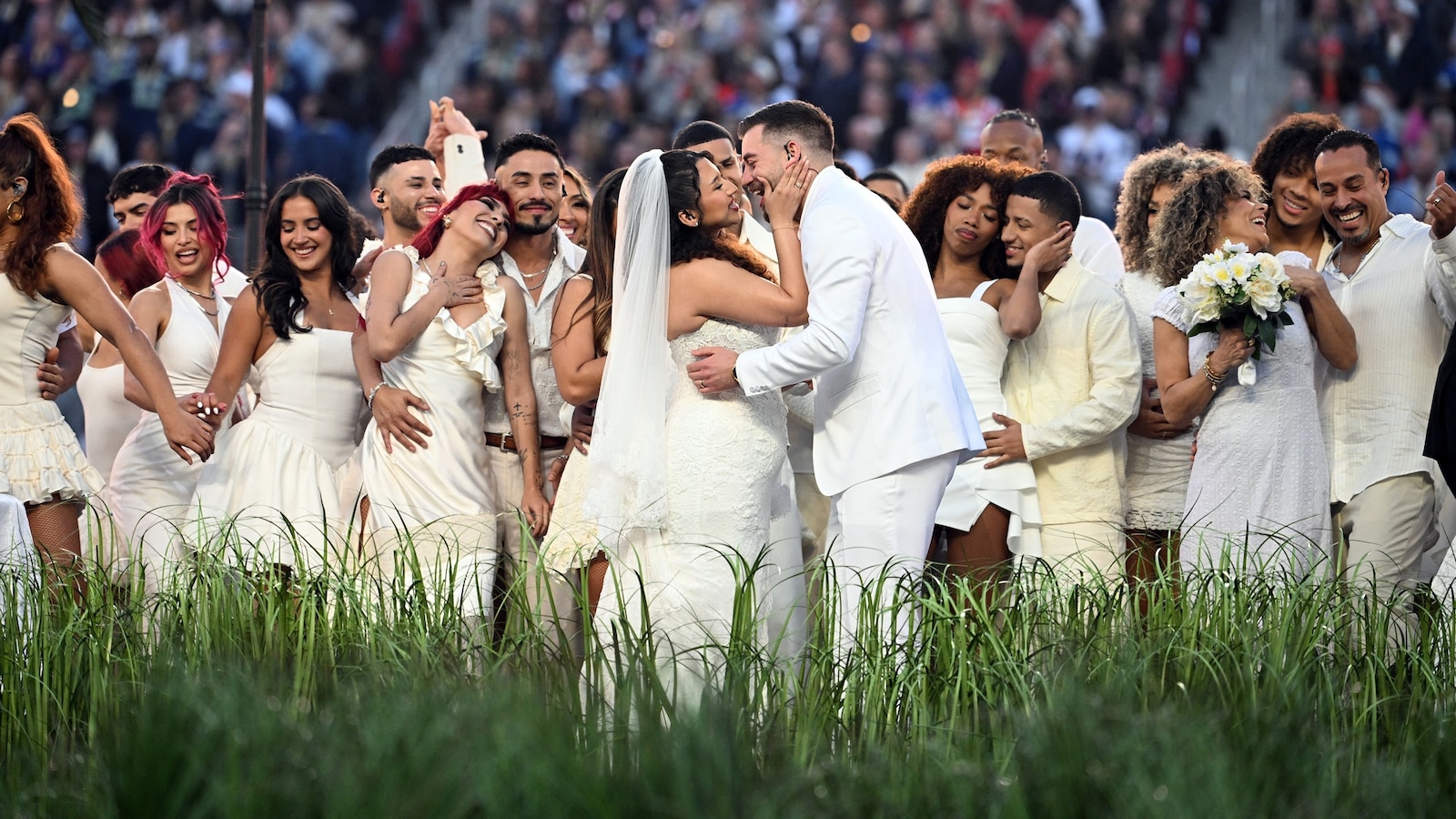
About halfway through Bad Bunny’s high-energy performance, viewers noticed a shift in the atmosphere. Dressed in matching all-white ensembles that coordinated beautifully with the other performers on stage, the couple stood alongside a pastor and an elegant orchestra. The scene was both intimate and grandiose—a delicate balance that only an artist of Bad Bunny’s caliber could pull off on such a massive platform. The pastor delivered a brief introduction in Spanish, honoring the Puerto Rican heritage that was the heartbeat of the entire performance. Then came the moment everyone watching will remember: the couple kissed, sealing their commitment to each other as fireworks (both literal and metaphorical) exploded around them.
What made this moment even more special was how seamlessly it transitioned into the next segment of the show. As the newlyweds celebrated their union, the stage transformed once again, this time welcoming the incomparable Lady Gaga. She emerged to deliver a salsa-inspired rendition of “Die With a Smile,” her powerful voice adding yet another layer of emotion to an already overwhelming moment. The fusion of a sacred personal ceremony with world-class entertainment created something truly unique—a reminder that even in our most public moments, human connection and love remain the most powerful forces.
A Vibrant Celebration of Puerto Rican Heritage
While the wedding certainly captured headlines, it was just one sparkling element in a halftime show that served as a love letter to Puerto Rican culture and music. Bad Bunny, whose real name is Benito Antonio Martínez Ocasio, has never shied away from his roots. Throughout his meteoric rise to international stardom, he has consistently centered his Puerto Rican identity, singing primarily in Spanish and infusing his music with the sounds and rhythms of his homeland. This Super Bowl performance was his biggest opportunity yet to share that culture with the world, and he seized it with both hands.
The setlist was a carefully curated journey through Bad Bunny’s catalog of hits, featuring fan favorites like “Tití Me Preguntó,” “BAILE INoLVIDABLE,” and “NUEVAYoL.” Each song showcased different facets of his artistry—from reggaeton to trap to the traditional sounds of Puerto Rican music. The staging was equally impressive, with vibrant colors, dynamic choreography, and visual elements that paid homage to Puerto Rican culture. For many viewers, especially those in the Latinx community, seeing their culture celebrated on such a prominent platform was deeply meaningful. Bad Bunny didn’t just perform; he made a statement about representation, visibility, and the richness of Spanish-language music and Puerto Rican heritage.
Star-Studded Guest Appearances
Bad Bunny didn’t celebrate alone. The halftime show featured an impressive roster of guest appearances that added even more star power to an already dazzling performance. Alongside Lady Gaga’s show-stopping moment, viewers were treated to appearances from Ricky Martin, the legendary Puerto Rican artist who paved the way for Latin music in mainstream American culture. His presence served as a beautiful bridge between generations of Latin performers who have fought for recognition and space in the global music industry.
The show also included appearances from Cardi B, whose Dominican and Trinidadian heritage and connection to Latin music made her a natural fit, as well as Jessica Alba and Pedro Pascal, both of whom have Mexican heritage and have been vocal advocates for Latino representation in entertainment. Even social media influencer Alix Earle made an appearance, representing the new generation of content creators who have massive cultural influence. This diverse collection of guests reflected the broad impact of Bad Bunny’s music and the way it transcends traditional genre boundaries to reach audiences across demographics, languages, and backgrounds. The collaborative nature of the performance reinforced one of the central messages of the show: culture is meant to be shared, celebrated, and experienced together.
A Historic Moment for Spanish-Language Music
The significance of Bad Bunny headlining the Super Bowl halftime show cannot be overstated. This performance represented a watershed moment for Spanish-language music and Latino representation in mainstream American entertainment. For decades, Latino artists have been pushing boundaries and fighting for recognition in an industry that has often marginalized non-English music. Bad Bunny’s journey to the Super Bowl stage is the culmination of that long struggle and a testament to how much the landscape has changed.
Just days before his Super Bowl performance, Bad Bunny made history at the Grammy Awards when his album became the first fully Spanish-language project to win Album of the Year—one of the music industry’s most prestigious honors. This groundbreaking achievement set the stage (literally) for his Super Bowl appearance, sending a clear message that Spanish-language music is not a niche market or a secondary category—it is mainstream, it is powerful, and it deserves the spotlight. For millions of Spanish-speaking viewers and Latino families watching the Super Bowl, seeing an artist who looks like them, sounds like them, and represents their culture on the world’s biggest stage was a profoundly emotional experience. Bad Bunny’s performance was more than entertainment; it was validation, representation, and a promise of more opportunities to come for Latino artists.
The Game and the Final Curtain
The spectacular halftime show concluded with fireworks erupting during Bad Bunny’s hit song “DtMF,” leaving the audience in the stadium and at home buzzing with excitement. The energy from the performance seemed to carry into the second half of the game, where the Seattle Seahawks built on their first-half lead to defeat the New England Patriots 29 to 13, securing their victory at Super Bowl LX. While football fans will remember the game for the Seahawks’ dominant performance, the broader cultural conversation in the days that followed centered on Bad Bunny’s historic halftime show—and particularly that unforgettable wedding ceremony.
In an era where Super Bowl halftime shows have become increasingly elaborate productions featuring the biggest names in entertainment, Bad Bunny managed to create something that felt both spectacular and deeply personal. By incorporating a real wedding into his performance, he reminded us that even in moments of massive spectacle, it’s the human experiences—love, commitment, celebration, and cultural pride—that truly resonate. The couple who exchanged vows on that stage will forever have the most unique wedding story imaginable, and millions of viewers will carry the memory of witnessing not just an incredible performance, but a genuine moment of joy and connection that transcended entertainment and touched something deeper in the human experience.