

Alabama Republicans Push for New Primary Elections Following Supreme Court Ruling on Voting Rights
A Swift Legislative Response to Weaken Democratic Representation
In a rapidly unfolding political drama, Alabama Republicans moved with remarkable speed this week to fundamentally reshape the state’s congressional landscape. On Friday, Governor Kay Ivey signed legislation that would allow the state to hold entirely new primary elections if courts permit the use of Republican-drawn House district maps in upcoming midterm elections. This controversial move has the potential to eliminate one of Alabama’s two Democratic congressional seats, raising serious concerns among voting rights advocates and civil rights organizations. The legislation represents part of a broader coordinated effort by Republican-controlled southern states responding to a recent Supreme Court decision that significantly weakened the Voting Rights Act—a landmark civil rights law that has protected minority voting rights for decades. The new Alabama law essentially sets aside the results from the state’s May 19 primary elections for certain congressional seats and grants the governor authority to schedule new primaries, but only if a court ruling allows the district boundaries to be redrawn according to Republican preferences.
The Legal Battle Over Alabama’s Congressional Maps
The current situation stems from a complex legal battle that has been ongoing since 2023. A court injunction issued last year requires Alabama to continue using its existing congressional map until after the 2030 census is completed. This current map includes five districts that lean Republican and two districts that lean Democratic, where Black voters comprise a substantial portion of the electorate. Importantly, this map was not drawn by state lawmakers but by a court-appointed expert in 2023, after both the Supreme Court and a lower court rejected two previous maps created by Alabama’s Republican-controlled legislature. Those earlier maps were found to violate the Voting Rights Act, which historically required states to ensure fair representation for minority communities. However, everything changed last week when the Supreme Court issued its decision in Louisiana v. Callais, which dramatically narrowed the scope of Section 2 of the Voting Rights Act. This section had historically required states to draw majority-minority districts under certain circumstances to ensure communities of color had meaningful representation in Congress. Following this ruling, Alabama Republicans immediately sought to implement a 2023 map that contains only one Democratic-leaning district with a plurality of Black voters, rather than the two such districts in the current court-ordered map.
Aggressive Legal Maneuvering and Court Challenges
The speed at which Alabama officials are moving demonstrates their determination to implement these changes before the midterm elections. On the same day Governor Ivey signed the legislation, Alabama Attorney General Steve Marshall asked the Supreme Court to halt the lower court’s injunction and allow the state to use its preferred 2023 map. Justice Clarence Thomas responded by requesting the opposing side submit their response by Monday, indicating the Supreme Court may act quickly on this request. Meanwhile, the lower court that originally issued the injunction rejected a request to pause its ruling, setting up a potential direct conflict between different levels of the judicial system. Governor Ivey expressed confidence in her statement following the special legislative session, saying “Alabama now stands ready to quickly act, should the courts issue favorable rulings in our ongoing redistricting cases.” This coordinated effort between the executive, legislative, and legal branches of Alabama’s Republican government demonstrates a well-planned strategy to capitalize on the Supreme Court’s recent weakening of voting rights protections.
Passionate Protests and Echoes of Jim Crow
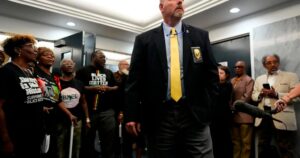
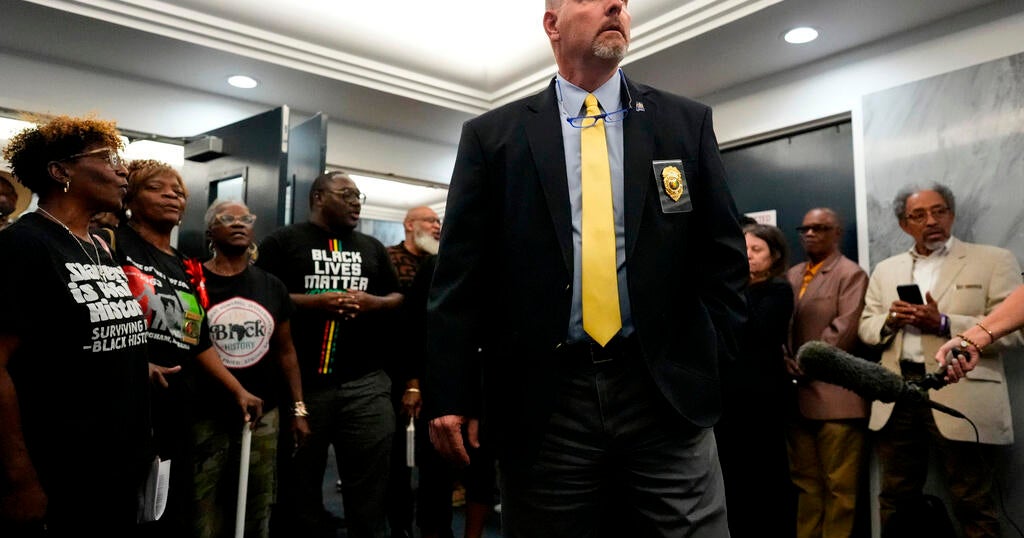
The passage of this legislation sparked intense protests both inside and outside the Alabama Statehouse, with demonstrators making their opposition unmistakably clear. The scene inside the Capitol building became chaotic as security officers physically dragged at least one protester from the packed House gallery. Outside, demonstrators gathered to shout powerful slogans including “fight for democracy” and “down with white supremacy,” connecting this modern redistricting effort to Alabama’s long and troubled history of racial discrimination and voter suppression. Inside the legislative chambers, Black lawmakers delivered impassioned speeches arguing that the Republican legislation represents a return to the state’s shameful Jim Crow era—the period following the Civil War when southern states systematically disenfranchised Black voters and enforced racial segregation through both law and violence. Senate Democrats expressed their outrage vocally, shouting “hell no” and “stop the steal” as their Republican colleagues voted to approve the measure. Democratic State Senator Rodger Smitherman captured the gravity of the moment in his remarks following the vote, stating bluntly: “What happened here today is that we were set back as a people to the days of Reconstruction.” His words reflected the deep concern among civil rights advocates that decades of progress in ensuring fair representation for communities of color is being systematically dismantled.
A Regional Pattern: Southern States Follow Similar Playbook
Alabama’s actions are not occurring in isolation but rather as part of a coordinated regional effort by Republican-controlled southern states. On the same day Alabama lawmakers debated their legislation, Republican lawmakers in both Louisiana and South Carolina presented their own plans to redraw congressional districts, facing similar opposition from civil rights activists and Democratic lawmakers. Just one day earlier, Tennessee had already enacted new congressional districts that deliberately carve up a Democratic-held, Black-majority district in Memphis, prompting the state Democratic Party to file a lawsuit on Friday seeking to prevent these districts from being used in this year’s elections due to the unreasonably tight timeframe. This wave of redistricting efforts represents an aggressive push by southern Republicans to capitalize on the Supreme Court’s weakening of the Voting Rights Act, potentially reshaping the political landscape across multiple states simultaneously. The stakes extend far beyond individual states, as these redistricting battles will help determine control of the closely divided U.S. House of Representatives in the upcoming midterm elections.
Virginia Court Ruling Compounds Democratic Setbacks
As if the situation weren’t challenging enough for Democrats, their redistricting efforts suffered an additional setback on Friday when the Virginia Supreme Court invalidated a redistricting measure that voters had narrowly approved in April. The court ruled that the Democratic-led legislature had violated constitutional procedural requirements when placing the redistricting amendment on the ballot. This ruling represents a significant blow to Democratic hopes of gaining additional congressional seats, as they had anticipated gaining as many as four additional U.S. House seats under the new districts approved by Virginia voters. The Virginia decision, combined with the aggressive redistricting efforts by Republican-controlled southern states, has dramatically shifted the redistricting battle in favor of Republicans. As both parties fight for every possible advantage in determining congressional district boundaries, the situation has created an environment where the fundamental principles of fair representation and equal voting rights appear increasingly threatened. The coming weeks and months will likely see continued legal battles, protests, and political maneuvering as these redistricting fights work their way through various court systems, ultimately shaping not just who represents these communities, but whether all Americans truly have equal voice in their democracy.