
Justin Timberlake’s DWI Arrest: Body Camera Footage Reveals What Really Happened That Night in the Hamptons
The Traffic Stop That Made Headlines
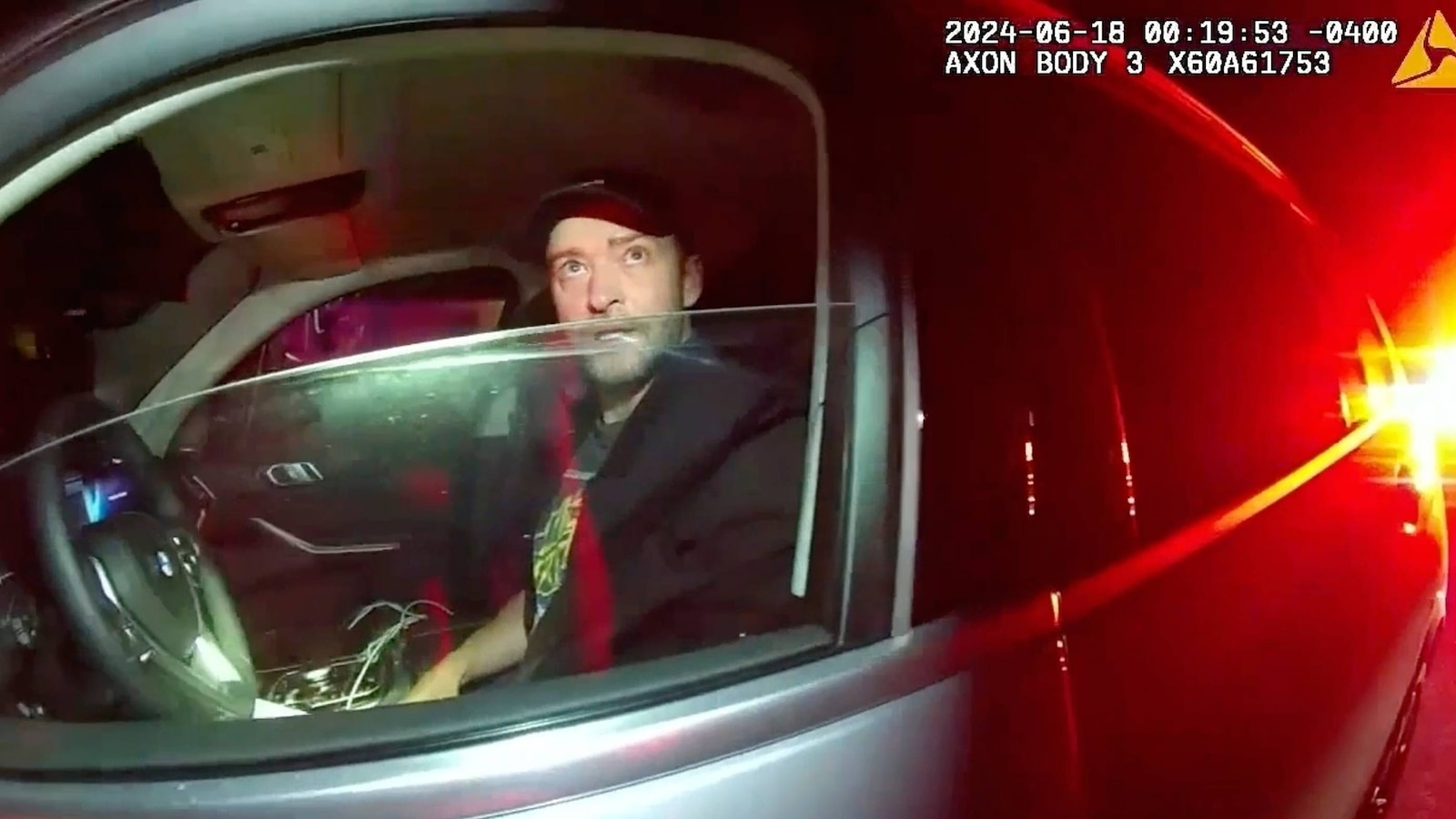
In what became one of the most talked-about celebrity incidents of 2024, pop superstar Justin Timberlake found himself in handcuffs on a summer night in the exclusive Hamptons area of New York. The Sag Harbor Police Department has now released body camera footage from that June evening, offering the public a revealing glimpse into the moments when the famous singer’s night took an unexpected turn. The video, which was distributed to various media outlets including the Associated Press and reviewed by ABC News, shows the entire sequence of events that led to Timberlake’s arrest on suspicion of driving while intoxicated. The footage begins with a routine traffic stop on June 18, 2024, when an officer pulled over the vehicle Timberlake was driving after observing what he described as erratic driving behavior—specifically, the car veering to the left side of the road and failing to stop completely at a stop sign. What might have been a simple traffic citation for an ordinary driver quickly escalated into something more serious when the officer suspected impairment and began investigating further.
“I’m Justin Timberlake”: The Singer Identifies Himself During the Stop
The body camera footage captures the interaction between Timberlake and law enforcement in real time, providing an unfiltered view of how the encounter unfolded. When the officer approached the vehicle and began questioning the driver, Timberlake readily identified himself to the police. In the video, the multi-platinum recording artist can be heard telling officers that he was only in the area temporarily because he was in the middle of a professional commitment. “I’m on a world tour,” Timberlake explained to the officers during the stop. He later made his identity even more explicit, stating directly, “I’m Justin Timberlake,” apparently expecting that his celebrity status might be relevant to the situation. The officer, following standard procedure, requested to see Timberlake’s identification documents. What follows in the footage is a series of standardized field sobriety tests—the kind of roadside assessments that police officers across the country routinely administer when they suspect a driver might be under the influence of alcohol or drugs. These tests are designed to evaluate a person’s physical coordination, balance, and ability to follow instructions—all factors that can be impaired by intoxication. The video then shows officers attempting to administer a breathalyzer test, which would provide objective evidence of Timberlake’s blood alcohol content. However, according to the footage, Timberlake refused to take the breath test, a decision that would have legal implications for his case.
A Friend’s Desperate Plea: “You Can’t Put Him in Jail”
One of the most emotionally charged moments captured in the body camera footage involves a woman identified as Timberlake’s friend, who can be seen and heard desperately trying to intervene as officers prepared to arrest the singer. As the situation escalated and police moved to place Timberlake in handcuffs, the woman’s distress becomes evident in her increasingly frantic appeals to the officers. “Stop it! No way! Don’t say it!” she exclaims as the reality of the arrest becomes clear. Her pleas continue as she watches her famous friend being taken into custody, with the woman telling officers, “You can’t, like, put him in jail.” She then makes an alternative suggestion, asking the police if she could simply take Timberlake home instead of having him arrested and processed through the criminal justice system. The officers, however, remained professional and firm in their response, declining her requests and explaining that Timberlake would need to be held and processed according to standard procedure. In what might be seen as either a creative negotiating tactic or a moment of desperation, the woman even references Timberlake’s famous musical catalog in her appeals to the officers. “You love ‘Bye Bye Bye,’ you’re on ‘SexyBack’—one favor,” she says, apparently hoping that the officers’ potential appreciation for Timberlake’s music might influence their decision. She then asks if she can at least inquire whether Timberlake wants his phone. The body camera footage concludes with images of Timberlake seated in the back of a police vehicle, the reality of his arrest now fully realized.
Legal Proceedings and the Plea Agreement
Following his arrest that night in the Hamptons, Timberlake faced the legal consequences of the incident through the court system. Initially, the singer entered a plea of not guilty to the charges stemming from his arrest, a common first step in criminal proceedings that preserves a defendant’s options while their legal team evaluates the evidence and explores possible resolutions. The case moved through the legal system over the following months, with Timberlake’s attorneys working with prosecutors to reach a resolution. By September 2024, approximately three months after the arrest, both sides had negotiated a plea agreement that would resolve the criminal case. Under the terms of this deal, Timberlake pleaded guilty to a reduced charge of driving while impaired—a lesser offense than the original driving while intoxicated charge. This type of plea bargain is relatively common in DWI cases, particularly for first-time offenders, and often results from negotiations between defense attorneys and prosecutors who weigh the strength of the evidence, the defendant’s criminal history (or lack thereof), and other relevant factors. As part of the plea agreement, the court imposed several consequences on Timberlake. He was ordered to pay a fine, the amount of which was determined by the court based on sentencing guidelines for the offense. Additionally, Timberlake was required to perform community service, a common component of sentences in impaired driving cases that serves both as punishment and as a way for offenders to give back to their communities while potentially learning from their mistakes.
The Legal Battle Over the Footage Release
Even after resolving the criminal charges through his plea agreement, Timberlake’s legal team continued to fight on another front—attempting to prevent the public release of the body camera footage that documented his arrest. Earlier this month, well after the criminal case had been settled, Timberlake filed a lawsuit seeking to block the release of the video. In legal filings, his attorneys argued that the footage captured the famous singer in “an acutely vulnerable state,” and that releasing it would cause unnecessary harm to Timberlake’s reputation and privacy. This legal maneuver highlighted the tension that often exists between the public’s right to access government records (including police body camera footage) and an individual’s privacy interests, particularly when that individual is a public figure whose image and reputation are closely tied to their professional success. The lawsuit raised interesting questions about how body camera footage should be treated under public records laws, especially when it involves celebrities or other well-known individuals. Should famous people receive different privacy protections than ordinary citizens in similar situations? Or does their public status actually justify greater transparency? These questions don’t have simple answers, and different jurisdictions have taken varying approaches to balancing these competing interests. Ultimately, rather than proceeding to a full legal battle over the footage release, Timberlake’s legal team and representatives of the Village of Sag Harbor reached a compromise agreement. Under the terms of this settlement, a redacted version of the body camera footage would be released to the public and media outlets. This middle-ground solution presumably removed certain portions of the video that Timberlake’s lawyers had argued were particularly sensitive or invasive, while still allowing for public access to the general documentation of the arrest. The redacted footage that was ultimately released is what media outlets including the Associated Press and ABC News reviewed and reported on.
Reflections on Celebrity, Accountability, and Second Chances
The release of the Justin Timberlake arrest footage offers more than just another celebrity scandal to dissect—it provides an opportunity to reflect on broader themes of accountability, the criminal justice system, and how society treats famous individuals who run afoul of the law. On one hand, the footage and the circumstances surrounding it demonstrate that celebrity status doesn’t place anyone above the law. The Sag Harbor police officers who conducted the traffic stop and arrest treated Timberlake professionally but firmly, declining to give him special treatment despite his fame and his friend’s appeals based on his musical accomplishments. This equal application of law enforcement procedures, regardless of a person’s wealth or fame, is a fundamental principle of justice that the American legal system strives to uphold, even if it doesn’t always succeed. At the same time, Timberlake’s case illustrates how individuals with resources and access to quality legal representation can often navigate the criminal justice system more successfully than those without such advantages. His ability to negotiate a plea agreement to a reduced charge, while certainly appropriate given the circumstances, reflects a level of legal advocacy that not every defendant can afford. For Timberlake’s fans and the general public, the incident serves as a reminder that even beloved entertainers are human beings who make mistakes and must face consequences for those errors in judgment. The singer’s decision to plead guilty to the reduced charge and accept responsibility for driving while impaired, rather than fighting the charges indefinitely, may ultimately prove beneficial to his reputation in the long run, demonstrating accountability and maturity. As Timberlake continues his career and moves forward from this incident, the body camera footage will remain as a permanent record of a difficult night—a cautionary tale about the dangers of impaired driving and a reminder that everyone, regardless of fame or fortune, must answer for their actions.