


Deadly Fuel Truck Explosion Rocks Panama’s Bridge of the Americas
Massive Blast Closes Critical Infrastructure Link
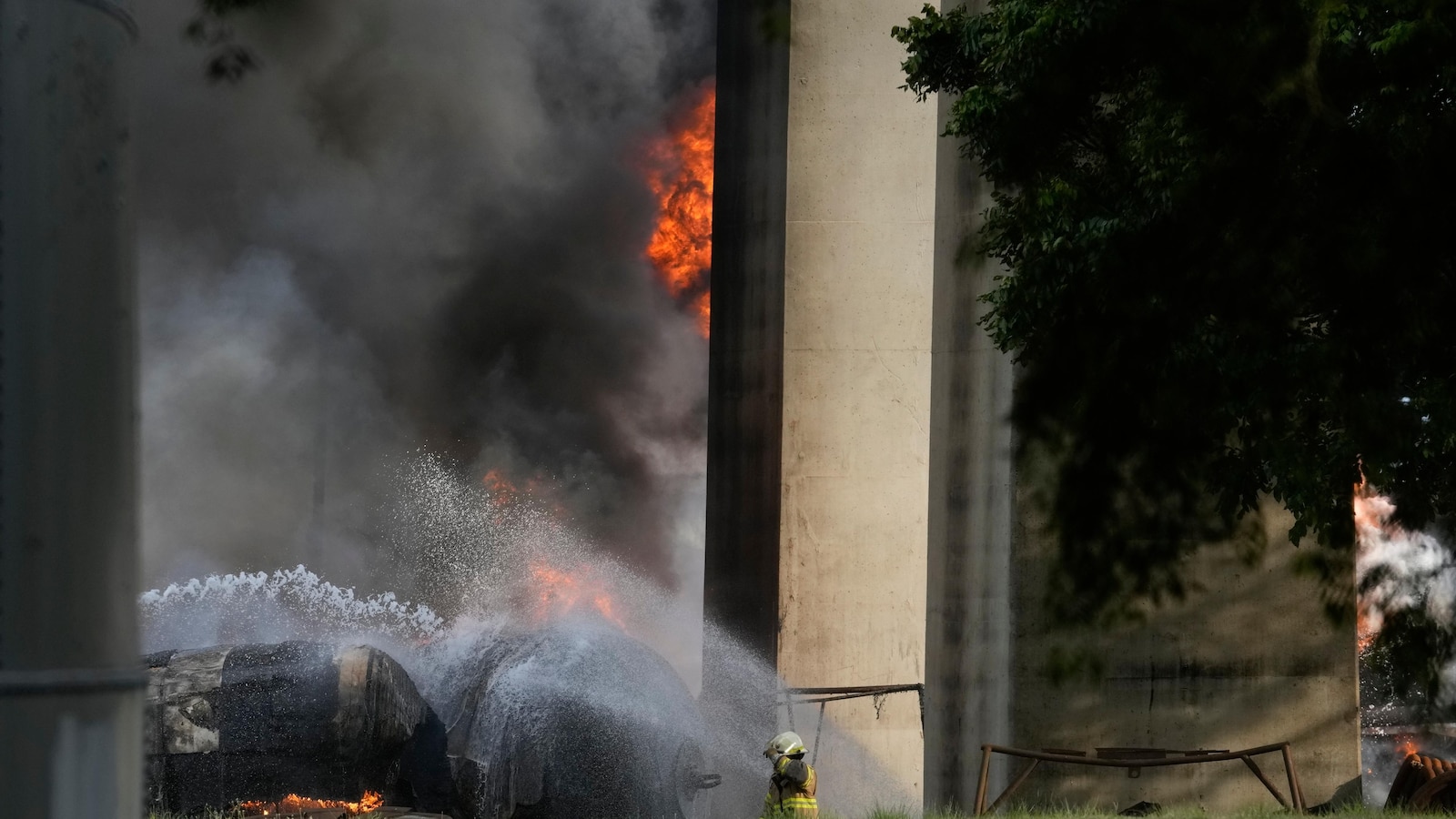
A devastating explosion involving a fuel tanker truck beneath Panama’s iconic Bridge of the Americas has claimed one life and forced authorities to shut down this vital transportation artery indefinitely. The incident, which occurred around 4 p.m. on Monday afternoon, sent shockwaves through Panama City as a massive fireball erupted at the base of the bridge, creating scenes that looked like something from an action movie. Security cameras positioned near the bridge captured the terrifying moment when flames shot skyward, reaching nearly to the top of the structure that serves as a crucial connection between Panama’s bustling capital and the western parts of the country, including the international airport and numerous suburban communities where thousands of residents live and work.
The explosion took place during what would have been a typical rush hour period, with several vehicles traveling across the bridge at the moment of impact. Miraculously, despite the proximity of these cars to the blast zone, their drivers and passengers escaped without injury from the flames. However, the explosion proved fatal for one worker who was with the fuel truck at the time of the incident. The worker’s identity has not been released pending notification of family members, but the tragedy has sent ripples of grief through the tight-knit community of transportation workers who keep Panama’s commerce flowing. Additionally, two firefighters sustained injuries while battling the intense blaze, though authorities have indicated their conditions are stable. These brave first responders rushed to the scene despite the obvious dangers, working to contain the fire and prevent it from spreading to the bridge structure itself or to other vehicles in the vicinity.
Investigation Underway as Cause Remains Unknown
Víctor Raúl Álvarez, the director of Panama’s Fire Department, addressed the media in the aftermath of the explosion, providing reassurance that beyond the confirmed fatality and the two injured firefighters, no other casualties had been reported. “We have no confirmation of any other people injured,” Álvarez stated, though he emphasized the preliminary nature of the information available. The investigation into what triggered such a catastrophic explosion is only in its earliest stages, with fire department officials, structural engineers, and safety experts all working together to piece together the sequence of events that led to this disaster. Álvarez was careful to note that determining the cause of the explosion will take time, as investigators must carefully examine the scene, review security footage, interview witnesses, and analyze any physical evidence that survived the intense heat of the fire.
The complexity of investigating such incidents cannot be understated. Fuel truck explosions can result from various factors including mechanical failures, improper maintenance, collision impacts, electrical malfunctions, or even improper handling of hazardous materials. Each possibility must be methodically examined and either confirmed or ruled out through scientific analysis and expert testimony. The investigators will be looking at everything from the maintenance records of the truck involved to weather conditions at the time, from the driver’s experience and training to the specific route the vehicle was taking. In the coming days and weeks, a clearer picture should emerge about what went wrong on that Monday afternoon, information that will be crucial not only for bringing closure to the victim’s family but also for preventing similar tragedies in the future.
Serious Concerns About Bridge Structural Integrity
Perhaps even more concerning than the immediate tragedy is the potential long-term impact on the Bridge of the Americas itself. This isn’t just any bridge—it’s a structure that has stood for more than six decades, serving as a vital artery for Panama’s economy and daily life. Engineers have raised serious red flags about the potential damage caused by the intense heat generated during the explosion and subsequent fire. Edwin Lewis, an engineer with Panama’s Public Works Ministry, explained the situation in stark terms: “The Bridge of the Americas is a structure that is over 60 years old. Due to the effects of the fire, if the metal structure was subjected to excessively high temperatures, it may have sustained damage.” His statement reflects a fundamental concern in structural engineering—that extreme heat can compromise the integrity of both steel and concrete, potentially weakening the bridge in ways that aren’t immediately visible to the naked eye.
When metal structures like bridges are exposed to the kind of temperatures generated by burning fuel, the molecular structure of the steel can change. The metal can lose its temper, meaning it becomes softer and less able to bear the loads it was designed to carry. Concrete can also suffer damage, with the extreme heat causing it to crack, spall, or lose its bond with reinforcing steel inside. These aren’t theoretical concerns—bridge collapses following fires have occurred elsewhere in the world, making Panama’s cautious approach entirely justified. The Public Works Ministry shared video footage on social media Tuesday showing teams of engineers carefully surveying the site, measuring, testing, and documenting every aspect of the structure. These specialized teams are conducting thorough evaluations of both concrete and metal components, using advanced techniques to detect damage that might not be visible on the surface. Officials have been clear: the bridge will remain closed until its safety can be absolutely confirmed, regardless of the inconvenience this causes.
Major Disruptions Expected Across Panama
The closure of the Bridge of the Americas represents more than just a traffic inconvenience—it’s a potential economic and social disruption of significant magnitude. President José Raúl Mulino took to social media platform X (formerly Twitter) to acknowledge the situation frankly, warning citizens that the bridge closure would “cause disruption” while expressing hope for a swift resolution. “We hope to return to normal as soon as possible,” the president wrote, recognizing both the necessity of the closure for safety reasons and the hardship it would impose on ordinary Panamanians. The bridge serves as a primary connection between Panama City, where hundreds of thousands of people live and work, and Tocumen International Airport, the country’s main air travel hub. It also links the capital to numerous western suburbs and communities, meaning its closure affects daily commutes, commercial transportation, tourism, and virtually every aspect of life in the region.
Alternative routes exist, but they’re not designed to handle the volume of traffic that normally crosses the Bridge of the Americas. The Centennial Bridge, opened in 2004 about ten miles north of the Bridge of the Americas, can absorb some traffic, but commuters and commercial drivers can expect significant delays, longer travel times, and general frustration as the region adapts to this new reality. Local businesses that depend on timely deliveries may face inventory challenges. Families might find their daily routines completely upended. People with flights to catch will need to allow considerably more time to reach the airport. The ripple effects of this single incident will be felt throughout Panama’s economy and society, demonstrating just how dependent modern infrastructure has made us on specific choke points in our transportation networks.
Historical Significance and Engineering Marvel at Risk
The Bridge of the Americas holds a special place in Panama’s history and identity. Opened in 1962, originally known as the Thatcher Ferry Bridge, it spans the Pacific entrance to the Panama Canal, one of humanity’s greatest engineering achievements. The bridge itself is an impressive structure, stretching about 1,650 meters (roughly 5,400 feet) in length, with its roadway standing approximately 117 feet above the water at high tide—high enough to allow the passage of large ships entering and exiting the canal. For decades, it was the only fixed crossing of the Panama Canal, making it absolutely essential to the country’s transportation network. The bridge has witnessed Panama’s growth from a small nation dominated by the Canal Zone into a modern, thriving country with a bustling economy built on banking, trade, tourism, and its role as a global shipping hub.
Now this historic structure faces perhaps its greatest challenge. The question on everyone’s mind is whether the bridge can be quickly declared safe and reopened, or whether more extensive repairs—or in a worst-case scenario, partial reconstruction—might be necessary. Modern engineering techniques should be able to provide answers relatively quickly, but thorough investigations cannot be rushed when public safety hangs in the balance. Similar incidents elsewhere have sometimes resulted in bridges being closed for weeks or even months while repairs are made. Panama’s authorities are clearly committed to erring on the side of caution, which is the right approach even if it means continued disruption. The investigation will determine not only what caused the explosion but also what lessons can be learned to prevent future incidents and how the bridge might be made more resilient to such accidents going forward. In the meantime, Panama and its people must adapt to a new temporary reality, hoping that their iconic bridge will soon be declared safe to use once again, standing strong for another generation as it has for the past sixty years.