
Royal Family Faces Growing Protests Amid Andrew Scandal
Demonstrators Greet Royals at Westminster Abbey
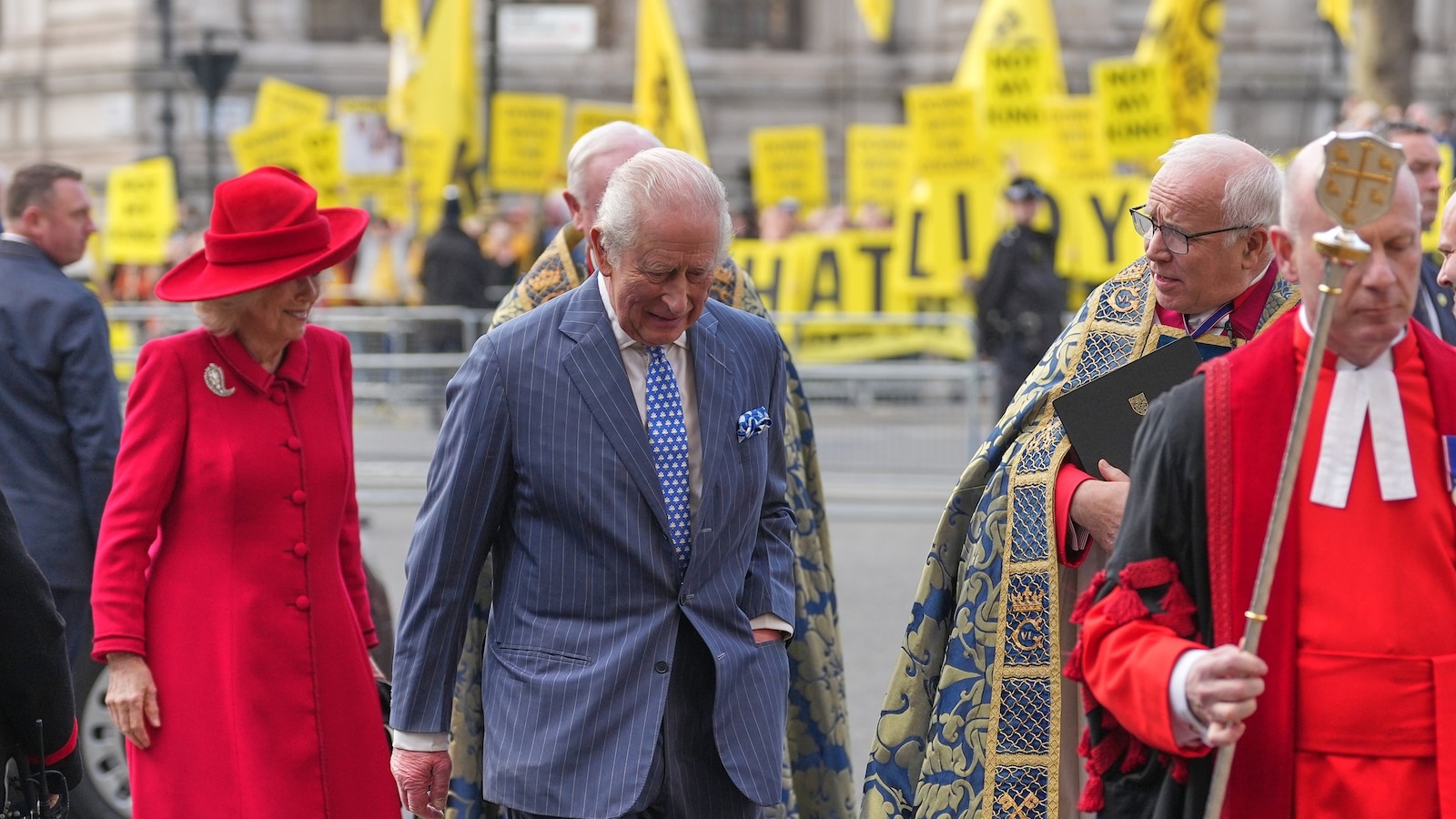
The British royal family encountered an unprecedented scene of public discontent on Monday as they arrived at Westminster Abbey for the annual Commonwealth Day service. King Charles III, Queen Camilla, Prince William, and Kate, the Princess of Wales, were met with boos and pointed chants from anti-monarchy protesters demanding answers about the family’s knowledge of and response to allegations surrounding Andrew Mountbatten-Windsor, the king’s younger brother formerly known as Prince Andrew. The demonstrators, organized by the anti-monarchy group Republic, held bright yellow signs reading “Not my king” and “Abolish the monarchy” just feet from where the royals entered the historic church. Despite the vocal opposition, the family members maintained their composure, smiling and looking forward as they greeted church officials, choosing not to acknowledge or respond to the protesters’ concerns. The scene marked a striking visual representation of the growing tension between the centuries-old institution and an increasingly skeptical British public.
The Andrew Mountbatten-Windsor Controversy
The protests stem from mounting questions about how the royal family has handled serious allegations against Andrew Mountbatten-Windsor, who was stripped of his “prince” title by King Charles last year. The controversy reached a new level when Andrew was arrested on February 23 on suspicion of misconduct in public office related to his former role as a U.K. trade envoy, a position in which he was responsible for promoting British business interests internationally. The allegations emerged after Andrew’s name appeared in approximately 3 million pages of documents connected to Jeffrey Epstein, the disgraced financier who died by suicide in 2019 while awaiting trial on charges of sex trafficking minor girls. These documents, released by the U.S. Department of Justice in January, have reignited public scrutiny of Andrew’s past associations and conduct. Throughout these developments, Andrew has consistently and repeatedly denied any wrongdoing in relation to Epstein or the activities associated with him, though public skepticism continues to grow.
Limited Royal Response Fuels Public Frustration
The royal family’s response to the escalating crisis has been notably restrained, with most members choosing silence or carefully worded statements that focus on victims rather than addressing specific questions about what they may have known about Andrew’s conduct. Prince Edward, brother to both King Charles and Andrew, became the only senior royal to speak publicly about the matter when he addressed a panel on education in Dubai on February 3. His brief comment emphasized remembering the victims, stating, “I think it’s really important always to remember the victims, and who are the victims in all this—a lot of victims in this.” Beyond Edward’s limited remarks, the royal family has communicated primarily through official palace statements. Buckingham Palace released a statement on February 9 acknowledging that King Charles has expressed “profound concern at allegations which continue to come to light in respect of Mr Mountbatten-Windsor’s conduct,” while maintaining that specific claims are for Andrew himself to address. The statement also indicated willingness to cooperate with Thames Valley Police if approached during their assessment of allegations. Similarly, Kensington Palace issued its first-ever statement about Andrew on behalf of Prince William and Kate on the same day, confirming that the couple has been “deeply concerned by the continuing revelations” with their thoughts remaining “focused on the victims.”
Protesters Demand Transparency and Accountability
Graham Smith, CEO of Republic—the anti-monarchy organization that coordinated Monday’s demonstration—told reporters that his group believes both Prince William and King Charles have “serious questions to answer about what they knew about Andrew.” Smith’s organization has been pushing for greater transparency from the royal family regarding their knowledge of Andrew’s activities and associations over the years. In an interview outside Westminster Abbey, Smith reflected on how dramatically public sentiment has shifted during his two decades leading the organization, describing the current moment as potentially “transformative” for the anti-monarchy movement. He explained that the royal family now finds itself in an impossible position: remaining secretive invites suspicion and erodes public support, while opening up and being transparent might reveal information that could be even more damaging to the institution’s reputation. “The very fact that we are in a situation where people are demanding transparency is very dangerous for them,” Smith observed, highlighting the no-win scenario the royals face as public pressure continues to mount for answers about what senior family members knew and when they knew it.
A Changing Relationship Between Monarchy and Public
The protests at Westminster Abbey represent more than just anger over one controversial royal family member—they signal a fundamental shift in how many British citizens view the monarchy itself. According to Smith, public attitudes about the institution have “changed fundamentally” over the past two decades, with younger generations in particular questioning the relevance and appropriateness of an unelected hereditary system in a modern democracy. The demands for accountability and transparency reflect broader societal expectations that even privileged institutions cannot operate above scrutiny or hide behind tradition when serious allegations emerge. The visual of protesters standing feet away from the royals as they entered one of Britain’s most historic churches would have been nearly unthinkable a generation ago, but has now become an increasingly common occurrence at major royal events. This erosion of automatic deference represents a challenge to the monarchy’s long-term viability, as the institution must navigate between maintaining the mystique that has traditionally been part of its appeal and meeting contemporary demands for openness. The Andrew scandal has accelerated these tensions, forcing questions about whether an institution built on secrecy and privilege can survive in an era that increasingly values transparency and accountability.
An Institution at a Crossroads
As the Commonwealth Day service proceeded inside Westminster Abbey while protesters remained outside, the scene encapsulated the precarious position of the British monarchy in the modern era. The institution that has survived for over a thousand years through wars, political upheavals, and social transformations now faces perhaps its most difficult challenge: maintaining public support in an age of information, accountability, and democratic values. The Andrew Mountbatten-Windsor scandal has become a focal point for broader questions about royal privilege, accountability, and whether an unelected family should continue to serve as heads of state and national symbols. How King Charles and the senior royals navigate this crisis may well determine the monarchy’s future viability. If they continue to deflect questions and avoid transparency, they risk appearing complicit or indifferent to serious allegations. Yet if they open themselves to full scrutiny, they may reveal uncomfortable truths about what was known and when, potentially validating the protesters’ suspicions. With each carefully worded statement and each public appearance met by demonstrators, the distance between the palace and the people it theoretically represents seems to grow wider, suggesting that the relationship between the British monarchy and its subjects has entered uncertain and uncharted territory.