
Breaking Barriers: How Chinese Chefs Are Redefining Fine Dining in America
From Childhood Shame to Culinary Pride
George Chen’s memory of lunchtime humiliation as a young immigrant carries a bitter irony that perfectly captures the journey of Chinese cuisine in America. When his family arrived in Los Angeles from Taiwan in 1967, the young Chen tried to fit in by bringing what seemed like a simple lunch to school—braised pork and Chinese sauerkraut between bread. Instead of acceptance, he faced disgust and mockery from classmates who found his food “gross.” Fast forward to today, and that same chef stands in his bustling San Francisco restaurant, China Live, watching customers eagerly order those very dishes that once marked him as an outsider. Now an established restaurateur operating on the edge of America’s oldest Chinatown, Chen has witnessed a remarkable transformation in how Chinese food is perceived and valued. His journey from that embarrassed schoolboy to a respected fine dining chef mirrors the broader evolution of Chinese cuisine in the American culinary landscape—a journey that’s been long overdue and is still fighting for the recognition it deserves.
The New Wave of Chinese Fine Dining
Across major American cities, a culinary revolution is quietly unfolding. Chen and his wife, Cindy Wong-Chen, have created more than just a restaurant at China Live—they’ve built an immersive Chinese culinary experience. Like a circus ringmaster, Chen orchestrates multiple stations: dumpling makers crafting delicate parcels, a stone oven producing perfectly roasted Peking ducks, noodle artisans pulling fresh strands, and a dessert station churning out innovative sesame soft serve. His ambitious Eight Tables concept upstairs offered course-by-course dinners ranging from $88 to $188, and the couple is now planning to replicate this success with Asia Live in Santa Clara. But the Chens aren’t working in isolation. Within walking distance of China Live, equally impressive establishments like Empress by Boon, Mister Jiu’s, and Four Kings are creating their own sophisticated Chinese dining experiences. In New York City, husband-and-wife team Bolun and Linette Yao opened Yingtao in Hell’s Kitchen in 2023, offering a $150 chef’s tasting menu that earned them a Michelin star. These restaurants share a common mission: to elevate Chinese cuisine beyond the takeout boxes and cheap buffets that have long dominated American perceptions, offering refined tasting menus that showcase the true depth and sophistication of Chinese culinary traditions.
Fighting the Price Perception Battle
Despite the growing number of upscale Chinese establishments, these restaurateurs face a persistent and frustrating challenge that their French and Japanese counterparts rarely encounter: convincing diners that Chinese food deserves fine-dining prices. When customers willingly pay premium prices for French haute cuisine or Japanese omakase without question, Chinese chefs consistently face resistance to similar pricing structures. Chen addresses this double standard directly and unapologetically: “Why shouldn’t I?” he asks about his prices. “Just because we’re in Chinatown? Or just because people’s perception of Chinese food is that it’s only good if it’s cheap? It’s not true.” This pricing bias reveals deeper issues about how ethnic cuisines are valued in America. Bolun Yao recognized this challenge when opening Yingtao, which he named after his grandmother. Armed with a master’s degree in food studies from NYU, Yao was well aware of the boundaries he needed to break: “We are trying to break this bias, this boundary of people who only think about like Sichuan food, Cantonese food, the takeout box.” Importantly, Yao emphasizes that he has tremendous respect for casual Chinese takeout restaurants—his goal isn’t to diminish them but to expand the spectrum of how Chinese food is understood and appreciated in America. His mission is clear: “to build a bridge between traditional Chinese and the fine dining scene that New York people are familiar with.”
Personal Missions and Cultural Representation
For many of these chefs, their work goes far beyond serving delicious food—it’s about representation, identity, and reclaiming their cultural heritage. Emily Yuen, a Chinese Canadian who became a James Beard Award semifinalist for her Japanese American cuisine at Brooklyn’s Lingo, joined Yingtao as executive chef because their mission resonated with her own journey. Having received culinary training that emphasized French techniques, Yuen felt a pull to explore her own roots: “I want go back to like, who I am, and kind of explore that.” She was drawn to Yingtao specifically because of Bolun’s mission statement about elevating Chinese culture and food—it “struck a chord” with her. At Yingtao, Yuen experiments playfully with traditional recipes, like transforming the beloved Cantonese custard egg tart, “dan tat,” into a savory dish topped with caviar and quail eggs—”egg on egg on egg,” as she puts it. Similarly, Ho Chee Boon, the Michelin-starred chef who revitalized San Francisco’s long-dormant Empress of China into Empress by Boon in 2021, sees his work as a cultural mission. Having witnessed high-end Cantonese food thrive in China and India, the Malaysia-born restaurateur wanted to bring that same level of sophistication to America: “I try to do something for the Cantonese cuisine and for the culture as well, for the young people and to know about and for other people to know about it.” His chain of Hakkasan Cantonese restaurants spans from Dubai to Mumbai to the United States, and he sees the San Francisco location as particularly significant: “We can try to something better here, and let people come back to Chinatown.”
Historical Context and the Economics of Prestige
The struggle these restaurateurs face isn’t new—it’s rooted in more than two centuries of shifting perceptions about China and its culture. Krishnendu Ray, director of NYU’s food studies PhD program, provides essential historical context: over 200 years ago, Europe highly prized Chinese silks, ceramics, and tea, viewing China as a center of refinement and culture. However, China’s defeat by the British in the 19th-century Opium Wars led to a dramatic shift, with China increasingly viewed “as a poor country.” When Chinese railroad laborers came to America and were forced into segregated enclaves, racist myths proliferated, painting Chinese people and their cuisine as strange and dirty. These stereotypes have proven remarkably persistent, continuing to impact Asian American restaurants today. Ray’s research reveals an important pattern: the prestige of an “ethnic” food tends to correlate directly with the economic power of its country of origin. As China’s economic influence has grown, so has the recognition of its cuisine—Ray’s analysis of Michelin’s New York City guides shows that mentions of Chinese regional cuisine grew from 3% to 7% between 2006 and 2024. While this represents progress, it also highlights how far Chinese cuisine still has to go to achieve parity with other international cuisines. Luke Tsai, food editor for San Francisco Bay Area PBS station KQED, takes a balanced view: “It’s fine also if you don’t think it is worth it. But at the same time, I’m really glad that these restaurants exist.”
Authenticity Over Fusion: Honoring Traditional Techniques
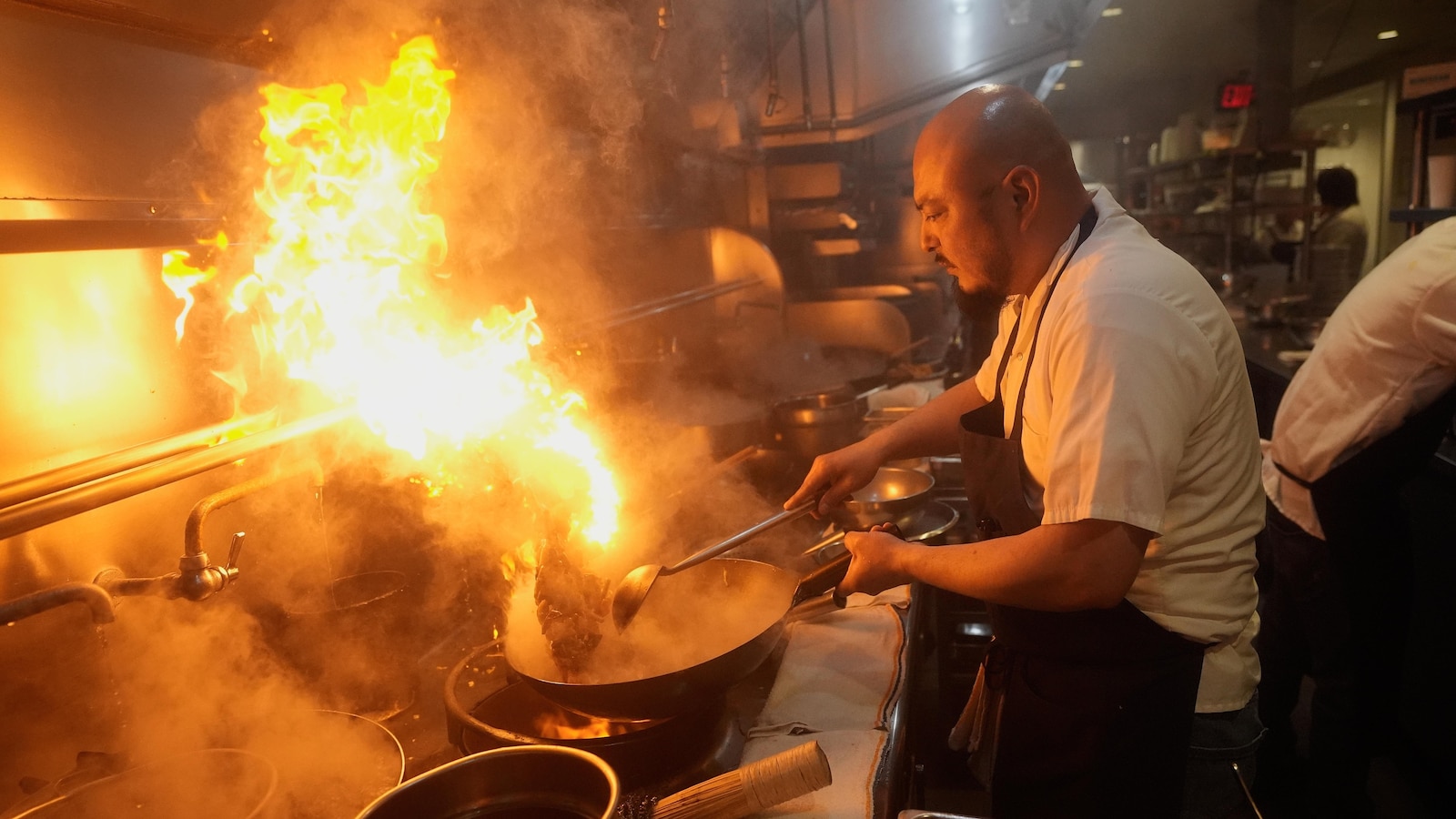
One critical distinction these chefs want to emphasize is that they’re not creating fusion cuisine or Western dishes with Asian influences—they’re presenting authentic Chinese food with contemporary presentations. Chen describes the approach as “more East to West rather than West to East,” a subtle but important difference that centers Chinese culinary traditions rather than adapting them to Western palates. Yuen pushes back strongly against the fusion label, which she believes creates confusion: “I think fusion food is in a lot of those places where it’s dimly lit with the trendy cocktails. What we’re trying to do is just Chinese.” Beyond ingredients and recipes, these chefs emphasize the importance of traditional Chinese cooking techniques, refusing to default to European methods simply because they’re more familiar to Western diners. At Empress by Boon, chef Boon maintains four wok stations using woks shipped directly from Hong Kong to ensure authenticity: “We want to do exactly everything the same operation. We want to keep the traditional, but we can look in a modern way.” Chen similarly takes pride in China Live’s open kitchen, where customers can watch woks and clay pots in action, representing techniques from various regions across China. “You actually look at the greater culinary disciplines of China and because you have the space, you can showcase the cuisine,” Chen explains. “I think that’s really served us well.” As the Year of the Fire Horse begins, many of these restaurants will offer special interpretations of traditional Lunar New Year dishes, continuing their mission to honor Chinese culinary heritage while earning the respect and pricing that this sophisticated cuisine deserves.