
Remembering Robert Duvall: A Seven-Decade Legacy of Quiet Power and Unforgettable Characters
The world of cinema has lost one of its most revered craftsmen. Robert Duvall, who passed away Sunday at the age of 95, left behind a remarkable body of work that spans seven decades and encompasses more than 90 films. His wife, Luciana Pedraza, confirmed his passing, marking the end of an era for Hollywood and film lovers everywhere. From the moment he appeared on screen as the enigmatic Boo Radley in 1962’s “To Kill a Mockingbird” to his iconic portrayal of the calm and calculating Tom Hagen in “The Godfather,” Duvall brought something special to every role—a quiet intensity and naturalism that felt effortless yet profound. He wasn’t the kind of actor who demanded attention through bombastic performances or scene-stealing theatrics. Instead, Duvall mastered the art of stillness, conveying entire worlds of emotion through subtle gestures, a measured tone, or a knowing glance. Throughout his illustrious career, he collaborated with some of Hollywood’s most celebrated directors and shared the screen with legendary performers, earning numerous accolades along the way, including an Academy Award for his deeply moving performance in 1983’s “Tender Mercies.” As we reflect on his passing, it’s worth revisiting some of the most memorable roles that defined his career and cemented his place in cinematic history.
The Unforgettable Madness of Lieutenant Colonel Kilgore in ‘Apocalypse Now’
When Francis Ford Coppola set out to create his surreal and haunting vision of the Vietnam War in “Apocalypse Now,” he needed actors who could capture the film’s strange blend of horror, absurdity, and dark poetry. In Robert Duvall, he found the perfect person to bring Lt. Col. William “Bill” Kilgore to life—a surfing-obsessed military officer whose enthusiastic embrace of warfare perfectly encapsulated the film’s unsettling perspective on combat. Despite appearing on screen for only a relatively brief portion of the movie’s runtime, Duvall’s Kilgore became one of cinema’s most memorable characters, delivering lines that have echoed through popular culture for decades. Who could forget his proclamation about the smell of napalm in the morning, or his casual indifference to danger as explosions erupted around him while he contemplated the perfect surfing conditions? Duvall earned an Oscar nomination for this supporting role, and rightfully so. In a 1984 interview with KCRA, the actor reflected on the film’s profound impact and recalled the intense filming process that brought Coppola’s vision to reality. He discussed how “Apocalypse Now” connected with audiences around the world, resonating with people far beyond American shores who recognized something universal in its examination of war’s dehumanizing effects. The film featured an impressive ensemble cast including Frederic Forrest, Albert Hall, Sam Bottoms, Laurence Fishburne, Dennis Hopper, and Harrison Ford, but Duvall’s brief appearance left an indelible mark that continues to fascinate viewers today.
The Trusted Counselor: Tom Hagen in ‘The Godfather’ Saga
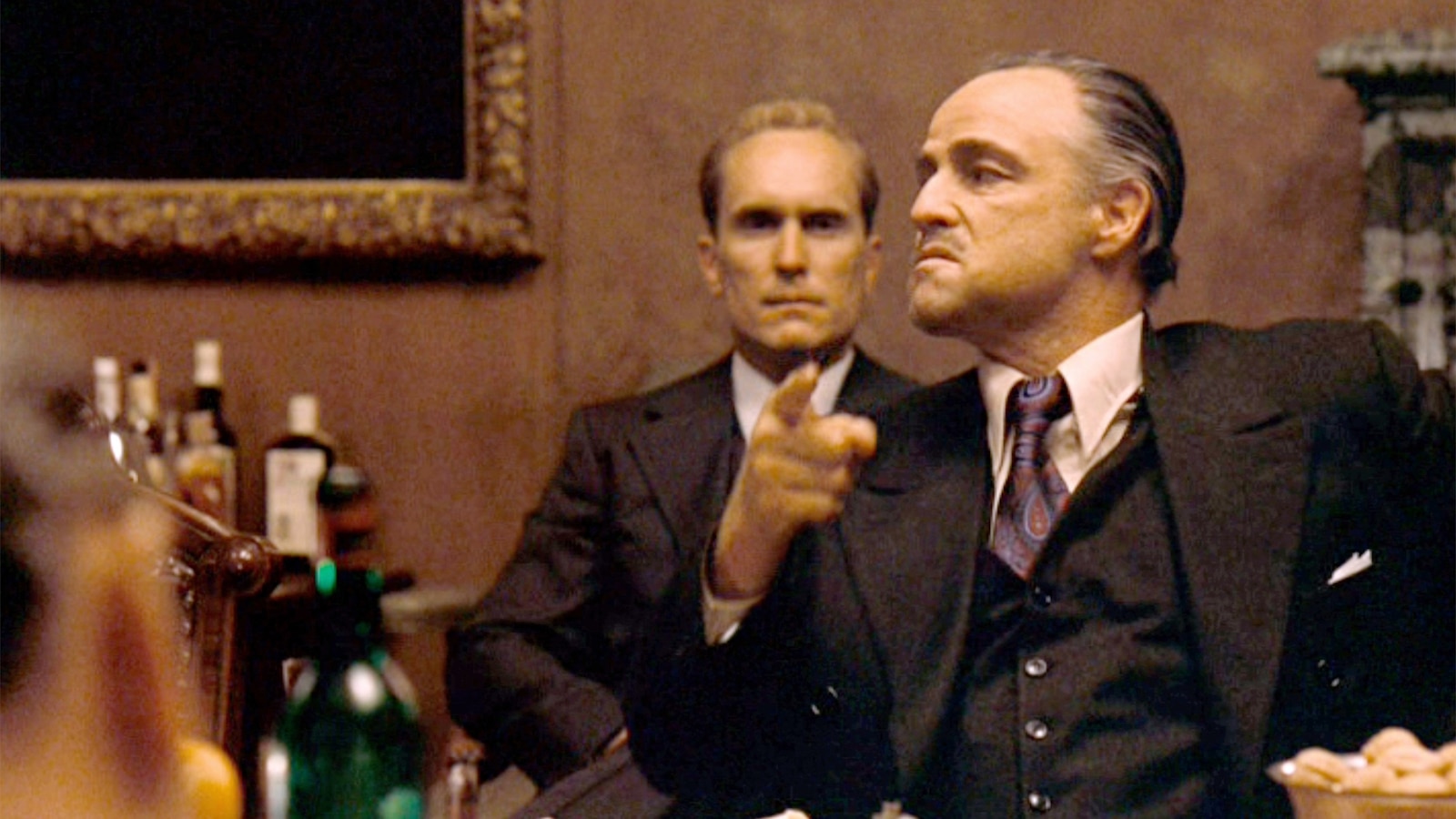
Perhaps no role better demonstrated Duvall’s gift for understated power than his portrayal of Tom Hagen in Francis Ford Coppola’s masterpiece “The Godfather.” As the Corleone family’s trusted consigliere, Hagen served as the calm, level-headed problem solver who handled negotiations and legal matters for Don Vito Corleone, played by Marlon Brando. What made Duvall’s performance so compelling was how he portrayed Hagen’s unique position within the family—adopted into the Corleone clan as a child, he remained eternally grateful for his place at the table, yet he was also keenly aware that he would never be blood, never be quite as close to the inner circle as the Don’s biological sons. Duvall brought tremendous nuance to this complex dynamic, showing us a man of fierce loyalty and intelligence who navigated the treacherous waters of organized crime with diplomatic skill. The performance earned him an Academy Award nomination and established him as one of Hollywood’s most talented character actors. When Duvall returned to the role in “The Godfather: Part II,” he continued to explore Hagen’s evolution, showing how the trusted adviser remains loyal even as Michael Corleone, now the family’s don, gradually pushes him further to the sidelines while consolidating his own control. In a 2022 interview with The A.V. Club, Duvall recalled sensing early on during the filming of the first Godfather movie that they were creating something special. “Well, I’ve only felt that twice,” he explained. “I felt that about a third of the way through ‘Godfather.’ I said, ‘we’re really doing something I think pretty special here that will live on for a long time to come.’ I felt that we were making a really important film.” His instincts, as we now know, were absolutely correct—the film became one of the most celebrated in cinema history, and his performance remains a masterclass in restraint and quiet authority.
Career-Defining Redemption: Mac Sledge in ‘Tender Mercies’
While Duvall earned critical acclaim and recognition for many roles throughout his career, it was his portrayal of Mac Sledge in 1982’s “Tender Mercies” that won him the Academy Award for Best Actor—and it’s widely regarded as one of the finest performances of his entire career. In this deeply moving film, Duvall starred as a washed-up country singer battling alcoholism who finds quiet redemption in a small Texas town. The role required Duvall to sing, to capture the weathered quality of a man who has lost everything, and to convey the slow, tentative process of healing and hope without resorting to melodrama or grand gestures. True to his commitment to authenticity, Duvall prepared for the role with characteristic thoroughness. According to Turner Classic Movies, he traveled hundreds of miles across Texas, recording regional accents and playing with local country bands to ensure that every detail of his performance rang true. This dedication resulted in a deeply restrained performance that never called attention to itself, never begged for the audience’s sympathy, yet somehow moved viewers profoundly. Mac Sledge’s journey from despair to tentative hope felt real because Duvall made it real, inhabiting the character so completely that you forgot you were watching an actor at work. The Academy recognized the achievement with its highest honor, and film scholars continue to study the performance as an example of cinematic acting at its very best—proof that sometimes the quietest performances speak the loudest.
Television Triumph: Augustus McCrae in ‘Lonesome Dove’
While Robert Duvall built his legendary career primarily in feature films, one of his most beloved performances came in the medium of television. As Augustus “Gus” McCrae in the 1989 miniseries “Lonesome Dove,” Duvall anchored this epic Western with humor, loyalty, and tremendous emotional depth. Gus was a witty, warm-hearted former Texas Ranger who embarks on one last grand adventure—a cattle drive from Texas to Montana—alongside his longtime friend and partner Woodrow Call, played by Tommy Lee Jones. The chemistry between Duvall and Jones provided the emotional backbone of the series, capturing a friendship forged over decades of shared danger and hardship. But it was Duvall’s particular gifts that made Gus McCrae such an enduring character—his ability to be both tough and tender, philosophical and practical, capable of sudden violence yet deeply romantic at heart. The role earned Duvall an Emmy Award and gave television audiences one of the most beloved characters in the medium’s history. Duvall himself frequently cited Gus as his favorite role, which speaks volumes considering the extraordinary characters he portrayed over seven decades. During a 2021 appearance on “The Late Show with Stephen Colbert,” he called “Lonesome Dove” the “Godfather of Westerns,” drawing a connection between two of his most celebrated works. That comparison is apt—both projects represented the pinnacle of their respective genres, both featured ensemble casts of remarkable talent, and both showcased Duvall’s unique ability to ground even the most dramatic stories in emotional truth and recognizable humanity.
The Beginning: Boo Radley in ‘To Kill a Mockingbird’
Every great career has to start somewhere, and for Robert Duvall, that somewhere was one of the most celebrated films in American cinema. His film debut came as Boo Radley, the shy, misunderstood neighbor in the 1962 adaptation of Harper Lee’s classic novel “To Kill a Mockingbird.” It was a small role—Boo appears only briefly in the film’s final scenes—but Duvall’s appearance leaves a powerful emotional impression that lingers long after the credits roll. The role perfectly highlighted what would become Duvall’s signature talent: the ability to say a great deal without words, using subtle expression and stillness to convey complex inner lives. As Boo, Duvall had to communicate years of isolation, kindness, fear, and gentle humanity without the benefit of extensive dialogue or screen time. He had to make us understand this character through presence alone, and he succeeded beautifully. That performance set the template for much of what followed in his career—roles that valued authenticity over showmanship, emotional truth over theatrical display, and the power of restraint over the temptation of excess. Looking back on his film debut many years later, Duvall expressed characteristic modesty about the opportunity. “It was terrific to be given that part,” he told People magazine in 2003. “I think I did okay.” That understated assessment—”I did okay”—perfectly captures the humility that defined Duvall throughout his career. He never seemed interested in celebrating himself or drawing attention to his considerable achievements. Instead, he simply showed up, did the work with complete commitment and professionalism, and let the performances speak for themselves. From that first appearance as Boo Radley to his final roles, Robert Duvall remained dedicated to the craft of acting, always seeking truth, always serving the story, always giving audiences characters they could believe in and remember. His passing marks the end of an extraordinary journey through American cinema, but the work remains—more than 90 films that will continue to move, challenge, and inspire audiences for generations to come.