
Christina Koch Makes History: First Woman to Travel Around the Moon
A Historic Launch and Mission
NASA has reached a momentous milestone in space exploration as astronaut Christina Koch embarks on a journey that will forever cement her name in the history books. At 47 years old, Koch is breaking barriers as the first woman to travel around the moon, serving aboard the Orion spacecraft for NASA’s highly anticipated Artemis II mission. The spacecraft lifted off on Wednesday evening from Kennedy Space Center in Florida, marking the beginning of a 10-day odyssey that has captured the imagination of people around the world. This groundbreaking mission represents the first time in more than five decades that American astronauts will orbit the moon, rekindling humanity’s relationship with our closest celestial neighbor since the Apollo era ended in the early 1970s.
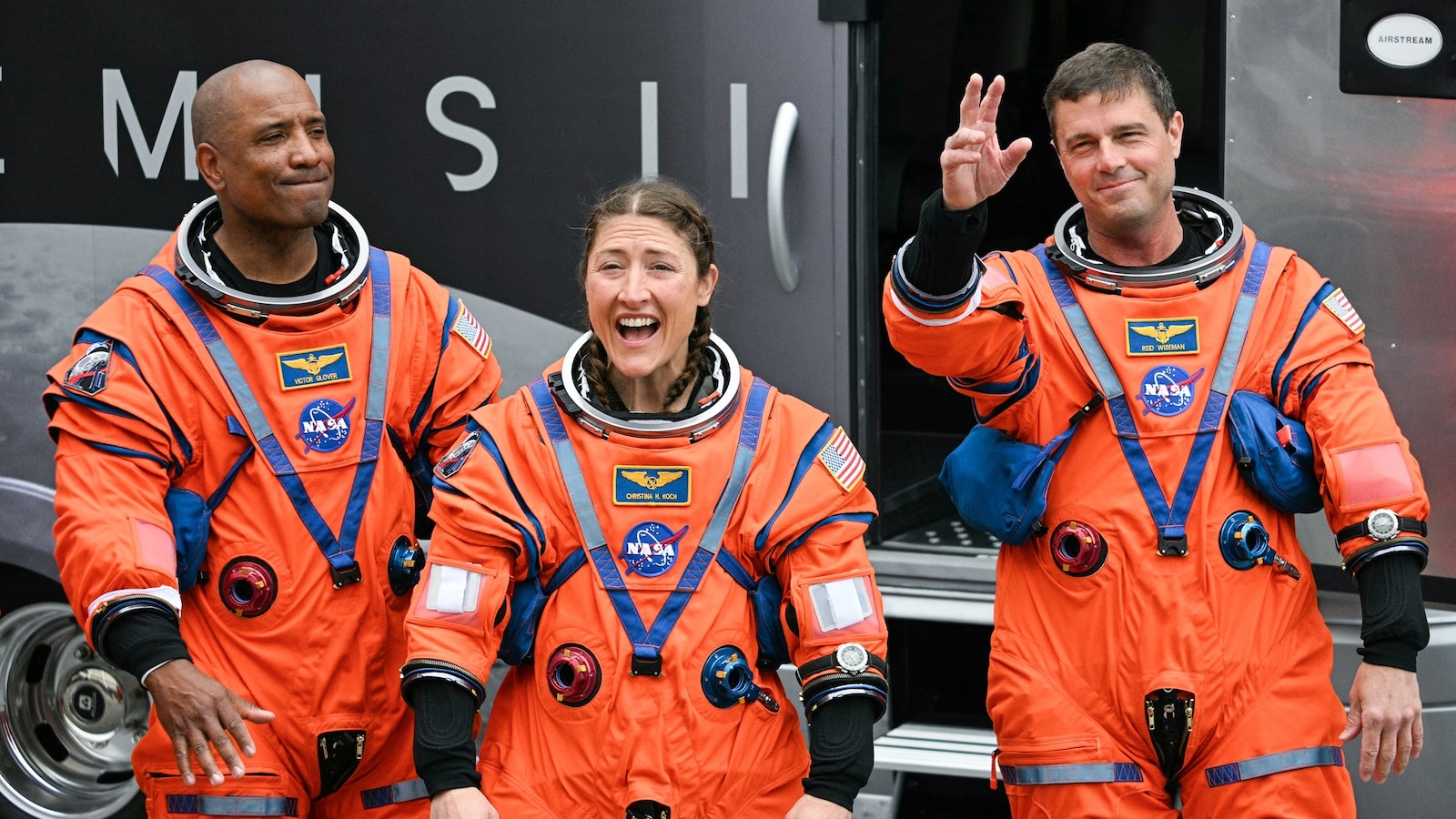
The Artemis II mission will cover an impressive 685,000-mile journey as the crew performs a lunar fly-by, traveling farther from Earth than any human has ventured in generations. Koch doesn’t travel alone on this historic voyage—she’s joined by three other exceptional astronauts who together represent the diversity and international cooperation that defines modern space exploration. Her crewmates include fellow NASA astronauts Reid Wiseman and Victor Glover, as well as Jeremy Hansen from the Canadian Space Agency. Together, this four-person team embodies the collaborative spirit of space exploration in the 21st century, demonstrating that the final frontier is truly a place for all of humanity. The successful launch has generated excitement worldwide, as millions watched the powerful rocket engines propel these pioneers toward the moon, carrying with them the dreams and aspirations of countless people who dare to look skyward and imagine what’s possible.
Christina Koch’s Remarkable Background
Christina Koch’s journey to this historic moment began far from the launch pads of Florida. Born in Grand Rapids, Michigan, and raised in Jacksonville, North Carolina, Koch’s path to becoming a record-setting astronaut was paved with dedication, education, and an insatiable curiosity about the world and universe around her. Her impressive academic credentials include Bachelor of Science degrees in both electrical engineering and physics, complemented by a Master of Science degree in electrical engineering, all earned from North Carolina State University. This strong educational foundation would prove essential in preparing her for the rigorous demands of space exploration and the complex technical challenges that astronauts face on a daily basis.
Before Koch ever donned a spacesuit, she built an impressive career that took her to some of the most remote and challenging environments on Earth. Her engineering background focused on space science mission instrument development, but what truly set her apart was her experience in remote scientific field engineering in both the Antarctic and Arctic regions. These extreme environments provided the perfect training ground for someone destined to work in the harsh conditions of space. At Antarctica’s Amundsen-Scott South Pole Station and Palmer Station, Koch didn’t just conduct research—she also served on firefighting and search and rescue teams, demonstrating the kind of versatility and courage that would later make her an ideal candidate for NASA’s astronaut program. These experiences in Earth’s most inhospitable regions taught her invaluable lessons about survival, teamwork, and problem-solving under pressure that would directly translate to her future work beyond our planet’s atmosphere.
A Track Record of Breaking Barriers
When Christina Koch was selected as a NASA astronaut in 2013, it marked the beginning of a career that would be defined by shattering records and pushing boundaries. Koch is no stranger to making history—in fact, this Artemis II mission is just the latest in a series of groundbreaking achievements that have defined her time with NASA. In December 2019, she set an incredible record for the longest single spaceflight by a woman, spending an astounding 328 consecutive days in space. To put this in perspective, that’s nearly eleven months living and working in the microgravity environment of the International Space Station, conducting critical research while being separated from Earth by the cold vacuum of space. This extended mission wasn’t just about setting a record—it provided invaluable data about the long-term effects of space travel on the human body, information that will prove crucial for future missions to Mars and beyond.
Perhaps equally significant was Koch’s participation in the first all-female spacewalk in October 2019, when she ventured outside the International Space Station alongside fellow astronaut Jessica Meir. This historic moment captured global attention and symbolized the increasingly prominent role women play in space exploration. But Koch didn’t stop there—she went on to complete two additional all-female spacewalks, accumulating a total of 42 hours and 15 minutes working in the harsh environment of space, tethered to the station as Earth rotated below. For the majority of 2019, Koch worked aboard the International Space Station during Expeditions 59, 60, and 61, contributing to a wide range of scientific research that has implications for both space exploration and life on Earth. Her work included performing robotics operations to upgrade the Alpha Magnetic Spectrometer, growing protein crystals for pharmaceutical research that could lead to new medical treatments, and testing 3D biological printers in microgravity—technology that could one day allow astronauts to manufacture medical supplies or even human tissue during long-duration missions.
Leadership and Technical Excellence
Christina Koch’s contributions to NASA extend far beyond her time in space. Her leadership abilities and technical expertise have made her an invaluable asset to the space agency even when her feet are firmly planted on the ground. Prior to her assignment on the Artemis II mission, Koch served as the branch chief over the Assigned Crew Branch in NASA’s Astronaut Office, a position that required her to coordinate and manage the complex schedules and assignments of her fellow astronauts. This leadership role demonstrated the trust and respect she had earned within the organization, as she was responsible for ensuring that astronauts were properly trained and prepared for their missions. Additionally, she completed a rotation as Assistant for Technical Integration for the Center Director at NASA’s Johnson Space Center, where she helped bridge the gap between technical operations and administrative decision-making, ensuring that the center’s various departments worked together seamlessly to achieve their mission objectives.
These leadership positions highlight an important aspect of modern astronauts—they’re not just space travelers, but also skilled administrators, engineers, and managers who contribute to the overall success of the space program in multiple ways. Koch’s ability to excel both in space and in these ground-based roles demonstrates the multifaceted nature of her talents and the comprehensive skill set required of today’s astronauts. Her technical background and hands-on experience with complex systems, combined with her leadership abilities and firsthand knowledge of spaceflight, make her uniquely qualified to contribute to NASA’s strategic planning and operational decisions. This well-rounded experience undoubtedly contributed to her selection for the prestigious Artemis II mission, as NASA sought crew members who could not only perform their assigned tasks but also adapt to unexpected challenges and provide valuable input on mission-critical decisions during the journey around the moon.
Life Beyond Space Exploration
Despite her demanding career and record-breaking achievements in space, Christina Koch maintains a rich personal life filled with diverse interests and hobbies that keep her grounded and connected to life on Earth. According to her official NASA biography, Koch is an active hobbyist with passions that range from surfing the ocean waves to scaling frozen waterfalls through ice climbing. These adventurous pursuits reveal a personality that consistently seeks challenge and excitement, whether navigating the zero-gravity environment of space or testing her limits against nature’s forces here on Earth. Her interest in woodworking showcases a more contemplative side, requiring patience, precision, and craftsmanship—skills that translate well to the meticulous nature of space missions where attention to detail can mean the difference between success and catastrophe.
Koch’s commitment to community service further demonstrates her character and values, showing that even as she reaches for the stars, she remains dedicated to making a positive impact on the ground. This balance between professional excellence and personal fulfillment is characteristic of many successful astronauts, who recognize the importance of maintaining diverse interests and connections outside their careers. These hobbies and activities not only provide necessary stress relief and mental health benefits but also help develop skills and perspectives that enhance their work as astronauts. Whether she’s riding waves, climbing ice, working with wood, or serving her community, Koch embodies the spirit of exploration and service that defines the best of human achievement, proving that the same curiosity and determination that drives someone to circle the moon also enriches every aspect of their life on Earth.
The Significance of Artemis II and Looking Forward
The Artemis II mission represents far more than just a technical achievement or a historic first for women in space exploration—it symbolizes humanity’s renewed commitment to lunar exploration and our ambitions to venture even farther into the cosmos. As Christina Koch and her crewmates orbit the moon, they’re paving the way for future Artemis missions that will eventually establish a sustained human presence on and around the moon, serving as a stepping stone for the ultimate goal of sending humans to Mars. Koch’s role as mission specialist means she’ll be responsible for a wide range of critical tasks during the 10-day journey, applying all the knowledge and experience she’s accumulated throughout her remarkable career. Her presence on this mission sends a powerful message to young girls and women everywhere that no dream is too big, no goal too ambitious, and that the future of space exploration belongs to everyone, regardless of gender.
The success of Artemis II will set the stage for Artemis III, which aims to land the first woman and first person of color on the lunar surface, continuing to break down barriers and expand our understanding of what’s possible. As we watch Koch and her fellow astronauts venture around the moon, we’re witnessing not just a moment in history, but the beginning of a new era in human space exploration—one that’s more inclusive, more ambitious, and more inspiring than ever before. Christina Koch’s journey from the beaches of North Carolina to the far side of the moon reminds us that with education, determination, and courage, the sky is truly not the limit.