
Finding Hope in the Waves: How Ocean Aquagym is Transforming Lives in Senegal
Early Morning Healing on Dakar’s Shores
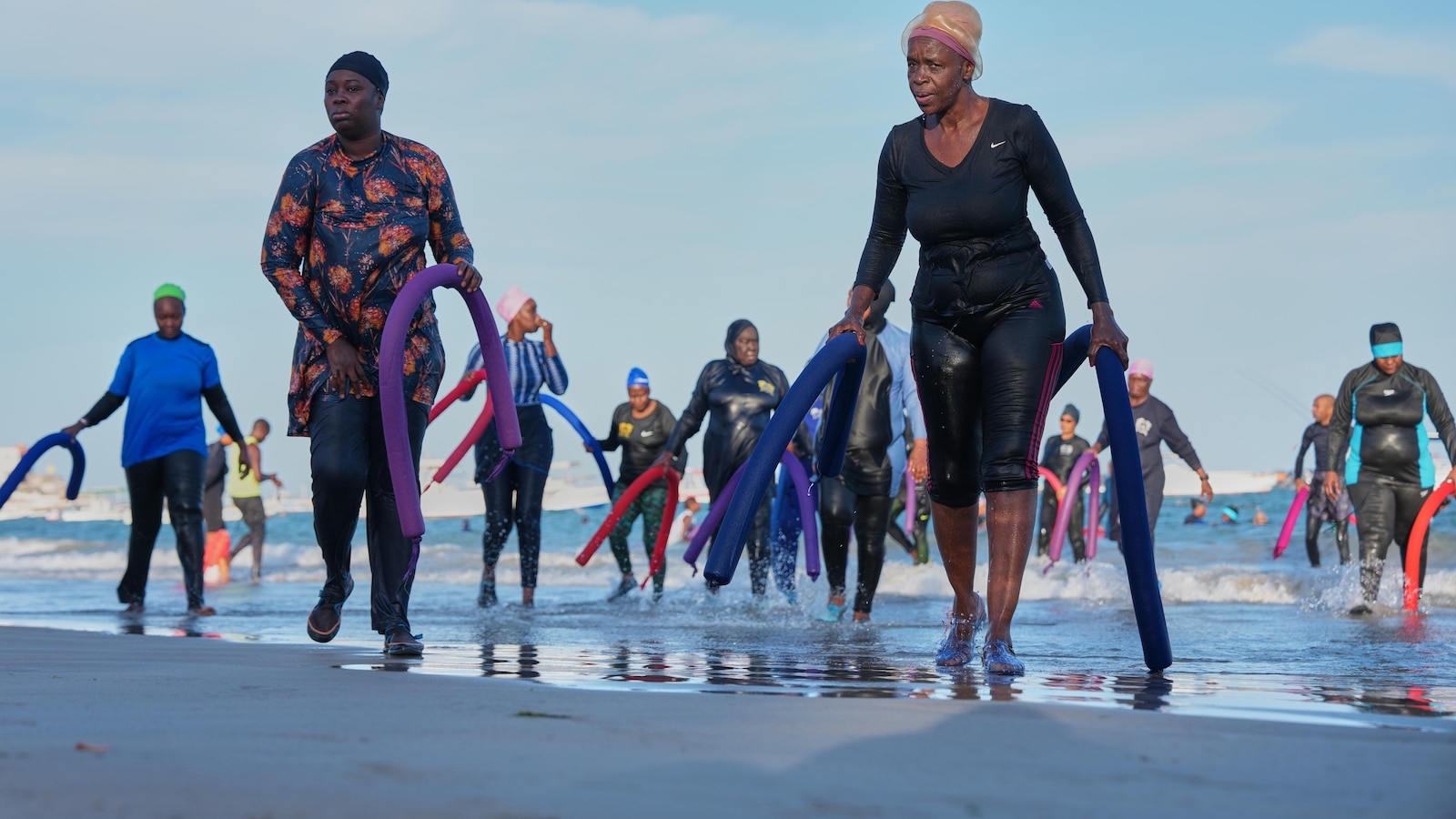
Before the first light of dawn breaks over Dakar, Senegal’s bustling capital, an extraordinary sight unfolds along the Atlantic coastline. Nearly a hundred people, clad in swimsuits and life jackets, gather on the beach with a shared purpose that goes far beyond simple exercise. Among them is 63-year-old Aminata Sall, who moves rhythmically through the chilly ocean water, foam noodles tucked securely under her arms as she kicks in unison with her fellow participants. On the sandy shore nearby, another group engages in a different form of therapy—people with limited mobility are buried knee-deep in the warm sand, gently rotating their torsos in movements designed to ease chronic pain and improve flexibility. This remarkable scene represents more than just a fitness class; it’s a lifeline for hundreds of Senegalese people facing debilitating chronic conditions who have found renewed hope and mobility through an innovative aquagym program that harnesses the healing power of the ocean.
A Personal Journey from Despair to Movement
Aminata Sall’s story embodies the transformative power of this unique program. Years ago, her doctor delivered devastating news: rheumatoid arthritis, a progressive autoimmune disease causing painful inflammation and joint damage, threatened to rob her of the ability to walk within just five years. The diagnosis hit her like a physical blow, leaving her emotionally paralyzed and withdrawn. “The shock was enormous,” she recalls, her voice still carrying traces of that difficult period. “I stayed at home for almost a year, doing nothing.” Depression and fear consumed her days as she contemplated a future of immobility and dependence. Then, one fateful morning, restlessness drew her from her self-imposed isolation. Wandering down to Ngor neighborhood beach, she encountered something unexpected—a group of people exercising together in the water, their movements purposeful and their spirits seemingly lifted by both the ocean and community. Curiosity overcame her hesitation. When she inquired about what they were doing, the response was simple and inviting: “Try it.” That single moment of outreach changed everything. Today, years later, Sall defies her doctor’s grim prognosis with a simple but powerful statement: “I’m still walking.”
Addressing Africa’s Growing Chronic Disease Challenge
Senegal’s aquagym program, featuring low-impact exercises perfectly suited to those with reduced mobility, has earned widespread recognition from health professionals for its effectiveness in helping people manage chronic conditions including heart disease, stroke, and various forms of arthritis. This initiative arrives at a critical time for Africa, where rising life expectancy has brought welcome news but also unexpected challenges. As more Africans live longer lives, chronic diseases that once seemed relatively rare have become increasingly common, often leaving older adults struggling with pain and severely limited mobility. Unfortunately, the continent’s healthcare infrastructure has not evolved quickly enough to meet these emerging needs. Public health systems across Africa remain primarily focused on infectious diseases, maternal health services, and pediatric care—understandable priorities given the continent’s predominantly young population, but leaving older adults in a precarious position. Prevention programs, diagnostic services, and rehabilitation facilities for chronic conditions remain scarce and difficult to access. Many older people report having little or no access to geriatricians or other specialists trained in age-related conditions, forcing them to either forego professional care entirely or settle for general practitioners who may lack specific expertise in managing complex chronic illnesses.
Economic Barriers to Healthcare Access
The economic dimension of healthcare in Senegal compounds these accessibility problems significantly. Most medical care must be paid for directly out of pocket by patients and their families, creating enormous financial pressure on households already struggling with limited resources. Public insurance coverage exists but remains frustratingly limited in scope, while private insurance plans carry premiums that place them far beyond the reach of average Senegalese families. Particularly devastating is the fact that costly procedures like surgery are often excluded from what limited coverage does exist. When Aminata Sall sought treatment for her rheumatoid arthritis, her doctor recommended surgery—with a price tag of approximately $10,000, an astronomical sum for most Senegalese citizens. Unable to afford the procedure, she was instead prescribed anti-inflammatory medication, which provided temporary relief until it was withdrawn from the market due to safety complications. “That’s when I started losing hope,” Sall remembers, her words reflecting the desperation many patients feel when conventional medical options disappear. “Some mornings, a blocked vertebra or swollen ankles would leave me unable to move all day.” Dr. Seydina Ousmane Ba, who directs the National Orthopedic Prosthetics and Rehabilitation Center in Dakar, confirms this troubling pattern: “A lot of people don’t come to us until things get really bad, and by then it’s much harder and more expensive to treat them.” This delay in seeking care, driven primarily by cost concerns, often results in conditions advancing to stages where treatment becomes both more complex and more expensive—a cruel irony that traps patients in a cycle of declining health and mounting debt.
The Aquagym Solution: Accessible, Effective, and Community-Centered
Into this challenging healthcare landscape, the aquagym program emerged just over a decade ago as a rare, affordable option for pain relief and mobility improvement. The program’s remarkable affordability—just 300 CFA francs (approximately 50 cents) per session—makes it accessible to people across economic backgrounds, removing the financial barriers that exclude so many from conventional healthcare. Founded and led by 69-year-old Ndiamé Samb, a former firefighter who specialized in underwater operations before becoming a lifeguard in 1988, the program draws on both professional expertise and cultural heritage. Samb belongs to the Lebu people, considered indigenous to Dakar’s peninsula, who maintain deep cultural and spiritual connections to the ocean. While training in Paris, Samb discovered aquagym and recognized its potential benefits for his community. His classes in Dakar stand out as among the very few worldwide conducted in the sea rather than in swimming pools—a practical adaptation given the scarcity of public pools in Senegal and the free accessibility of the ocean. What began modestly with just eight to ten participants has grown exponentially. “Now, we sometimes get up to 200 people per session and have a total of around 600 students,” Samb reports proudly. The program runs on volunteer coaches and minimal funding—the small session fees combined with a $3,000 annual city subsidy—yet delivers results that have attracted participants not just locally but from as far as France and the United States. Samb’s brother Alassane, age 60, serves as both a lifeguard and licensed massage therapist, personally guiding newcomers through their first sessions and providing individualized attention that helps participants maximize therapeutic benefits while remaining safe in the ocean environment.
Transformative Results and Sustainable Hope
The medical community has taken notice of the program’s success, with healthcare professionals praising the specific advantages of water-based exercise for people with mobility limitations. “Aquagym has benefits you don’t always get on land,” explains Dr. Ba. “The water supports your body, reduces pain and makes movement easier, so patients can exercise more comfortably.” This buoyancy effect allows participants to perform movements and exercises that would be painful or impossible on land, gradually rebuilding strength, flexibility, and confidence. For 76-year-old Khadija Wade, diagnosed three years ago with spinal stenosis—a degenerative condition causing painful compression of spinal nerves—the program offered hope when other options seemed closed. After her husband’s death earlier this year, Wade’s condition deteriorated significantly. “I became very sedentary. I could spend an entire month at home without walking,” she recalls. Well-meaning friends suggested seeking specialist care in Italy or France, but obtaining visas remains extremely difficult for most Senegalese citizens, and treatment abroad carries prohibitive costs. When her doctor recommended aquagym last month, Wade decided to try despite her skepticism. The results surprised even her: “I came to my first session with a cane, but now I can walk without it.” Such testimonials multiply across the program, with participants reporting reduced pain, improved mobility, better sleep, and enhanced mental health. As each session concludes and participants emerge from the water, their smiles and animated conversations speak to benefits extending beyond the physical—the program has created a supportive community where people facing similar challenges encourage one another, share experiences, and refuse to surrender to their conditions. Aminata Sall, who attends three times weekly, captures this spirit perfectly: “What keeps me coming back is seeing other people not giving up.” In a region where people with reduced mobility face steep hurdles—inaccessible public spaces and transportation, scarce specialized healthcare, limited rehabilitation services—this ocean-based program represents not just exercise but dignity, community, and the fundamental human right to move through the world with confidence and reduced pain.