
A Night of Terror: The White House Correspondents’ Dinner Attack
When Celebration Turned to Chaos
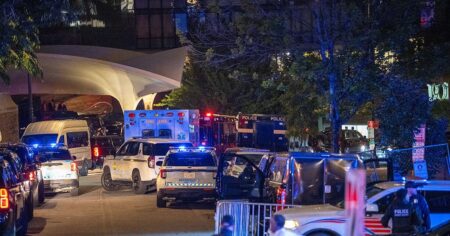
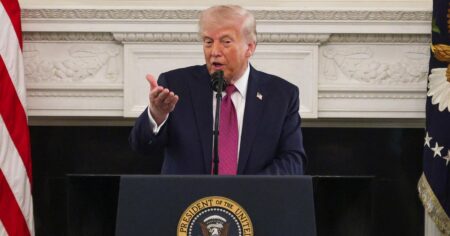
What should have been an evening of glamour, humor, and celebration of press freedom turned into a nightmare in mere seconds. On Saturday night, April 26, 2026, the Washington Hilton became the scene of a terrifying security breach that would shake the nation. The annual White House Correspondents’ Association dinner, attended by President Trump and 2,600 distinguished guests including journalists, celebrities, and high-ranking government officials, was suddenly interrupted by the sound of gunfire echoing through the grand ballroom. A man armed with two firearms and knives had somehow breached what was supposed to be one of the most secure perimeters in the country, racing past Secret Service checkpoints with stunning speed and determination. Though law enforcement managed to stop him before he could reach the dinner attendees, the incident exposed vulnerabilities in security protocols and left everyone shaken. A Secret Service officer was struck by a bullet but thankfully survived thanks to protective body armor. The evening that was meant to celebrate the freedom of the press and the relationship between journalists and those they cover became instead a stark reminder of the dangers faced by public servants and the constant vigilance required to protect our leaders and institutions.
The Breach: Twenty Seconds That Changed Everything
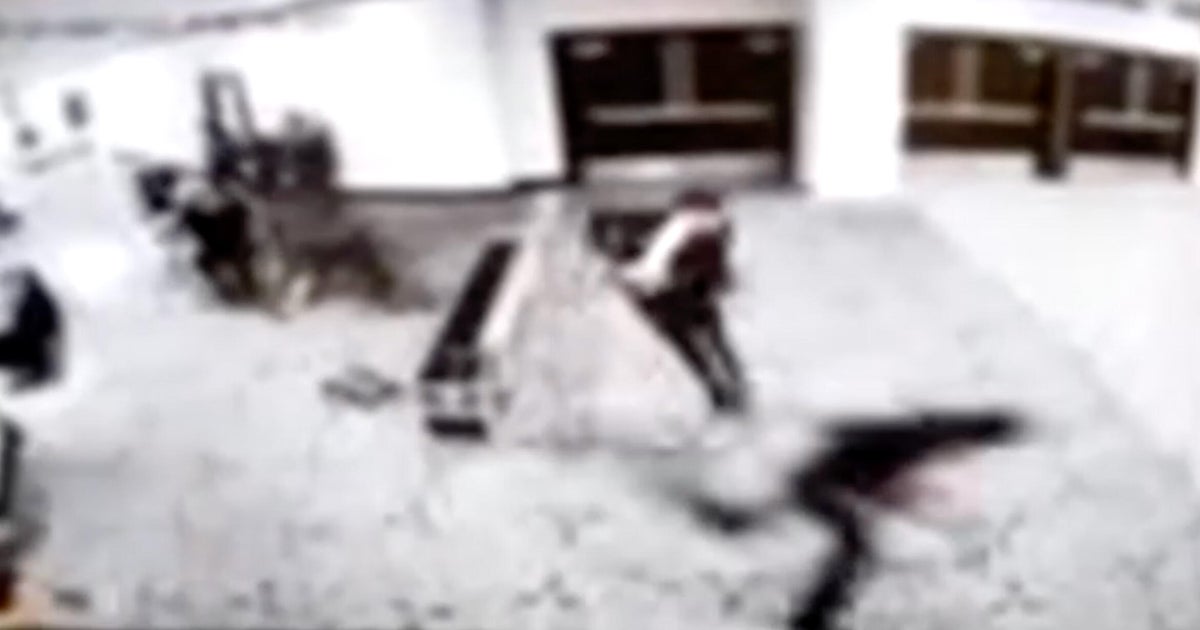
At precisely 8:34:29 PM, surveillance cameras captured the moment that would dominate news coverage for weeks to come. A figure moved with extraordinary speed and determination through a Secret Service metal detector, his velocity so intense that he nearly collided with a plainclothes officer who immediately drew his weapon. The footage, later shared by President Trump himself on Truth Social, shows approximately half a dozen security officers standing near the checkpoint, momentarily stunned by the audacity and speed of the breach before springing into action. Within seconds, a swarm of officers gave chase, their training kicking in despite the shocking nature of the intrusion. The checkpoint was separated from the massive 30,000-square-foot ballroom by only a staircase – a short distance that suddenly felt far too close for comfort. Just one floor below, in the elegantly decorated space, thousands of guests were enjoying their appetizer course of bread and salad, completely unaware that danger was racing toward them. The contrast between the violent action unfolding upstairs and the peaceful dinner scene below couldn’t have been more stark. In those first crucial seconds, the Secret Service faced every security professional’s worst nightmare: a determined intruder moving at full speed toward a room filled with some of the nation’s most prominent figures, including the President of the United States.
Gunshots and Confusion in the Ballroom
Just four seconds after the breach, at 8:34:33 PM, rapid gunfire shattered the atmosphere of the dinner. The experience of those shots varied dramatically depending on where guests were seated in the enormous ballroom. On the dais where President Trump sat alongside First Lady Melania Trump, press secretary Karoline Leavitt, and White House Correspondents’ Association President Weijia Jiang, the sounds were muted or perhaps not audible at all. Some people at the front thought a member of the waitstaff had simply dropped serving trays – a common enough occurrence at large events. But for those seated toward the back of the venue, closer to where the incident was unfolding, there was no mistaking what they heard. The sharp crack of gunfire and the acrid smell of gunpowder filled the air, unmistakable to anyone who had experienced it before. At the precise moment shots rang out, mentalist Oz Pearlman, the evening’s entertainer, was performing a trick for the head table guests. Pearlman would later confirm to CBS News that he had been attempting to guess the name of Leavitt’s unborn daughter, who was due the following week – a lighthearted moment frozen in time by the intrusion of violence. The surreal juxtaposition of entertainment and emergency played out over agonizing seconds. It took more than 20 seconds – an eternity in security terms – for the president to be removed from the stage by his protective detail.
Panic, Protocol, and Protection
Within seconds of the gunshots, the ballroom transformed from an elegant dinner venue into a scene of controlled chaos. Guests in the raised seating area at the back of the ballroom, those closest to the sound and smell of gunfire, immediately dropped to the floor and scrambled under tables for protection. In our modern age, many instinctively pulled out their phones to document the unfolding crisis, capturing shaky footage that would later help piece together the timeline of events. At 8:34:40 PM, just seconds after the shots were fired, security officers flooded into the ballroom with impressive speed. They rushed up the center aisle, climbing over chairs and fanning out across the massive space to reach their assigned protectees. The scene captured on video shows Cabinet members and members of Congress crouching under tables, their formal evening attire contrasting sharply with their vulnerable positions. On stage, the evacuation unfolded with revealing differences. Secret Service agents appeared on stage twelve seconds after shots were fired. An agent immediately grabbed Vice President Vance by the shoulders and physically pulled him from his chair. Vance was escorted offstage within just four seconds, demonstrating the urgency of the protective protocols. Meanwhile, President Trump remained seated as an agent positioned himself as a human shield in front of him. The first lady was visible beside him, while entertainer Pearlman stood behind them, still holding papers from his interrupted magic trick. It wasn’t until Vance had already left the stage that the first lady began lowering herself to the floor, followed four seconds later by President Trump responding to agents shouting to “stay down.” The evacuation was far from smooth – Trump was initially escorted standing, then lowered to the ground and covered by four agents, then stood back up again before finally being escorted offstage with the first lady. The entire process took 20 seconds from when Vance departed – precious time in a crisis situation.
The Lockdown and Clearing Operation
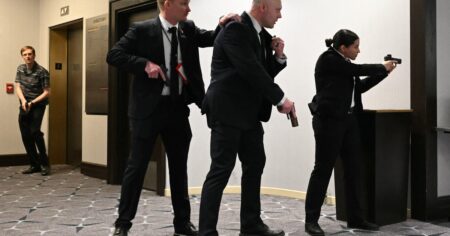
As dignitaries were being evacuated, law enforcement began the critical work of securing the venue and ensuring no additional threats remained. At 8:35:47 PM, armed officers occupied a stairwell at the rear of the ballroom, weapons drawn and voices tense. An agent’s shout pierced the air: “Is anyone in the kitchen? Is anybody in the kitchen?” Behind swinging doors, terrified kitchen staff had lined up with their arms raised, understanding that any sudden movement could be misinterpreted by the heavily armed agents clearing the area with guns drawn. The image of hospitality workers – people who had simply come to work what they thought would be a prestigious catering event – standing with hands up as armed agents swept through speaks to how quickly normalcy had evaporated. By 8:37 PM, security details began the systematic removal of high-ranking officials from the ballroom. Treasury Secretary Scott Bessent, Defense Secretary Pete Hegseth, and acting Attorney General Todd Blanche were among those escorted out while other dinner attendees continued sheltering under their tables. House Majority Leader Steve Scalise – himself a survivor of a 2017 shooting at a congressional baseball practice – was hustled through the room by his Capitol Police detail, no doubt experiencing traumatic echoes of his own brush with violence. The scene represented a massive security operation unfolding in real-time, with multiple agencies coordinating to protect hundreds of high-value individuals while simultaneously clearing a complex venue.
Aftermath and the Decision to Reschedule
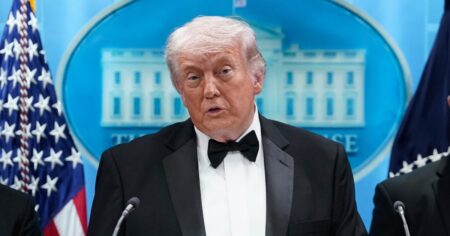
As the initial crisis subsided and security established that the threat had been contained, attention turned to what would happen next. At 9:17 PM, approximately 43 minutes after the breach, President Trump took to Truth Social to update the nation. He confirmed that the shooter had been apprehended and revealed that he had “recommended that we ‘LET THE SHOW GO ON’ but, will entirely be guided by Law Enforcement.” He added that regardless of the final decision, “the evening will be much different than planned, and we’ll just, plain, have to do it again.” Twenty-two minutes later, at 9:39:12 PM, WHCA President Weijia Jiang returned to the podium to make the official announcement that the dinner would not continue as planned. However, she added that President Trump was insisting the event be rescheduled within the next 30 days. In remarks that took on profound new meaning given the night’s events, Jiang addressed the room full of journalists: “I said earlier tonight that journalism is a public service, because when there is an emergency, we run to the crisis, not away from it. And on a night when we are thinking about the freedoms in the First Amendment, we must also think about how fragile they are.” Her words captured the dual nature of the evening – a celebration of press freedom interrupted by violence, yet also a demonstration of the resilience and courage that defines both journalism and public service. The White House Correspondents’ Dinner has survived wars, presidential scandals, and political upheaval throughout its century-long history, and it would survive this too, though forever changed by those terrifying minutes when celebration turned to crisis.